Intersolar Europe 2010 product launches

Jenoptik
Image: Jenoptik


Lasers for transparent modules

The Votan Solas 600 laser system from Jenoptik’s laser and material processing division can be used to manufacture semitransparent thin film solar modules for building-integrated photovoltaics. Selective lasering of the module’s entire absorption area provides semi-transparency. On request, specific designs and transparencies can be provided because the matrix for transparent structures can be flexibly programmed. The transparency matrix can be set between five and 50 percent.

Generally, that value ranges from 10 to 20 percent. The shape and distribution of the transparent structures influences cycle time. Jenoptik says that special add-ons allow the machine to reach exceptionally short cycle times that reduce production costs to a minimum. There are two versions of the laser machine. It can be integrated in-line or as a bypass in the existing backend production lines.

Adept Technology
Image: Adept Technology

Robot with encapsulated mechanics

At Automatics, which will be taking place alongside Intersolar, Adept will be presenting two robot systems suitable for cell and wafer handling. One of them is the Adept Cobra e-Vario, a very fast, four-axis robot system. The other is the Adept Quattro s650HS, a variation of the s650. The mechanics in the new system are completely encapsulated. The drives have a low moment of inertia to allow the robots to accelerate quickly. Additional features include diagnosis displays for troubleshooting and temperature sensors. Adept says the systems are very precise, reliable, and easy to configure.

Hermann Otto
Image: Hermann Otto

Casting compound for sockets

Otto Chemie has launched Novasil RTV-2, a two-component silicon casting compound. It is designed to be used to attach and cast sockets. It hardens at room temperature without any additional energy input, such as active heat or UV. Because it hardens extremely quickly, Otto Chemie says it enables short buffer times during handling; the hardening time but can furthermore be adjusted slightly to suit the parameters of the customer’s specific production process. The material’s viscosity is designed to allow rear cuts to be reliably filled. The material even reportedly covers sensitive contacts, protecting them reliably for years.

Reis Robotics
Image: Reis Robotics

Contactless opening

The Reis Robotics Group has developed a new process for the fully automated assembly of sockets. In a patented procedure, a module’s laminated back is opened to reach the connection contacts. The manufacturer of automation systems says this approach considerably lowers the cost of module production because connection strips no longer need to be carefully fit in. The strips are therefore no longer damaged, which saves up to ten percent material. Furthermore, the cell breakage rates and wear out of the eliminator membrane are reportedly reduced.

KME Copper Ribbons
Image: KME

Copper ribbons for module construction

At Intersolar, KME is presenting copper ribbons with specially treated surfaces developed for photovoltaic modules. Under the brand name HP Ribbons, the strips are available in thicknesses ranging from 0.1 to 0.6 millimeters and widths of 1.0 and 11.0 millimeters. The basic material is Cu-ETP or Cu-OF. The galvanized surfaces are either pure zinc or a special zinc-silver alloy. The mechanical properties of the ribbons can be tailored to the module manufacturer’s individual specifications. According to KME, HP Ribbons offer superior chemical and mechanical properties, and narrow tolerances.

Auria Solar
Image: Auria Solar

All the different colors

Auria Solar of Taiwan is presenting a micromorph BIPV solar module that can have any of the colors in the visible spectrum. It’s said that architects can design these building-integrated modules freely according to their wishes. The modules are said to be available in finely differentiated hues – blue, light blue or dark blue – and are particularly good-looking, for micromorph modules have a very uniform appearance. The module’s properties are said to make it an alternative to glasses with low emissivity that environmentally friendly architects would like to use but that strongly reflect certain parts of the spectrum. The modules are obtainable worldwide.

AS Solar
Image: AS Solar

Joy to the installer

AS Solar has added a module with medium capacity to its Seginus series for clients installing on small roofs. The AS Seginus 180 consists of 48 cells and has a capacity of 180 watts. It measures 1357 by 990 millimeters and weighs 16 kilograms. The AS Seginus 180 is offered with monocrystalline or polycrystalline cells. Its small dimensions and relatively low weight make it easy to carry.

Isofoton
Image: Isofoton

Stable and efficient

Spanish module maker Isofotón is presenting its most powerful solar module so far at Intersolar. The ISF-235 is said to have an efficiency of 14.2 percent and an output of 235 watts. Its three conductive tracks instead of the usual two are said to reduce electrical series resistance losses. Isofotón says it has a watertight junction box for improved heat dissipation. The module’s aluminum frame has been anodized, which gives it a 20-micron covering to protect against corrosion. The company guarantees the module for ten years and gives a three-stage 25-year guarantee of performance. The modules have been tested by TÜV Rhineland and can take a maximum load of 5400 pascal. The new ISF-235 module is to go on sale internationally in late 2010.

BP Solar
Image: BP Solar

Half-cells for more performance

At Intersolar, BP Solar is presenting the BP 3280T high-performance module, which consists of 144 half-cells. BP Solar says this configuration improves the module’s output: under partial shade, the energy efficiency of the 280 watt module is increased because it has more bypass diodes per cell. BP Solar has also developed Thermocool, a heat-dissipating EVA film that it says improves the cooling of the back of the module and increases energy yield by up to three percent over that of conventional modules. BP Solar is also showing the black BP 3215B module at its stand. Its dark frame and black backsheet are said to make it particularly aesthetic. Both modules will go on sale in Europe in late 2010.

Bosch Solar Energy
Image: Bosch Solar Energy

Thin film module with low voltage

Bosch Solar Energy is presenting two thin film modules . The company produces modules using amorphous (a-Si) and micromorphous (µm-Si) silicon technology. The new micromorphous module is framed and made with a glass-to-film bond. A backplate is not needed, so the module weighs only 17 kilograms, much less than glass-to-glass thin film modules. It’s also said to have a lower voltage than conventional silicon thin film modules. Bosch says up to seven modules can be connected in a 600 volt string, reducing cabling work. The other Bosch offering is a CIS thin film module, obtainable with or without a frame. It measures approximately 120 by 50 centimeters and weighs 10.5 kilograms. The modules can also be installed with transformerless inverters. Both thin film modules will be available Europe-wide in September.

Solarion
Image: Solarion

High transparency

Solarion is presenting semi-transparent solar cells at Intersolar. The firm makes flexible CIGS thin film cells on a plastic substrate and says they can be perforated to achieve transparency without ruining them. The output of individual cells is reduced only by the potential of the missing area. The semi-transparent cells are now being used in an unframed glass-to-glass module, approximately one square meter in area. With nine-percent light transmittance, Solarion says it achieves between eight and nine percent efficiency and suggests one possible use is for glazing greenhouses. The module is to come onto the market in 2011. The cells can also be used in flexible modules.

Heckert Solar
Image: Heckert Solar

Solar roofing tiles in silver or black

Heckert Solar is to offer PXL 200 Solrif, a new in-roof module, in May. Heckert’s unframed PXL 200 solar modules are intended for use as solar roofing tiles in combination with Schweizer’s Solrif photovoltaic in-roof installation system. They replace conventional roof cladding and are said to be suitable for almost all slanting roofs in old and new buildings.
The combination of Heckert solar modules with the Solrif system is said to permit great freedom of design for a complete roof covering. The extruded aluminum sections of the modules are specially produced and available in silver or black.

Q-Cells
Image: Q-Cells

Thalheim now makes modules too

Q-Cells is presenting the Q.PRO and Q.SMART modules at Intersolar. Q.PRO 225-240 is a multicrystalline solar module suitable for small to medium-sized on-roof arrays. The solar cells are produced in-house, and Q-Cells says they achieve a cell efficiency of up to 17 percent. Even in unfavorable lighting conditions, the module is said to display a good low-light characteristic. It is reportedly secure against overheating, because only cells without hot spots are used. The solar module can withstand heavy snow and wind loads of 5400 pascal. It’s made of hardened glass and has a torsionally stiff frame. A drainage aperture in the frame is said to make it weatherproof for lengthy periods.

It’s compatible with all current inverters and installation systems. It was only in March that Q-Cells announced its entry into the crystalline module business. Now the company is also presenting the Q.SMART thin film module, which is obtainable in several power classes, framed or unframed. The CIGS modules are homogeneously black. They can also be connected to transformer-less inverters. The unframed modules can be installed at any angle and used on both flat roofs and facades.

Nexpower Technology
Image: Nexpower Technology

Tandem layer for higher light absorption

Taiwan’s NexPower is presenting the NT-140AX micromorph tandem solar module, which consists of an amorphous and a microcrystalline silicon layer. Each layer processes a different wavelength of light. NexPower says the double layer has a higher light absorption rate than a pure amorphous solar module. The module is said to absorb a wide spectral range and its output is allegedly very stable, thanks to the company’s very rigorous quality control. Munich Re is said to have insured product performance. The tandem module, which reportedly achieves a good output even at high ambient temperatures, is certified under the international norms IEC 61646 and 61730 and is to come onto the market worldwide in late 2010.

REC
Image: REC

New cell design

REC of Norway is presenting its Peak Energy solar module at Intersolar. The improved design of this multicrystalline module is said to raise its yield per square meter. One change is that it has three busbars and better contact between cell and metal finger, increasing output by an average of nine watts. Another is a two percent increase in energy production thanks to Sunarc technology, a special glass etching process. The modules weigh 18 kilograms, are said to be easy to install, and have perfectly fitting cable and several earth connection points. Fewer connecting cables are reportedly required for their installation. REC says they are robust and withstand mechanical loads of 5400 pascal. The new series of modules is manufactured in Singapore and is available in five power classes, from 215 to 235 watts. Module efficiency is 13 to 14.2 percent.

Roto Sunroof
Image: Roto Sunroof

An active roof

Roto is presenting a new development, SRP Traverso. Developed on the basis of the Sunroof photovoltaics series, it can now be laid horizontally as well. For a given roof size, horizontally oriented modules can present a larger useful area. The Traverso module is watertight, impact-proof, and part of a modular system that can replace all of the tiles on the roof. All elements are of uniform appearance and size. They are linked with special covering frames that create a uniform transition between the modules. Visually matching skylights can be integrated into the solar roof. All cables are laid under cover plates, which protect against weathering and rodent attacks. The system normally allows a combination of photovoltaic and thermal systems, but that isn’t possible with the Traverso module. Roto says roofs covered with the Sunroof are watertight and impact-proof, so not even an under-roof is required.

Inventux Technologies
Image: Inventux Technologies

Micromorph module with ten percent efficiency

Inventux is presenting the new generation of the X series Micromorph at Intersolar. This micromorph thin film module reportedly has greater output than its predecessor and an efficiency of ten percent. It’s said to perform particularly well in conditions of weak light, partial shading and high temperatures. Its integrated carrier profiles of rustproof stainless steel make it quick to install. The module is made in Germany and is said to have a tight output tolerance of plus or minus three percent.
Inventux is also presenting the fiX flat installation system for flat roofs. The main benefits of this system are quoted as low weight and tool-free installation. It will go on sale in September.

Soleos Solar
Image: Soleos Solar

Modules with tight output tolerance

Soleos Solar is presenting the Soleos 250-2MS monocrystalline solar module at Intersolar. It’s said to have an output tolerance of plus or minus five watts and a module efficiency of 15.2 percent. The aluminum junction box reportedly dissipates heat well from the bypass diodes. This solar module is also certified for a snow load of 5400 pascal. Soleos Solar is also presenting photovoltaic modules made by Upsolar. The Upsolar UP-M185M monocrystalline module has an efficiency of 14.5 percent. Its output tolerance of plus or minus three percent is said to make mismatch losses negligible. Both modules are certified under protection class II and pass the tests of IEC 61215 and IEC 61730.

Trina Solar
Image: Trina Solar

Performance, design and Quadmax cells

Trina Solar is presenting three solar modules at Intersolar. The TSM-PC14 multicrystalline module has been developed for large ground-mounted solar arrays. It has an output of 265 to 290 watts and a positive output tolerance of zero to three percent. The 72-cell module will come onto the European and North American markets in late 2010. Trina Solar is also presenting black modules in its Design series. The TSM-DC01 Black monocrystalline module, also on sale with high efficiency cells, has an output of 165 to 185 watts and an efficiency of up to 14.5 percent. The TSM-PC05 Black multicrystalline module delivers more power, from 215 to 235 watts, and has an efficiency of up to 14.4 percent.

Both modules have a black aluminum frame and will go on sale in Europe and North America in late 2010. As a third innovation, Trina is presenting the TSM-DC80 module, made with the firm’s own Quadmax cells that are said to have an average efficiency of 18.2 percent. It is said to be especially suitable for on-roof arrays. The module, with 72 cells and a maximum output of 200 watts, will be obtainable in Europe, North America and Asia in early 2011.

Scheuten Solar
Image: Scheuten Solar

Modern design 
for residential buildings

Scheuten Solar is presenting the Multisol P6-60 polycrystalline module at Intersolar, extending the Multisol series with a power range of 215 to 230 watts. Its black anodized aluminum frame and black backsheet is said to give it a modern design and be particularly suitable for residential buildings. The solar module made in Germany is graded into narrow power classes, so mismatch losses are reportedly negligible. Scheuten Solar says it has an exclusively positive output tolerance of zero to ten watts. The junction box complies with protection class IP65 and has three bypass diodes. The solar module is covered by a low-iron laminated safety glass four millimeters thick.

Azur Solar
Image: Azur Solar

Colored protective coating for modules

As last year, Azur Solar is presenting the AZUR 2P colored coating for modules at Intersolar. The product is a UV-resistant protective coating. What’s new is that the films will be available in all colors of the RAL chart for the first time. The coating is said to protect the module simultaneously from sand, dirt, termite attack, water, acids, alkaline solutions, bird droppings, pollen and salt mist. Azur Solar says the protective coating slows down the ageing of the module. Degradation of the modules after 20 years is quoted as less than two percent. The colored coating is available internationally.

Azur Solar is also offering AZUR 2F, a flexible solar film. It’s said to be suitable for almost any roof area and is fully glued down. The film, made of amorphous cells, is said to have an output of 92 watts and a high tolerance of shading. It’s already on sale on the German market and will shortly be introduced in France, Belgium and Italy.

Avancis
Image: Avancis

Black with a pinstripe look

Thin film manufacturer Avancis is now introducing its CIS module Power Max in a performance category of 130 watt. The glass-glass module has an energy conversion efficiency of 12.1 percent. It will most likely be available in larger amounts from the third and fourth quarter of this year on. Its dimensions amount to 1595 by 684 millimeters and it weighs in at 19.6 kilograms. Like the other modules in the Power Max series the 130 watt model is remarkable for a homogeneous, black surface and cells with a pinstripe look. The assembly clamps are hidden in a decorative shadow gap. The module is laminated with a PVB foil, butyl edge sealing protects the semiconductor against dampness and thus against de-lamination and power loss. The floated bearing of the glass-glass laminate on an adhesive bed is designed to prevent punctiform loads on the laminate. In this manner the load is shifted to the aluminum hollow chamber frame, which is extremely resistant to buckling and non-corrosive. And, in addition to the hardened front plate, it provides for additional mechanical stability. To make installation easier the two multi-contact (MC) wiring boxes are equipped with cables and MC3-plugs. Avancis guarantees stability against wind and snow loads of up to 551 kilograms per square meter.

Sunways
Image: Sunways

Laminate as roof cladding

At Intersolar, Sunways is presenting the SM 215L solar laminate, also obtainable in combination with an in-roof installation system such as the SM 215L-IN. Sunways says the water-repellent system along with the installation system can take over the function of the building shell and replace conventional roof cladding in a new building or renovated roof. The unframed module is covered by a laminated safety glass four millimeters thick and can accept a mechanical load of up to 5400 pascal. Tight cell grading is said to reduce module mismatching. The module is made in Germany and is said to be easy to install. It has three busbars, aimed to increase output.

Sunplugged
Image:Sunplugged

Solar modules for vehicle roofs

At Intersolar, Sunplugged of Austria is presenting the Heliostar solar module, which can be integrated into the roofs of refrigerated trucks and city buses. Sunplugged says the module can supply solar energy to on-board electronics or a refrigerating unit when the engine isn’t running, thus reducing both fuel requirements and carbon emissions. This light module is said to be insensitive to vibrations and weathering and flexibly adaptable to vehicle roofs. If surplus electricity is produced, it can be stored temporarily in a battery pack. When the sky is overcast, control electronics even compensate for fluctuations. The photovoltaic array can optionally provide heating to help remove snow from the vehicle roof in winter.

Donauer Solartechnik
Image: Donauer Solartechnik

Faster mounting for flat roofs

Donauer Solartechnik has improved the design of its Futura Flat Roof assembly systems for non-penetrating flat rooftop solar installations. The second generation system has a streamlined design, which decreases installation time. The design of the ballast suspension bracket enables a robust mounting base without additional stress on the rooftop. Donauer also redesigned the base plates, which are now disc-style units that rest on an EVA base. The construction reduces the ballast by up to 85 percent compared to conventional designs, the manufacturer says, and is compatible with most types of modules on the market. The Futura Flat Roof system supports solar modules at a 25-degree angle, while additional rear-mounted sheeting on each module carrier enables optimized aerodynamic performance in heavy winds.

Bosch Solar Energy
Image: Bosch Solar Energy

Slide-in mounting 
for thin-film frameless modules

At Intersolar Bosch Solar Energy is exhibiting a slide-in mounting system for its thin-film micromorph-Si plus modules. The frameless solar panels slide into tracks along the mounting frame and are then fixed without the typical four point clamping system. The manufacturer says that it enables a 15 second mounting process without installation brackets and clamps, which enables a 40 percent material cost savings. Combined with a base frame that comes in variable table lengths, bracket spacing and insert depths, the slide-in track frame forms a complete unit to securely enclose the solar modules for the long term. Hardened glass on the front panel of Bosch’s thin film modules supports loads of up to 2400 Pascal. The mounting system product line is being expanded, with plans for solutions for other types of modules. The complete system, including thin film panels and mounting components, is being marketed in Europe and North America.

Gehrlicher
Image: Gehrlicher

Systems approach for large sized modules

Gehrlicher is featuring its new logistics, transport and mounting solution for very large thin film PV modules. The solution is targeted at companies that are using Applied Materials’ SunFab turnkey production lines. Until now, transporting the large modules was a challenge.

Gehrlicher offers a logistics solution that moves the modules from the fab to PV installations, typically ground mounted solar power generating sites. The transport cassettes can carry up to 18 full-sized modules. Gehrlicher-developed robots, along with a Gehrlicher backrail system comprise the solution. The so-called backrail tracks are glued onto the large thin film panels, which mesh with carrier rail tracks for transport. Gravity holds the modules in place once they slide into the tracking system. The system will be available globally by end of 2010.

Degerenergie
Image: Degerenergie

Tracking for 12 kilowatts

At Intersolar Degerenergie is exhibiting its Deger Tracker 9000NT, a two axis active solar tracking solution for modules that measure 70 square meters in size. An innovative design enables the 9000NT system to withstand winds of up 300 km/h, despite the large-sized modules it has to move. It is targeted at power generating sites that experience high winds. The trackers work with all types of solar modules. Depending on the module type, the system enables power output of between nine and 12 kilowatt/p. The tracking system itself requires about nine kilowatt-hours of power annually in order to follow the sun. Mast lengths range from 3.3 to 5.5 meters. The product is available worldwide.

K2 Systems
Image: K2 Systems

Foundation for greenhouse solar arrays

K2 Systems is exhibiting three new sub-structures for mounting solar modules at Intersolar. The Freiland V is made for free-standing ground-mounted PV plants. It is equipped with V-shaped support beams, rather than typical N-shaped struts, which enables easier access to the PV plant for maintenance and repairs, according to K2. K2 Green, a foundation design particularly suitable for solar arrays sited on greenhouse roofs, is also now available. In addition, K2 presents an integrated rooftop solution that features a SpeedClip fastening system, a fiberglass-reinforced clip used for direct assembly, which the company says enables faster and easier installation. K2 products are available worldwide.

Kemper
Image: Kemper

Solar tracking for large-sized modules

At Intersolar, Kemper is exhibiting for the first time its solar tracking system for modules that measure up to 120 square meters. Called the KemTrack 120, the system calculates optimal positioning using date, location and time algorithms to automatically re-position panels. The tracker is targeted at string or centralized inverter systems. The product can be configured to protect against voltage irregularities and can be equipped with an emergency power generator in case of power outages.

MP-Tec
Image: MP-Tec

Tracking with opto electric sensors

Brandenburg-based Mp-tec is exhibiting its second generation solar tracking system. A galvanized steel platform supports modules that can measure up to 18 square meters. Optoelectronic sensors enable real-time adjustment and positioning according to the sun’s brightness for optimal positioning and light absorption throughout the day. According to Mp-Tec, the new tracking system enables greater power output for a PV installation, up to 30 percent more compared to a static installation. Even more precise sensors are the latest improvement in the Skytrap range of products. The new sensors guarantee positioning accuracy to within two degrees, and are low-power, requiring 0.1 volts under normal operating conditions. Skytrap has a rotational axis of 90 degrees. Polymer parts enable quiet and even drive movements. And to protect against wind and snow, the driver motor is integrated in an overload-protected housing unit. The Skytrap system can withstand wind force factor twelve and functions in a temperature range between minus 25 to 70 degrees Celsius. The foundation is made of aluminum and stainless steel and exhibits an in-house developed Quick-Line-Mounting system.

JMS Solar
Image: JMS Solar

Rapid assembly enabled by innovative screw

A new universal fastener is available from JMS Solar. The patented SiSo screw system is used to fasten modules to mounting systems without the need for additional drilling or pre-drill holes, which saves time, according to the manufacturer. Fastening elements like nuts and bolts that provide rigidity are not necessary because a SiSo membrane secures the screw in place. SiSo screws can be inserted in mounting channels at any point on a module mounting system, according to the manufacturer. A version of the screw is available to prevent theft and tampering once screws have been positioned and secured. The so-called sheer-head screw has a groove in the hexagonal head that can be sheared off at a torque speed defined by the manufacturer. A tool can be used to remove the sheer-head screws if repairs become necessary.

Renusol
Image: Renusol

Fit for thin film and roof integration

The company Renusol will present four new products at the Intersolar trade exhibition. VarioSole DS is the thin film variant of the VarioSole system for on-roof installation. According to information provided by the company, it has clamping profiles that offer fixations over the entire length of the side of the module – and they function without tension because of their rubber lining. Lateral separators provide for secure positioning. Polyamide anti-slip protection keeps the modules from slipping downward during assembly. In addition, Renusol is launching InterSole Rolls on the market. It is unrolled above the support structure of the roof and cut off to size in order to seal it. The modules are then installed on-roof. Up to now Renusol offered plates with which the company lead the market in France. The role now saves time on assembly.

Renusol developed IntraSole CL because next year in France it will be advantageous if the modules themselves form the watertight layer and not the role beneath it. The modules are snapped on and cover plates and transition adapters ensure water drainage.
All of the visible system parts consist of black anodized aluminum, thus providing for an aesthetic appearance. In addition, the company offers a Web configuration facility with which a fastening system can be designed and the required parts ordered. The program is available in five languages.

Rusol
Image: Rusol

Rooftop integration for frameless modules

Rusol, a distributor of PV solutions is partnering with Kappa to market a new mounting solution for integrated rooftop PV systems. It is visually appealing and targeted at new buildings as well as older ones with tilted roofs, according to Rusol. Suitable for most roof tile styles, casings, and slate roofs, the mounting system parts are pre-fabricated for most frameless module types, according to the distributor. The Kappa integrated roofing system is mounted directly onto rooftop battens on an aluminum frame, replacing existing roof tiles or slates. When installed, the modules are flush with surrounding roofing materials, offering a visual uniformity, according to Rusol. The Kappa design offers optimal backside ventilation that ensures water drainage and protection from water damage and leaks, in the same way that a conventional roof tile is watertight. The system profile and sheeting has an aluminum finish, which is corrosion resistant, supporting a minimum ten year manufacturer’s guarantee.

Image: Wolf/ Ubbink

Uniform look for solar thermal and PV rooftops

Wolf Heiztechnik and Ubbink have developed a prototype they call the Energy Roof, which combines solar heating and photovoltaic systems but also integrates roof ducts and windows into a uniform look that the company says is aesthetically pleasing.
In the center are solar thermal collectors that look like photovoltaic modules due to their size, thickness, and color. In addition the roof can be equipped with imitation or dummy solar modules that look like the real thing, but it can be cut to size on site in order to frame windows and air vents. A watertight roof substructure can be added to stabilize the foundation. According to Wolf, modules from more than one manufacturer can be integrated on the Energy Roof and the selling price is lower than solutions of this type that are already on the market. The Energy Roof will be available in the summer of 2010, initially in Germany.

Schletter
Image: Schletter

Underground stability 
solar carports

Schletter is presenting its CarportMicro mounting solution for flat roof carports at Intersolar. Typically carports require re-construction in order to be able to support the weight of a solar PV installation, which has limited their use for solar power generation, according to Schletter. The CarportMicro module mounting solution relies on concrete fixtures that are lodged underground. The concrete posts provide the needed weight for stability. As a result the solution does not require alteration of the existing above ground structure, nor does it introduce obstructions at the site. It also offers impact protection, according to Schletter.

Sapa
Image: Sapa

Corner mounting 
for solar module frames

Sapa is presenting an aluminum finished module framing concept. The frames have an integrated water-draining channel system, and a grounding screw channel is already drilled into the corner mounting part. The module frames are available for all module sizes and are available worldwide. Customer-specific branding or labeling is offered at no additional cost.

Krinner
Image: Krinner

Streetlights that can be screwed in

Krinner offers the Streetfun EPS solar lamp, which is installed on the company’s screw foundations that are simply screwed into the ground. The lamp is 3.60 meters tall and equipped with bright LED lights that have a long life of 50,000 operating hours. It includes two lamp heads, one with a wide beam of light and one with a kidney-shaped beam. A solar module at the top of the column supplies electricity – with a capacity of 25 watts, it produces enough charging current for the integrated high-performance battery even on cloudy days. The battery stores enough energy for 15 hours of light each night over three to four consecutive nights. Ascha, Germany, has already installed seven of the lamps.

The Streetfun EPS solar lamps meet the requirements in the European standard DIN EN 13201. In June, the company plans to introduce more versions in lighting classes CE 0 to CE 5 that conform to standards for shopping streets, intersections, roundabouts, and storage spaces; later, they will also offer solar lights in lighting classes ME 1 to ME 6 for traffic areas with moderate to high speeds.

Degerenergie
Image: Degerenergie

Automatic snow removal

Degerenergie offers a snow sensor as an accessory for its tracking systems. The sensor ensures that the systems remove snow loads independently. The company says that this process would ensure protection against snow damage and increase an array’s energy yield. According to the firm, in the case of snow the system positions the modules vertically, but only until the snow has been removed – then the Degerconecter steering sensor immediately positions them according to the sun again. Degerenergie says the snow sensor can also be used at night: after snow removal, the modules return to their normal nighttime horizontal position, which protects them against theft. Degerenergie is already delivering its system as an option with all double-axle tracking systems.

Care Solar
Image: Care Solar

PV monitoring without an inverter protocol

Care Solar of Ulm, Germany, presents its Care Solar data logger. The monitoring system measures a photovoltaic array’s electric output directly from the power line. As such, it is not based on the inverter protocol’s data, the firm says, making it completely independent of the inverter.
Hall sensors measure the solar generator’s direct current capacity at individual strings, with the data logger using the electricity meter in order to determine alternate current capacity at the inverter output. Usually, in system monitoring, the operator is dependent on inverter data. The unit can thus monitor not only the PV modules’ performance based on individual strings, but also the inverter’s performance. The measurements are directly transferred to a data logger and can be viewed in a web portal or by e-mail / text message. There are two varieties of Care Solar, one for systems between 3 and 30 kilowatts-peak and one for arrays of at least 30 kilowatts-peak.

National Semiconductor
Image: National Semiconductor

Power optimizer in the wiring box

Solarmagic made for a big bang at the last Intersolar trade exhibition and immediately won the innovation award. This year National Semiconductor presents Solarmagic integrated into a module wiring box. The device provides each module with its own MPP tracker and thus reduces losses caused by partial shading and mismatching. The energy conversion efficiency increased to 99.5 percent.

ILK Dresden
Image: ILK Dresden

Solar-operated refrigerated containers

At Intersolar, Phaesun is presenting a solar-operated refrigerated container. The Institute of Air Handling and Refrigeration in Dresden (ILK Dresden) developed the container, which is to be used in hospitals and food warehouses in regions with instable or lacking energy supply. Depending on implementation, the integrated solar modules have a capacity of 1.7 to 3.6 kilowatts. The larger system has a refrigerated area that can hold up to 400 kilograms of meat or vegetables. Solar energy helps keep the food at a temperature between zero and ten degrees Celsius. The smaller container is suitable as a medicine cabinet and can set temperatures of zero to eight, 10 to 15, and 22 to 25 degrees Celsius in three separate areas. The outside temperature can be no higher than 52 degrees Celsius. The refrigerated containers can be individually adjusted according to clients’ wishes. The system stores a share of the solar power to serve as a reserve for three consecutive days without significant insolation. Standard containers can be transported by train, truck, or helicopter and are suited to both mobile and stationary use. Phaesun offers a ten-year guarantee on main components.

Phaesun is also introducing a solar module with an integrated lithium-iron battery that can operate an LED streetlight. The lithium-iron battery from Chinese manufacturer Build Your Dreams (BYD) is much lighter than gel batteries and has a higher energy density, Phaesun explains.

Gustav Hensel
Image: Gustav Hensel

Connecting distribution systems quickly and easily

Gustav Hensel is showing its Enysun distribution system at Intersolar and says that it offers standards-compliant, modular power distributors for both the DC and AC sides. It is tested and pre-assembled, the firm says, so the installer can connect it quickly and easily. The generator terminal boxes and inverter collectors (a box or rails which combine multiple inverters) are equipped with bus bars protection systems and connections in such a way that the only on-site task remaining is wiring. The product includes all necessary installation and distribution systems, such as surge protection and general DC isolation. According to the manufacturer, the distribution system is shock-resistant, dust-proof, protected against streams of water and can resist UV rays and corrosion. Positioning aids help ensure that the installation units are automatically installed at a suitable distance from each other and, at the same time, in the right position relative to the plate that protects against accidental contact. Ventilation slits ensure good air circulation in the housing. Enysun is sold in Europe, Asia, and Australia.

Leoni Studer
Image: Leoni Studer

Temperature-resistant cable

Leoni Studer is introducing the BETAflam Solar 125-flex FRNC photovoltaic cable at Intersolar. It is double insulated and electron-beam crosslinked. According to the manufacturer, it has a high temperature resistance and consists of non-meltable materials. Surrounding temperature can be between negative 40 and 90 degrees Celsius, while operating temperature can reach 125 degrees Celsius. The company says that the cable is also resistant to UV light, ozone, and hydrolysis and is very flexible even in cold. In addition, it fits all standard plug types and is halogen-free and flame-retardant.

Phocos
Image: Phocos

Solar LED lights with USB chargers

Phocos has a new solar-powered light called Pico. A number of functions are united in its piston-shaped housing: the solar combination light can function as a hand, wall, or ceiling lamp. In addition, the manufacturer says that Pico’s USB connection can be used as a charging station for USB products, such as cell phones. Pico pulls the charging energy from a solar module or a 12-volt connection. High-power LEDs of up to 120 lumens serve as the light source and should achieve an illumination period of over 50 hours with a lifetime of at least 50,000 hours. Phocos says that the plastic housing is sealed against spray water and also protects the inner electronics from dust, moisture, and insects. The housing is also equipped with a fluorescent, glow-in-the-dark rubber protection ring that makes it easier to locate the lights in the dark. Pico should be on the market worldwide in June 2010.

Wieland Electric
Image: Wieland Electric

Lightning protection prevents fire damage

Wieland Electric is showing a modular solar conductor called wietap GM YPV SCI at Intersolar. It unites surge, fire, and operator protection in one unit, the company explains. The solar conductor combines a disconnect and short-circuit apparatus that safely disconnects the electrical connection in the case of a short circuit. The protection module thus prevents fire damage that DC switch arcs could cause. A Y-switch prevents damage to the surge protection should there be insulation defects in the generator circuit. The protection module can be used in all photovoltaic systems. It fulfills protection type IP20 and withstands temperatures of negative 40 to 80 degrees Celsius.
It can therefore also be installed outside in a distribution box. Wieland Electric says that, according to research by insurance companies, surge defects cause about 45 percent of all damage to photovoltaic systems. Surge protection in buildings is not sufficient for photovoltaic arrays.

Solar Edge
Image: Solar Edge

Power Maximizer can do much more

Already last year, the company SolarEdge presented its power optimizer. The Power Box is attached to each individual module and provides it with its own MPP tracker. According to information provided by the company, the MPP tracking at the module level reduces losses caused by partial shading and mismatching. This year SolarEdge presents an add-on that operates for module outputs of up to 350 watts peak. In addition, the Power Box has now been integrated into the modules. The system also includes an inverter that changes direct current into alternating current. Up to now it was available for outputs of three to six and for ten watts. Now eight twelve-watt variants are being launched on the market – and even a 15 watt version in the USA.

The company claims to achieve energy conversion efficiency of more than 97 percent. SolarEdge also addresses a problem that is often overlooked: that, if there is a fire, firefighters must take care not to get an electrical shock if a photovoltaic system is installed and the sun is shining.Thus electronics are integrated in the Power Box that removes the module from the DC electric circuit if danger threatens. That is the case if the inverter is deactivated, if the AC circuit is not connected to the grid, if arcs are detected or if sensors report that it is too hot. This also protects solar experts during installation and maintenance.

According to SolarEdge, the Power Box now also offers monitoring at the module level. The data are transmitted via the current cable, without additional wiring. Web-based software warns if modules or strings do not provide full performance and displays the problematic parts. Also available as an iPhone application.

Günther Spelsberg
Image: Günther Spelsberg

Great accountability

Spelsberg’s PV 1410-2 junction box has received the Underwriters Laboratories (UL) certificate. Spelsberg says it conducted strict preliminary tests in its own laboratory in compliance with the UL 1703 safety standard before submitting the unit to the American testing center. The testing center confirmed UL conformity and awarded a test seal. Besides the UL certificate, the junction box’s quality in protection type IP 65 and protection class II was confirmed with a quality and safety assessment in compliance with DIN V VDE 0126-5. PV 1410-2 is available in different variants as a four or six-pole PV junction box. It can take ribbon widths of up to 8 mm using the screwless, patented Omega clamp. On the output side, the contacting of solar connection cables with widths of up to six square millimeters is possible. The PV junction box is designed for rated voltages up to 1,000 volts and a maximum rated current of 9.5 A.
The company recently announced that its adhesive mounting for junction boxes received TÜV certification. Using full-cover adhesive pads to adhere junction boxes makes module production significantly easier and faster, the company says.

Wieland Electric
Image: Wieland Electric

Plug connection with a locking device

At Intersolar, Wieland Electric is showing its PST40i1 single-pole solar plug connection, claiming it is resistant to heat, cold, and dirt and completely sealed against moisture. It is suited to high currents of up to 40 amperes and designed to connect cross-sections up to ten square millimeters. Since the plug connection has twisted contact pins, its contact resistance is low. Its polyamide body is resistant to UV light and ozone. The plug connection has a hook on its housing so it can’t be disconnected by mistake. As an option, the connection can be equipped with a locking clip only to be opened with a tool. With this clip the plug connection fulfills the NEC requirements for allowance on the North American market; it has also received North American ETL certification. The additional clip could protect the array from unauthorized access, the company points out.

Tritec
Image: Tritec

Mobile characteristic curve analyzer

At Intersolar, Tritec is showing the TRI-KA II handheld measurement device, which measures module strings’ current/voltage curve. With a push of a button, it can display output, short circuit current, and open circuit voltage. With an input range of 0.1 to 15 amperes for electricity and 1 to 1,000 volts for voltage, the unit can measure both individual modules and entire strings. Due to its handy size, low weight of 500 grams, and robust housing in protection class II, the measurement device is well suited for use on roofs and in the field, the firm says, and a color touch display allows intuitive operation.
The external TRI-SEN sensor has a monocrystalline and a polycrystalline reference cell and measures and stores cell temperature and insolation in the solar module level without contact. With this process, installation errors and module values that are too low can quickly be identified, according to the company. Measurement results can be transferred to a computer and subsequently evaluated. TRI-KA II goes on sale in September 2010.

Solar Datensysteme
Image: Solar Datensysteme

More self-consumption

Solare Datensystems is showing its Solar-Log array control system at Intersolar. The system can monitor not only electricity production but also electricity consumption. If a configurable threshold value is exceeded, up to four consumers of electricity can be systematically turned on or off. To ensure that household appliances work even with little solar power available, the user can set a latest time to turn them on. This time can be linked to a coincidence factor so not all consumers start at once and unnecessarily load the grid. The company says that this is technically possible using commercially available grid outlets, which can take up to three kilowatts, depending on their version. The only condition for monitoring self consumption is a connection to a digital electricity meter. Software updates for Solar-Log are free, and older units can be updated at any time.

Solar-Log500 and Solar-Log1000 display the current energy balance with a traffic light system, allowing the array owner to see current electricity production and consumption directly on the display and decide, for example, whether to turn on the washing machine. The monitoring system also calculates the self-consumption quota.

Solarschmiede GmbH
Image: Solarschmiede GmbH

Modular version of PVscout for design

Software vendor Solarschmiede is launching version 1.9 of its PVscout design program for grid-connected PV systems at Intersolar. The software enables users to optimize the specific energy yield and profitability of their photovoltaic systems. The Munich company believes that the program, which can be used regardless of system manufacturer anywhere in Europe, is distinguished by its comprehensive databases and clear presentation. Unlike the previous version, version 1.9 now has a modular structure, enabling it to be individually adapted to a broad range of requirements. The modular design makes the software just as suitable for installation system and inverter manufacturers as it is for installers, solar contractors, system houses and planners.

The company says that PVscout 1.9 has a database containing more than 5,000 solar modules, over 600 inverters, and European climate data with average temperatures at a resolution of a minute. In addition, the engineers at Solarschmiede have integrated an analysis tool into the program that calculates shading. The tool simulates shadows cast by obstructions, such as dormers and skylights, taking into account both the orientation of the solar array and the height of the object. Just in time for Intersolar and for the premiere occasion, Solarschmiede offers classes for its customers. PVscout 1.8 users can upgrade their software to the latest version for a modest fee. A fully functional demo version is also available for a 30-day trial period.

Data Design System
Image: Data Design System

CAD software for 
system planning

Data Design System is presenting its DDS-CAD PV software at Intersolar. The software generates 2D and 3D planning mock-ups in addition to a photorealistic simulation of the path of the sun and resulting shade. An integrated database provides climate data from more than 8000 weather stations. The program also has a comprehensive module and inverter product database. It generates installation plans for in-roof, on-roof, façade and ground-mounted arrays and calculates the yield of the planned system. The installation diagrams are available in DWG, DXF, and PDF formats and can be printed to scale. The CAD software is available worldwide.

Stoehr-Sauer
Image: Stoehr-Sauer

Program system for solar power plant design

Stöhr+Sauer CAD and Computer Systems will be introducing the public at Intersolar 2010 to its Helios 3D solar park planning system for ground-mounted solar power plants. The vendor emphasizes that the system uses a digital terrain model that enables users to automatically equip drawing boards with solar plans for optimal output and to ensure that no shading occurs. According to the company, the digital terrain model serves as a valuable planning basis from project development to design planning; yields can be optimized, the system documented, and data output as a list of mounting-stand post coordinates (such as GPS coordinates) for post drivers. The program reportedly offers a level of planning security and time savings never before available. Helios 3D solar park planning software not only enables users to quickly generate different layouts and planning variants, but also to compare them to one another.

Donauer Solartechnik
Image: Donauer Solartechnik

System planning in 3D

With its PVdesigner software, Donauer Solar Systems wants to help solar installers sell photovoltaic systems. The configuration and planning program aims to make complicated training unnecessary. Donauer says that offers and 3D planning diagrams can be created in just a few minutes. The program generates parts lists, two-dimensional installation diagrams, yield estimates, and color 3D views. Wiring diagrams and utility application forms can also be created. The software takes obstructions and shading into account when planning photovoltaic arrays, and it calculates snow and wind loads in accordance with DIN 1055. PVdesigner is currently slated for distribution in the French, Italian, Portuguese, and German markets.

Energiebau Solarstromsysteme
Image: Energiebau Solarstromsysteme

Planning with a legal structural certificate

Energiebau is presenting the latest version of its Lorenzplaner design software for slanted roofs at the Intersolar exhibition. When performing calculations for solar arrays, the redesigned version now takes into account DIN 1055 requirements, clamp specifications of module manufacturers, and the special conditions at roof edges. That guarantees legal conformity for installers because, the vendor says, the program is the only planning software that provides a legally binding certificate of structural integrity. The certificate can help sell a solar array or be used as documentation for insurance. The software also calculates the economic viability of systems and generates calculations for any product class or mounting system. A roof sketch provides a visualization of the module layout, taking into account such obstructions as dormers and skylights. The dimensions of the module array and the design of rafters and purlins can be adapted. The program automatically sets the right roof hooks. In addition to the structural integrity report, the software outputs roof coverage, frame construction, wiring diagrams, and parts lists. Purchasers of the software receive free training from Energiebau in structural planning and use of the software.

Dr. Valentin Energiesoftware
Image: Dr. Valentin Energiesoftware

New versions with more 3D

Dr. Valentin Energy Software has updates for its PV*SOL Expert 4.5 and PV*SOL 4.5 software. Both programs can be extended with the Meteonorm module, containing 8000 global climate data sets, and an integrated photo mensuration program. The expert version can generate 3D images and module layouts of multiple buildings, sawtooth roofs, and – for the first time ever – dormers. Many new shading objects are now available as well. The Meteonorm module and photo mensuration program are also available for the stripped-down basic version of the software.

Fronius
Image: Fronius

High yield

Fronius of Austria is presenting its new Fronius CL central inverter at Intersolar. The company speaks highly of this modular system’s Fronius MIX design and good power electronics. Both yield and system stability are said to be good. In power classes 36, 48 and 60 kilowatts, it’s suitable for solar arrays going up to several hundred kilowatts. Also on show is the revised Fronius IG Plus inverter, which meets the requirements of the German medium-voltage directive. The Fronius IG TL transformerless inverter has reportedly been given new, user-friendly extensions.

SMA Solar Technology
Image: SMA Solar Technology

Four new smart devices

SMA is announcing four products for Intersolar. The Sunny Boy 3000HF inverter goes on sale in mid-year. It has a high-frequency transformer and an efficiency of 96.3 percent, comes in power classes 2 and 2.5 kilowatts, and weighs 18 kilograms. Input voltage ranges from 175 to 700 volts, and it uses the Sunclix connector system shown last September. SMA says the module can be connected to only two strings in most case due to its bulk. This saves time, installation effort and cost. One of the inputs can be earthed via a plug-in module. The lower part of the inverter is available in a version that meets the special U.S. connection requirements.

The Sunny Central 800CP, with an output of 800 kilowatts, covers the other end of the power scale. It has an efficiency of 98.7 percent and is one of the products nominated for the innovation prize. SMA says its weatherproof casing makes it the first photovoltaic inverter of more than 500 kilowatts that can be installed outdoors. The Optiprotect function monitors up to 1,600 individual strings for possible failure, using a self-learning process.The inverter delivers around 25 percent more output than other devices on the market, while at the same time reducing the specific price by around 25 percent.

The Sunny Tripower inverter that SMA presented in March also has the Optiprotect function and an electronic string fuse. It has a quoted efficiency of 98 percent and an extremely wide input voltage range, with an asymmetrically dimensioned multistring input. String lengths can therefore be selected so that the inverter works at maximum efficiency most of the time, even with a precisely defined number of modules. SMA has developed a technology for off-grid use that, together with the Multicluster-Box 36, allows modular hybrid systems of up to 300 kilowatts to be built for the first time.

Sputnik Engineering
Image: Sputnik Engineering

Kilowatt increase

Sputnik of Switzerland is presenting three new MT multitracking inverters at Intersolar. The MT series has an output range of 10 to 15 kilowatts and feeds the grid with three-phase electricity. The maximum input voltage of MT inverters is around 900 volts, so they should be able to implement especially long module strings to cut down on cabling work and line losses. The MT design also permits installation with only one inverter on roofs that differ in area, alignment and inclination. European efficiency is around 97.5 percent, and the cooling concept has also been revised. Full nominal power is said to be available at ambient temperatures up to 50 degrees Celsius. IP54 protection means they can be installed both indoors and outdoors. A DC circuit breaker, graphic display with integrated data store, status report contact, and RS485 and Ethernet communications interfaces are incorporated.

Sputnik is also extending its SolarMax TS inverter series with two central inverters that deliver more power. The SolarMax 300 TS has 300 kilowatts of nominal power and an MPP range from 430 to 800 volts. European efficiency has been increased to 95.5 percent from the 94.8 percent of the previous SolarMax 300 C model. Sputnik doesn’t use a low-voltage transformer with the SolarMax 330 TS-SV, which delivers 330 kilowatts. Up to four inverters can be integrated into a SolarMax Power Station to feed electricity directly into the medium-voltage grid via a medium-voltage transformer. The inverters can also be used with thin film modules and back-contact modules. These must be earthed with an optional earthing kit. The two new central inverters are said to comply with the BDEW medium-voltage directive. They can export reactive power and stay on the grid despite brief grid failures.

Sunways
Image: Sunways

High efficiency

At Intersolar, Sunways is showing its NT 10000, NT 11000 and NT 12000 three-phase inverters. These models are obtainable in power classes of ten to twelve kilowatts. Their three MPP trackers let them deliver high yields even under different operating conditions. They have HERIC topology and three-phase output, and Sunways says their efficiency is up to 97.6 percent. An input voltage range of 340 to 900 volts and three individually dimensionable inputs offer many connection options. The NT series also has an integrated DC load disconnect switch and can be used anywhere in Europe. Country settings are loaded by pressing a button. The inverters have comprehensive communications interfaces to allow for system monitoring. Plug connections, described as easily accessible and sturdy, are located on the underside of the inverters. A large illuminated display with keypad eases operation.

Voltwerk
Image: Voltwerk

Eight to 1,200 kilowatts

At Intersolar, Voltwerk is presenting the new VIS 400-1200 kVA (S) central inverter station that’s of modular design and can be equipped for power classes from 400 kilowatts to 1.2 megawatts. Output can be set in 100-kilowatt steps. In addition to Voltwerk’s own inverters and the medium-voltage transformer, the station contains all the required connection and ventilation devices and a monitoring system. The inverter station has a system efficiency of 98 percent.
Voltwerk is also showing its VS series string inverters in power classes eight, eleven and 15 kilowatts. The highest output setting gets a European efficiency of 97.4 percent. The VS series is said to have rapid and precise MPP tracking that reduces yield losses while solar radiation varies. The PowerCool cooling concept ensures good heat distribution within the inverter, preventing premature ageing of the power electronics. The inverters have IP65 protection and can withstand temperatures from minus 20 to 60 degrees Celsius. An input voltage of 1000 volts allows for maximum string lengths and thus cost-effective module interconnection. The VS series and the central inverter station are on sale throughout Europe.

Solon
Image: Solon

Module for large projects

Solon is offering the Solon Black 220/16 module especially for large projects. For on-roof or ground-mounted solar arrays, this module has a stable cavity frame and a hardened protective glass cover four millimeters thick. It has 60 monocrystalline cells with a maximum output of 235 watts. There is a five-year product warranty on the module, which weighs 22 kilograms. The company also gives a five-stage performance guarantee for 25 years. Solon is also presenting the Black 280/12 crystalline module, which is glued to trapezoidal roofs. As it is supported by the roof, the developers have been able to reduce the thickness of the glass, making the module particularly light and suitable for industrial roofs.

Schüco
Image: Schüco

Savings with fewer parts and pre-assembly

Schüco is presenting the MSE500, a new mounting system for its premium line of solar PV modules and solar thermal collector, developed for flat roofs, non-penetrating and integrated rooftop sites. The assembly labor required is decreased due to the system having fewer parts than previous models, says the manufacturer. For on-roof mounting the product enables a choice of front or side roof anchoring, so that there is easier access to mounting components and parts. The flat roof version of the assembly system offers a more streamlined installation process thanks to a new pre-assembled and foldable foundation. In the third quarter of this year a new version of the mounting system for facade integration is expected to be launched, as is a new attic window PV solution, which offers a uniform look when both PV modules and solar thermal collectors are installed.

Solarday
Image: Solarday PX 60 Classic

Wide range

Solarday Spa, an Italian manufacturer of polycrystalline modules, is presenting three versions of the Solarday PX60 module with output ranging from 210 to 240 watts peak: the Classic, the Trend and the Glamour. The Classic module intended for homes and farms is available in two power classes, 210 and 220 watts-peak. The Trend module delivers 225 watts peak and is intended for unusually inclined roofs, such as gently sloping roofs. Glamour comes in three different versions: 230, 235 and 240 watts-peak. Solarday recommends this range for all applications, from roofs to facades to tracking systems.

Better efficiency on overcast days

Suntech is presenting the Ad+ monocrystalline module series at Intersolar. Suntech says they have an efficiency of up to 15.3 percent and a guaranteed positive output tolerance of zero to five watts. A new cell design is said to produce markedly more solar power than the previous model. Ad+ modules also reportedly retain their high efficiency even under weak light on overcast days. Their pyramidal cell surface is said to capture a particularly large amount of sunlight. A water-repellent anti-reflective coating increases light absorption, as well as ensuring that dust does not settle on the modules. The Ad+ series is designed to take wind loads of 2400 pascal and snow loads of 5400 pascal.

Small power supply system for polysilicon

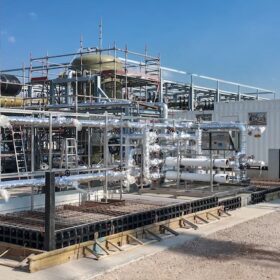
AEG says its new Thyrobox M is the most compact power supply unit for manufacturing polysilicon. Depending on the type of reactor, it takes up roughly 25 percent less space than previous models and up to 70 percent less space than competitive products. The device reportedly provides poly silicon manufacturers with greater performance, reliability, and stability with expanded process monitoring options, a power factor of 0.95, and an efficiency exceeding 99 percent. Thyrobox M is equipped with a warning system to reduce the risk of interruptions when ingots tear or melt. It also has a medium-voltage ignition to improve the stability of the process. Power consumption and the weight of the ingots are constantly monitored by a data recording and analysis system to increase the energy efficiency of the process.

Metallization line

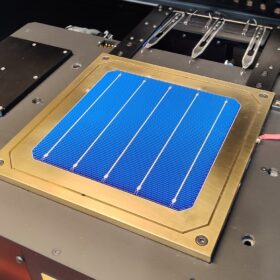
Asys is presenting its Ultraline for the metallization of solar cells. The scalable device reportedly has a throughput of between 1,200 and 4,600 cells per hour and is available with a single, dual, and triple-track system. Asys supplies a completely automated solution, including loading and unloading systems, screen printers, firing ovens, as well as inspection systems and laser edge isolation-based cell tester and sorters for metallization steps.The equipment can support double-front-print emitter applications, as well single-step back-side contacts filling via additional modules.

Cross-struts for added stability

Japanese manufacturer Kyocera is presenting the KD235GH-2PB high-performance module at Intersolar. With 60 cells and a capacity of 235 watts, it’s said to be particularly suitable for industrial and ground-mounted solar installations. Its high capacity with just a few modules saves installation costs. This large (1662 by 990 millimeter) module has two additional cross-struts on the back to make it more stable, so it’s said to be able to withstand strong mechanical stresses, such as wind pressure or snow loads of up to 5400 newtons per square meter. The contacts on the junction box are soldered rather than clamped, reducing fire hazard. The junction box complies with the highest fire resistance class 5V-A under UL94. Kyocera says it makes all the components in its own facilities. All KD modules meet the IEC 61215 ed.2 and IEC 61730 norms.

More than 18 percent efficiency

Sanyo’s HIT solar modules consist of monocrystalline wafers enveloped by an ultra-thin amorphous silicon layer. Sanyo says they deliver more power than conventional crystalline modules. The HIT N modules have an output of 225 and 230 watts, and their efficiency is up to 18.2 percent. They will go on sale in Europe in the fall of 2010. The HIT HD modules have an output of 245 and 250 watts. Their efficiency is up to 18 percent, and they will go on sale in the spring of 2011.

Energy storage for solar power

At Intersolar, a+f is presenting Cellstrom’s FB10/100 and FB 200/400 energy storage systems, now that it has achieved a majority holding in Cellstrom. The battery system is based on “vanadium redox flow” technology and makes solar power available 24 hours a day. It is characterized by its high storage stability and fast reaction time, the company says, and can be used as solar power storage, a solar filling station, or an emergency power system. The storage system can also provide energy for load and peak balancing. The company is also showing its single-axle tracking system SunCarrier 300, which can permanently move a module area of up to 287.5 square meters according to current solar conditions.

PowerRouter PR50S
Image: PowerRouter PR50S

Autonomous hybrid power station

The Dutch company Nedap will present the PowerRouter PR50S, a scaled down variant of the PR50SB that can be gradually expanded. The PR50S includes all of the components that are important for photovoltaic applications. The inverter is designed for a plant with a generator out of 5.5 kilowatts peak. The European energy conversion efficiency amounts to 96 percent.

Several devices can be connected together. In the expanded version the PowerRouter can take over energy management. A wind turbine can be additionally attached or a battery integrated with which the system can then work as a standalone system or increase the share of personal consumption.

Solarvill
Image: Solarvill

Resilient cable

At Intersolar, Villingen is showing its SolarVill PV1-F duplex cable, which connects solar modules, individual panel strings, and inverters. Installation time is cut in half compared to older models, the firm says. The photovoltaic cable can be installed in dry or humid areas, even outside in direct sunlight. In addition to being flame-retardant and halogen-free, the company says the cable can last 25 years, given that it is especially resistant against weathering and wear. In the case of fire, no corrosive gases are produced and fume density is low. The cable complies with the applicable safety standards and can be installed without need for further approval. All materials used conform to the RoHS and REACH regulations. According to the firm, the flexible cable can withstand high mechanical loads and extreme climate conditions.

ETU
Image: ETU GetSolar Professional

Simulation program with intuitive user guide

ETU Software is presenting a photovoltaic system simulation program at Intersolar. The unique selling point of the application is that it guides users intuitively through the program and can incorporate digital photos. The program will be available in Germany, Austria, and Switzerland. The company will also show its GetSolar Professional software, an internationally available program for solar circuit dimensioning.

Kaco
Image: Kaco

From ten to 500 kilowatts

Kaco new energy GmbH is presenting three product classes at Intersolar. A new generation of inverters has been developed that performs the typical functions of a power station. Powador 10.0 TL3, 12.0 TL3 and 14.0 TL3 transformerless three-phase inverters comply with the medium-voltage directive that comes into force in 2011. They’re equipped with a data logger and a web server, so the system can be monitored over the internet without extra equipment. Nominal AC power is nine, ten or twelve kilowatts and efficiency better than 98 percent. They have two DC inputs, each with an independent MPP tracker and an MPP range from 350 to 800 volts to permit flexible system design. Maximum input current for each power section is 17.5 amperes and maximum input voltage is 1,000 volts.

Kaco is also presenting two new large XP series inverters. The Powador XP200-HV and Powador XP250-HV TL have a nominal AC output of 200 and 250 kilowatts, respectively. A 500-kilowatt station contains two XP250 inverters in a special steel housing. Both inverters run under fully digital control. The Powador XP200-HV is supplied with a transformer and the Powador XP250-HV TL not. As such, so the XP200 can deliver directly to the low-voltage grid, while one or more XP250s can deliver to the medium-voltage grid via a suitably selected transformer. Country-specific grid parameters are preset. Peak efficiency is quoted as 97.4 percent for the XP200 and 98.2 percent for the XP250, and the MPP range is quoted as 450 to 830 volts. The inverters comply with the low-voltage and medium-voltage directives.

Kaco is also bringing two new models of the TR3 three-phase inverter to the market this year, the 16.0 TR and the 14.0 TR for a maximum generator output of 16 or 14 kilowatts. They meet the requirements of the 2011 medium-voltage directive. Maximum input voltage is around 600 volts, and European efficiency apparently 95.6 percent. The MPP range extends from 200 to 510 volts. They also have a web server and can thus be monitored with a web browser.

Smaller and more efficient

At Intersolar, Conergy is presenting the IPG T three-phase string inverter for systems of six to 100 or more kilowatts. Conergy says the inverter takes up little space and can be quickly installed to simplify setup; it also has an efficiency of 98 percent and fast MPP tracking.For larger systems, Conergy is presenting the IPG C central inverter. It’s obtainable in four versions, giving output power from 100 to 300 kilowatts, and is said to be smaller but more efficient than the previous model. IPG-C inverters will also be used in the CIS central inverter station in future. Conergy says it can supply a completely preconfigured station, with all connections, cables, ventilation and protection systems, to the construction site and put it into operation.

Schletter PvComfort
Image: Schletter PvComfort

Design software with a structural check

Schletter introduces PvComfort design software for slanted roofs, which allows installers to create various roof surfaces and configure modules on them. They can then assemble a suitable mounting system. The software immediately checks for structural integrity. Finally, the whole configuration, including the structural integrity report, an installation sketch, and a project report, can be printed. The PvComfort program can be used to configure slanted roofs and simple mounting frames. Schletter offers more comprehensive calculation programs for other mounting systems.