Delayed inverter startup can reduce a solar plant’s annual energy yield by 1.88%.


Brazilian researchers have found that delayed photovoltaic inverter startup can result in annual energy losses of 1.88% at a utility-scale solar plant. They analyzed 2023 operational data from a PV plant in the western part of the Brazilian state of São Paulo and developed a methodology to quantify losses associated with delayed inverter startup after sunrise.
The scientists said inverter startup can be delayed even when irradiance levels are sufficient for power generation. At the plant analyzed, they recorded delays of up to four hours after sunrise.
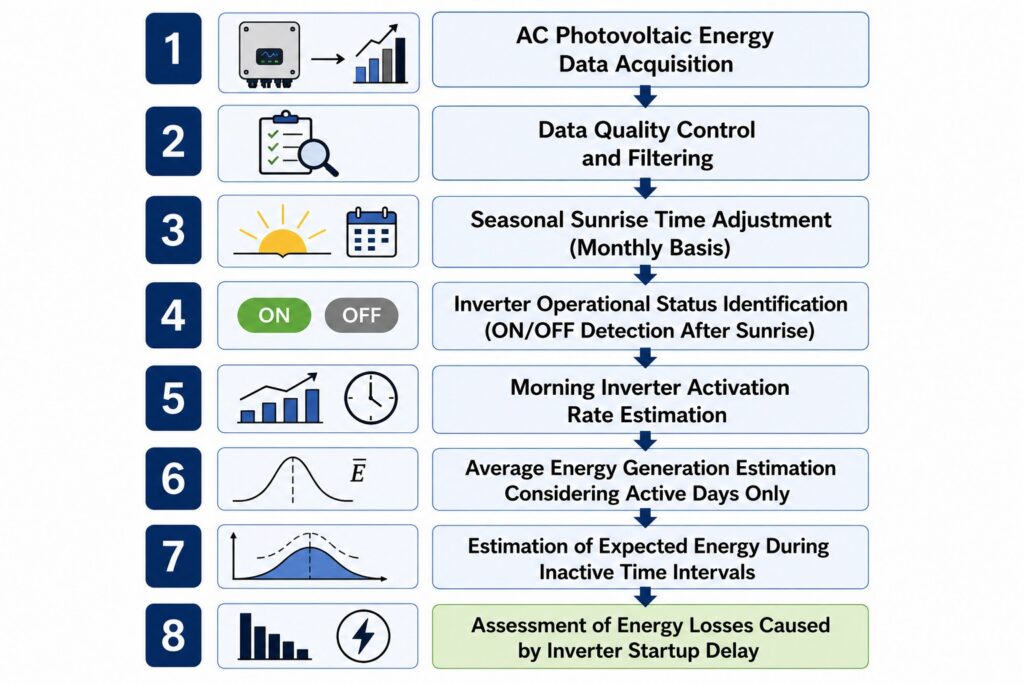
The proposed methodology primarily relies on sunrise times and the plant’s alternating-current (AC) active power data. Plane-of-array (POA) irradiance measurements are required only during the configuration and validation stages, reducing the instrumentation needed for the analysis.
Losses after sunrise
The results showed that more than 55% of annual losses associated with inverter startup delays occurred within the first 90 minutes after sunrise. The researchers also found that losses varied throughout the year.
A quarterly analysis showed that the first half of the year, corresponding to summer and autumn in the Southern Hemisphere, accounted for 68.8% of the recorded losses. The researchers said the results indicate that assessing inverter behavior at the beginning of the daily generation period could help identify opportunities to improve plant performance.
The study also revealed significant differences among the eight inverters analyzed. Monthly losses associated with startup delays ranged from 0.14% to 5.02% of each inverter’s energy generation.
According to the researchers, the variability indicates that startup delays do not necessarily affect all inverters at a plant equally. Identifying the units responsible for the largest losses could therefore enable more targeted operational interventions.
Performance assessment
The researchers said losses caused by inverter startup delays can be difficult to distinguish from other sources of performance losses at PV plants. Their methodology uses sunrise as a reference point to determine when inverters should begin operating and compares the expected startup behavior with recorded power output.
The approach makes it possible to distinguish startup losses from other factors affecting energy generation, including system unavailability, component mismatch, and weather conditions.
At the plant analyzed, inverter startup delays resulted in annual energy losses equivalent to 1.88% of total generation. The researchers said the figure is comparable to losses typically considered in PV system performance and availability assessments.
They said the methodology can be applied to utility-scale PV plants using existing operational data, helping operators identify inverter startup issues and improve plant performance.
Researchers from the Marcelo Villalva Photovoltaic Energy and Systems Laboratory (LESF-MV) at the University of Campinas (Unicamp) conducted the study. The research team included João Frederico Souza de Paula, Marcel Veloso Campos, João Lucas de Souza Silva, Marcelo Vinícius de Paula, Valentin Ferrer, Gustavo Fraidenraich, and Tárcio André dos Santos Barros.
The study, “A method for quantifying availability losses caused by PV inverter start-up delays in a large-scale PV power plant: A case study in Southeastern Brazil,” was published in Electric Power Systems Research.
This content is protected by copyright and may not be reused. If you want to cooperate with us and would like to reuse some of our content, please contact: [email protected].

Please login to comment