French agrivoltaic trials cut water loss, lift maize yields by 19.6%

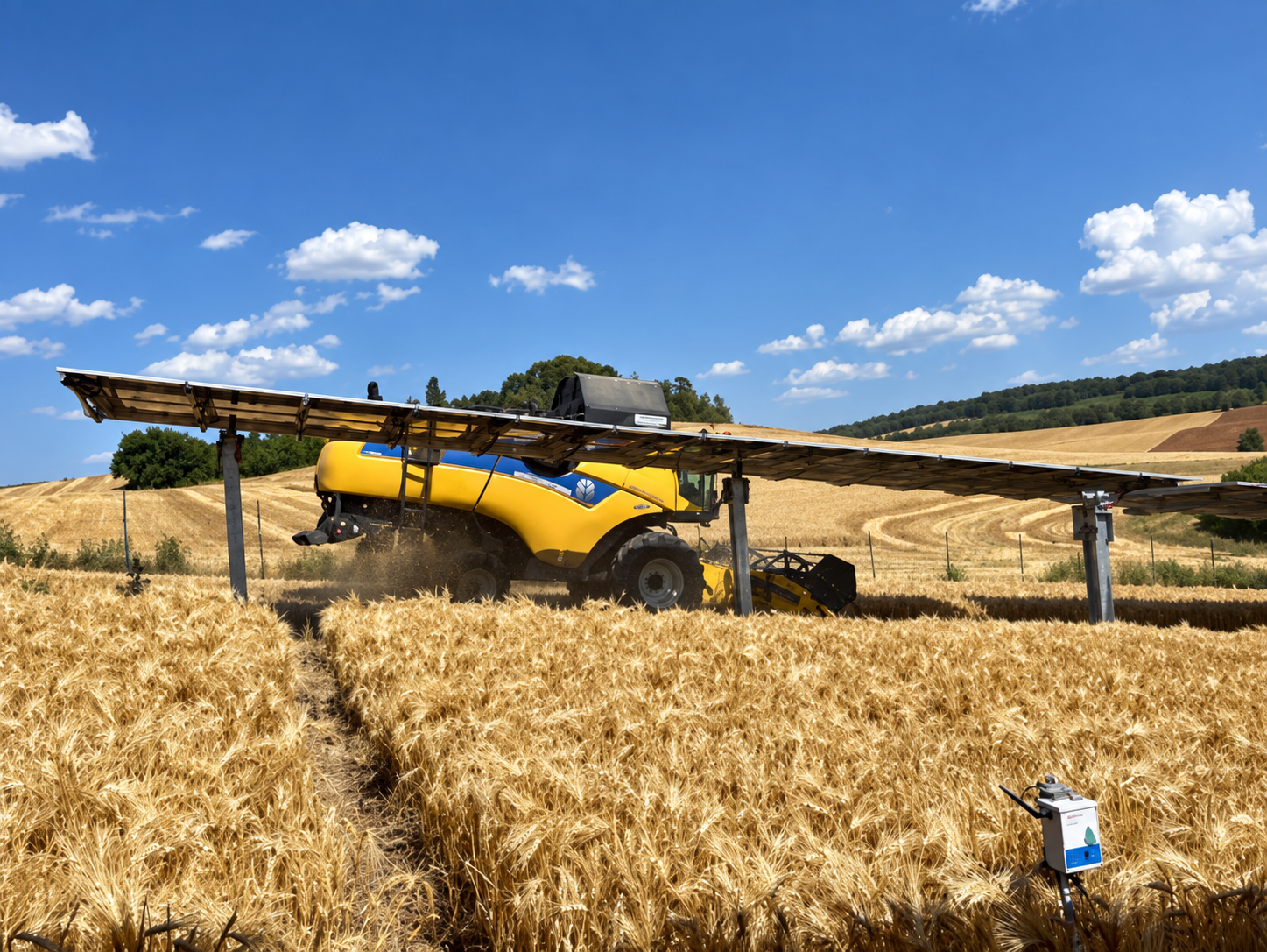
French renewable energy producer TSE has reported results from agronomic monitoring at its agrivoltaic sites, including barley yields of up to 96% of those recorded in a control plot, a 20% reduction in seasonal evapotranspiration, and a 19.6% increase in maize yield under exceptionally hot and dry conditions.
TSE deployed an agrivoltaic canopy at a site in Chadeleuf, in the Puy-de-Dôme department of central France. The site was planted with winter forage barley, which was harvested in late June. It is equipped with 18 radiation sensors, 14 weather stations, and 14 probes that measure soil temperature and moisture.
Agronomic research company Antédis harvested the crop with an experimental combine harvester. The Puy-de-Dôme Chamber of Agriculture and the Limagne Centre for Technical Agricultural Studies (CETA) conducted the monitoring and validated the results.
Evapotranspiration falls by 20%
Initial comparisons with a control plot without solar panels showed that barley yields beneath the agrivoltaic canopy reached between 90% and 96% of those recorded in the control area.
“In all scenarios, the requirements of the decree of April 8, 2024, on the development of agrivoltaics – specifically, a yield loss of less than 10% – were met,” TSE said.
The company said its PV panel control system also reduced heat stress beneath the canopy. Grain specific weight, an indicator of quality, was 3% higher than in the control plot.
Evapotranspiration declined by 20% over the growing season, improving water management.
Canopy moderates temperature extremes
According to the agronomists, the canopy’s protective effect was most pronounced during periods of extreme heat. At the hottest time of day, the air temperature at crop level was 4.1 C lower beneath the panels. Evapotranspiration during these periods fell by 2.15 mm per day.
On the coldest nights, temperatures beneath the canopy were up to 3 C higher. Measurements taken in 2025 and 2026 at TSE’s agrivoltaic site in Brouchy showed that the structure reduced the average daily temperature range by about 1.5 C. Similar effects were observed beneath the Chadeleuf canopy in 2026.
Maize yield rises 19.6% at Amance
TSE also published results from its agrivoltaic canopy in Amance, in the Haute-Saône department of eastern France. Silage maize was planted at the site on April 25, 2026.
The crop faced severe weather stress during a spring and summer marked by exceptional drought and heat. A rainless April coincided with maize emergence, followed by hot, dry conditions during the final stages of stem elongation and flowering, when maize is particularly vulnerable. Temperatures in the open-field control plot exceeded 35 C.
“In this context, the canopy provided the expected protective effect,” TSE said.
Ear sterility was most prevalent in the control plot, although similar symptoms were also observed beneath the canopy. Maize plants beneath the canopy reached an average height of 200 cm, compared with 160 cm in the control plot.
Dry-matter yield was ultimately 19.6% higher beneath the canopy than in the control plot.
Although the maize grown beneath the panels was also affected by the exceptional heat, TSE said the agrivoltaic system helped mitigate the impact and secure a forage harvest. The company is processing the recently received crop-quality analysis.
This content is protected by copyright and may not be reused. If you want to cooperate with us and would like to reuse some of our content, please contact: [email protected].

Please login to comment