Inclusion by design: The leadership behaviours PV innovation needs
Innovation results from people combining expertise, questioning assumptions and learning across professional and organisational boundaries. It cannot reach its potential when seniority determines whose knowledge carries weight, concerns remain unspoken, or teams fail to develop collective intelligence.
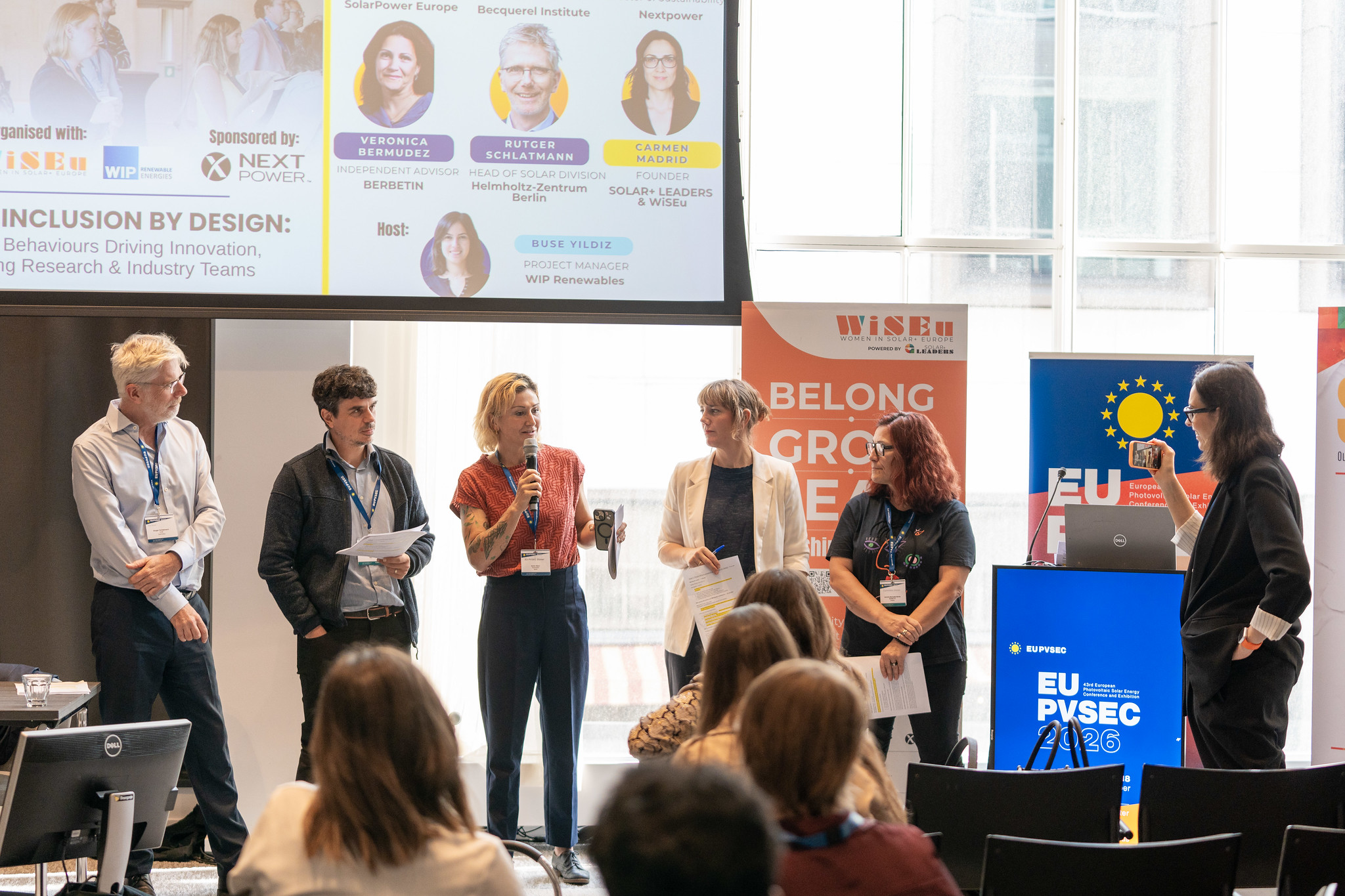
This premise shaped “Diversity in PV: Embedding Inclusion by Design – The Leadership Behaviours Driving Innovation, High-Performing Research & Industry Teams,” delivered by Women in Solar+ Europe (WiSEu) and Solar+ Leaders at EU PVSEC 2026.
Research and industry participants used a fictional but recognisable case to explore how leadership, psychological safety, bias, integrity and systems thinking affect innovation. Facilitated groups then identified practical outcomes for leadership behaviour, team practices and cross-sector collaboration.
Know your teams and create shared direction
A central conclusion was that leaders must understand the people behind team roles and connect their contributions to a common objective.
“Leaders and managers need to educate themselves and receive training in cultural aspects, understand their teams better and make the effort to really know them,” said Verónica Bermúdez, Independent Advisor at BERBETIN.
“We also discussed the importance of establishing what common success means and translating that success to the individual teams,” Bermúdez added. “Ultimately, it is a bottom-up approach: the success of the different teams contributes to the overall success of the consortium. But if this is not cascaded from the top, the bottom-up contribution will not work.”
Communication therefore needs to do more than circulate information. It must create transparency and connect individual responsibilities with collective purpose.
“The overarching topic of our discussions was communication: making sure everyone understands not only the success we want to achieve, but also the information needed to get everyone on the same page,” said Walburga Hemetsberger, CEO of SolarPower Europe. “It means being transparent with your teams and making open communication a priority. Communication is the key to success.”
Shared direction does not require uniform thinking. It gives different perspectives enough context to challenge, complement and improve one another.
Create genuine, not performative, participation
Seniority, confidence and communication style can affect which ideas receive attention, regardless of their value. The groups therefore emphasised balancing ego and intentionally creating time for contribution.
“The first thing we realised was how important it is to learn to manage and balance the ego,” said Sarah Albert, Director of Sustainability at Nextpower. “The second is to train ourselves to give everyone the time to speak and be heard.”
“We can practise it in every interaction: with our families, with our friends and then within the business,” she added. “In the meetings we hold, everyone should have the time to speak and be heard.”
Yet inclusion should not become performative. Visible participation does not guarantee trust or influence.
“We discussed trust and the importance of having a clear, common understanding,” said David Moser, Managing Director of Becquerel Institute Italia. “During meetings, it should be safe to speak, but you should not have to. I think that is also important.”
“Even with the best ideas and intentions, when trying to introduce change, you can sometimes become less effective,” Moser explained. “If you are in a meeting and force everyone to speak, it does not necessarily mean it will be a good idea. What matters is that everyone in the room knows that, if they want to say something, they will be heard.”
Psychological safety means having credible ways to contribute without compulsion: during a meeting, in writing, through an agreed process or after time for reflection. What matters is confidence that the contribution will be fairly considered.
Combine leadership responsibility with individual agency
The workshop also challenged the idea that inclusion depends entirely on formal leaders. One group focused on junior professionals whose specialist knowledge may struggle to influence decisions.
“The most striking part of our discussion was how the contribution of people in junior positions, who are well educated and know what they are doing, can be heard,” said Rutger Schlatmann, Head of the Solar Division at Helmholtz-Zentrum Berlin.
“It is not only about what leadership should change,” Schlatmann continued. “It is also about how junior team members can come prepared, be assertive and speak up. All members have a responsibility to make sure they are able to contribute.”
Leaders must create environments where those contributions are welcomed, while inclusive cultures should help professionals build the confidence and preparation to exercise their agency. This does not shift responsibility onto less-powerful team members; it connects supportive leadership with individual capability.
Design the conditions for collective intelligence
Across the conclusions, inclusion emerged as part of how innovation is created, not as an objective beside it.
“Inclusion is not something we add to innovation after the priorities have been established and the important decisions have already been made,” said Carmen Madrid, Founder of Women in Solar+ Europe and Solar+ Leaders. “It must be designed into how teams meet, how knowledge is shared, how assumptions are challenged and how different forms of expertise influence decisions from the beginning.”
“When people feel able to contribute their knowledge, question assumptions and share uncertainty, teams can identify risks earlier, develop stronger ideas and make better-informed decisions,” Madrid added. “That is why inclusion is not an initiative sitting alongside innovation. It is how stronger and more responsible innovation becomes possible.”
For PV research–industry partnerships, this means deliberately designing how knowledge is shared, uncertainty communicated, competing interests managed and accountability established. Inclusion is not only about who is represented, but whether their expertise can genuinely shape what happens next.
“Creating space for these conversations is essential because the future of PV depends not only on the technologies we develop, but on how we bring people and expertise together,” said Buse Yıldız, Project Manager at WIP Renewable Energies. “We were delighted to co-organise and host this workshop as part of EU PVSEC and to support an important conversation that can strengthen inclusion, innovation and collaboration across our sector.”
The views and opinions expressed in this article are the author’s own, and do not necessarily reflect those held by pv magazine.
This content is protected by copyright and may not be reused. If you want to cooperate with us and would like to reuse some of our content, please contact: [email protected].
Please login to comment