Negative electricity prices could favor thermal storage over industrial heat pumps

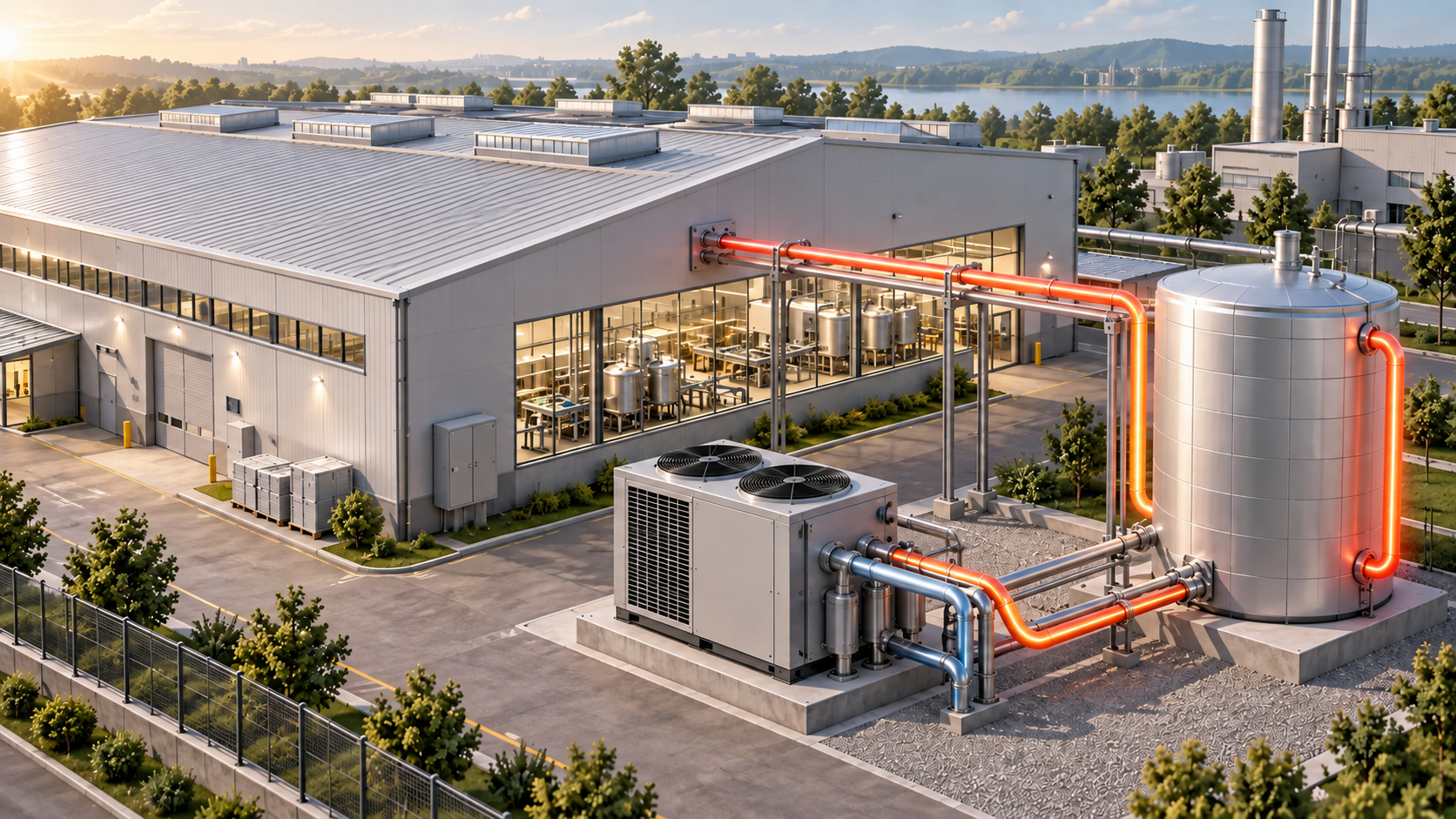
Researchers from China have compared the life‑cycle economic performance of thermal energy storage (TES) and heat pumps (HP) for industrial heating applications under negative price conditions.
“To our knowledge, prior techno-economic comparisons between heat pumps and thermal energy storage for industrial heating mostly focused on conventional time-of-use electricity tariffs, without systematically quantifying their full-life-cycle competitiveness under negative-price market conditions driven by high renewable penetration,” said corresponding author Zijian Liu to pv magazine. “Our work fills this gap.”
Liu further explained that his team built a two-layer co-optimization framework covering both system sizing and hourly dispatch, explicitly incorporating two core characteristics of negative prices: price depth and occurrence probability. “We further generated quantitative decision maps for three typical industrial heating scenarios: hot-water, low-pressure steam, and high-pressure steam,” he added.
More specifically, the researchers modeled a factory with a constant heating demand and compared a heat pump that supplies heat directly with an electric heater that can either supply heat directly or charge a hot-water storage tank for later use. They also modeled a system using both technologies, allowing the amount of heat supplied by each to vary hour by hour. The three applications were hot water at 60 C, low-pressure steam at 130 C, and high-pressure steam at 180 C.
Using an industrial tariff from China’s Shandong province as the baseline for normal hours, the team modeled negative prices occurring during daytime hours and varied both their frequency and depth. In a separate future-scenario analysis, it tested four combinations: −0.05 yuan ($−0.0075)/kWh during 5% of hours, −0.10 yuan/kWh during 10%, −0.15 yuan/kWh during 15%, and −0.20 yuan/kWh during 25%. The researchers also varied the systems’ relative upfront costs and compared their annualized investment and operating costs over a 20-year lifetime.
“Even though thermal storage suffers from relatively low round-trip efficiency, it can outperform heat pumps economically, especially for high-temperature industrial heating such as high-pressure steam,” Liu said of the results. “In our modeled parameter space, thermal storage becomes the cost-effective choice unless the heat-pump initial investment drops below 30% of the thermal-storage capital cost. This happens because high-temperature operation significantly degrades heat-pump coefficient of performance (COP), while electric thermal storage performance is barely affected by the heat-supply temperature level.”
The researcher also noted that the study found the hybrid heat-pump plus thermal-storage combination delivers highly uneven benefits across heating use-cases. “It brings large economic gains for hot-water applications (superior to either standalone system in 96% of evaluated cases), yet delivers almost no benefit for high-pressure-steam scenarios,” he said.
“We also noticed that under extreme future negative-price assumptions (25% occurrence probability, −0.20 yuan/kWh depth), thermal storage can achieve lower life-cycle cost across nearly all investigated COP and investment-ratio ranges,” Liu said. “Such market conditions may appear in high-renewable microgrids, even if uncommon in large interconnected power grids.”
In addition, the results showed that for hot-water production, standalone thermal storage became cheaper than a heat pump whose initial investment was 30% of the storage system’s only under sufficiently frequent or deep negative prices. For low-pressure steam, storage was cheaper across the entire range of negative-price conditions examined once heat-pump investment exceeded 70% of storage investment.
“Our current study adopts fixed annual-average negative-price parameters and does not capture seasonal fluctuations or regional market diversity,” concluded Liu. “Our intended follow-up work will integrate real monthly, region-specific spot-market price datasets. This will allow us to evaluate how seasonal variation and geographical differences shift the economic comparison between thermal storage and heat pumps, improving the real-world practical guidance of the model.”
The article “Techno-economic assessment of thermal energy storage vs. heat pumps for industrial heating under negative electricity prices” appeared in Sustainable Energy Technologies and Assessments. Researchers from China’s China Electric Power Research Institute, Beijing University of Civil Engineering and Architecture, Shanghai Jiao Tong University, and North China Electric Power University have contributed to the study.
This content is protected by copyright and may not be reused. If you want to cooperate with us and would like to reuse some of our content, please contact: [email protected].

Please login to comment