U.S. homeowners are now slightly less mistrustful of solar companies

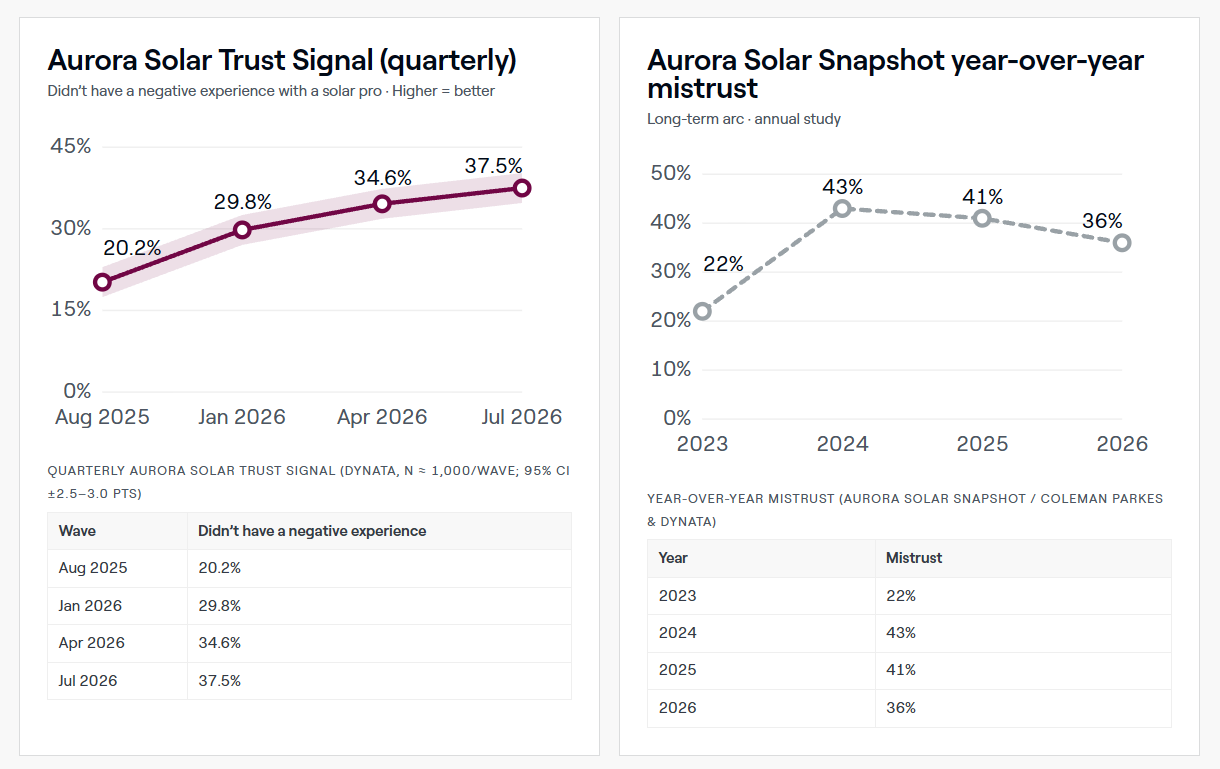
Aurora Solar has launched a new quarterly benchmark called “Trust Signal,” which tracks the incidence of homeowners who report having negative experiences with solar installers in the previous three months, with each survey covering a sample of approximately 1,000 homeowners.
In the four most recent quarterly surveys, conducted with market research platform Dynata, the share of homeowners who reported not having a negative experience with a solar professional has climbed from 20.2% in Q2 2025 to 37.5% in Q2 2026, the most recent survey.
Aurora says the Trust Signal is designed as a “lighter” quarterly companion to its annual Aurora Solar Snapshot report, which tracks multiple facets of installer trustworthiness. In the most recent Snapshot, Aurora data showed that 36% of people who were actively shopping for solar at the time cited trustworthiness as a top concern.
While the overall trend points to decreases in those homeowners who express concerns over solar installer trustworthiness, the incidence of those concerns remains higher than historical data suggests is normal.
The increases in perceived installer trustworthiness come following the sunsetting of the Section 25D tax credit at the end of 2025, which has caused a marked decline in new home solar installations.
This decline has led to both installer bankruptcies and increased competition for customers between the solar companies that remain. 54% of installers who responded to Aurora’s 2026 Snapshot survey reported increased competition over the previous year.
“Solar has reached a point where the homeowner experience matters just as much as the technology itself,” said Aurora Solar co-founder Chris Hopper, in a statement. “The Trust Signal gives the industry a way to see where consumer confidence is improving and where there is still friction. The encouraging news is that homeowner experiences are moving in the right direction, but to really rebuild trust we need to make it easier for people to understand their options and the value they’re getting for their money.”
Aurora points to one key figure from the latest survey that shows 57% of homeowners say they want solar professionals to be upfront about installation costs and savings estimates.
Earlier this year, the company introduced an online marketplace that seeks to address those desires by presenting homeowners with cost and savings estimates based on any home address. The marketplace allows Aurora partner installers to set baseline pricing, and uses Aurora’s satellite scans of home roofs to estimate energy production and savings based on a homeowner’s roof and average electric bill.
Importantly, unlike some other online solar marketplaces, the Aurora solution presents users with cost and savings estimates without requiring them to log in or provide any personal information.
The Aurora Solar marketplace differs from others on the back end as well, said one installer. In a conversation with pv magazine USA, Chet Zimmer, an owner of Sunpath Services in Beaverton, Oregon described the marketplace as “pay per close” rather than the typical “pay per lead” model seen with other lead generators.
According to Zimmer, though, the marketplace is very much “in its infancy” — at least in Oregon, where average electricity prices are about 15% lower than the national average. He signed on to use the Marketplace because his team uses the Aurora design tool, but he hasn’t yet seen much homeowner interest from it.
The Aurora Solar Trust Signal report is available now on the Aurora Solar website.
This content is protected by copyright and may not be reused. If you want to cooperate with us and would like to reuse some of our content, please contact: [email protected].

Please login to comment