Researchers test laminated bamboo structures for floating PV platforms

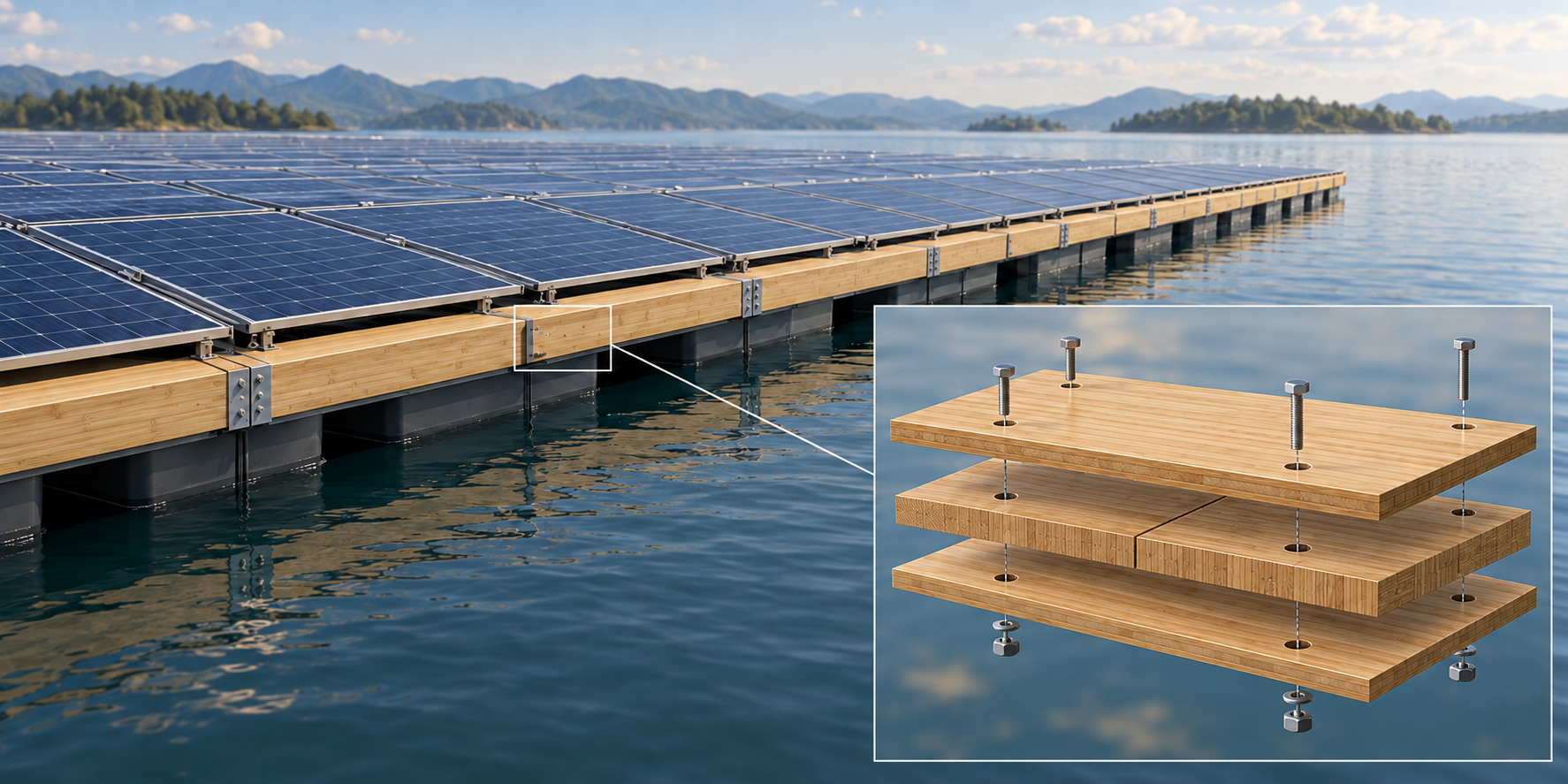
A research team in China has analyzed the flexural behavior of thin-plate glued laminated bamboo (glubam) systems for floating PV platforms.
“Glubam systems show promising potential for FPV platforms due to their high strength-to-weight ratio, low carbon footprint, and favorable balance between flexibility and bending stiffness,” the researchers said. “This study investigates the flexural behavior of bolted three-layer thin-plate glubam assemblies for floating photovoltaic structures under monotonic loading.”
The researchers tested different glubam assemblies using four-point bending tests with varying plate configurations and thicknesses, alongside numerical simulations and parametric analyses. They also developed mechanics-based models for bending stiffness and ultimate capacity.
For the experimental part of the study, the researchers built six glubam configurations and tested two specimens of each. All specimens were 200 mm wide and featured continuous 2,000 mm upper and lower plates, a 15 mm segmented middle plate, a 10 mm lower plate, and M10 bolts. To create the six configurations, they combined two upper-plate thicknesses – 20 mm and 25 mm – with three middle-layer layouts: 1,200 + 1,200 mm, 600 + 600 + 600 mm, and 600 + 600 + 600 + 600 mm.
The researchers subjected the specimens to four-point bending tests. The specimens rested on supports spaced 1,500 mm apart, with loads applied at two points 700 mm apart.
The team recorded load, midspan deflection, and plate strain as the specimens approached their peak loads. It then developed ABAQUS models of the six configurations and compared the predicted stiffness and peak loads with the experimental results.
The scientists subsequently used the models to assess how bolt diameter, bolt spacing, and plate thickness affected load-bearing capacity.
“The flexural failure of the assemblies was governed by rolling shear of the middle layer, followed by cracking of the upper plate,” they said. “The flexural stiffness showed limited sensitivity to middle-layer segment length and configuration within the investigated range, whereas the ultimate capacity depended on whether a middle-layer discontinuity was located within the shear span.”
Compared with the 1,200 + 1,200 mm layout, the 600 + 600 + 600 + 600 mm configuration reduced ultimate load capacity by 10.00% with the 25 mm upper plate and by 28.22% with the 20 mm upper plate. For the 600 + 600 + 600 mm configuration, the corresponding reductions were limited to 6.22% and 2.49%, respectively.
The parametric analysis showed that increasing bolt diameter from 10 mm to 12 mm improved ultimate moment capacity by between 8.43% and 12.11%, although the benefit diminished at larger diameters. Reducing bolt spacing from 200 mm to 100 mm was more effective, increasing capacity by 40.39%, provided that minimum spacing and edge-distance requirements were met.
“Increasing upper-plate thickness from 15 mm to 20 mm increased capacity by 20.54%, whereas a further increase from 25 mm to 30 mm raised capacity by only 3.19%,” the researchers said. “At a fixed total thickness, allocating additional thickness to the face plates, particularly the lower plate, produced a greater increase in ultimate capacity than allocating it to the middle plate.”
The study, “Flexural behavior of three-layer thin-plate glubam assemblies for floating photovoltaic platforms”, was published in Structures. Researchers from China’s Hebei University of Engineering, Tianjin University, Tianjin University of Technology, and Hong Kong Polytechnic University contributed to the work.
This content is protected by copyright and may not be reused. If you want to cooperate with us and would like to reuse some of our content, please contact: [email protected].

Please login to comment