France hits record 800 hours of negative, zero electricity prices

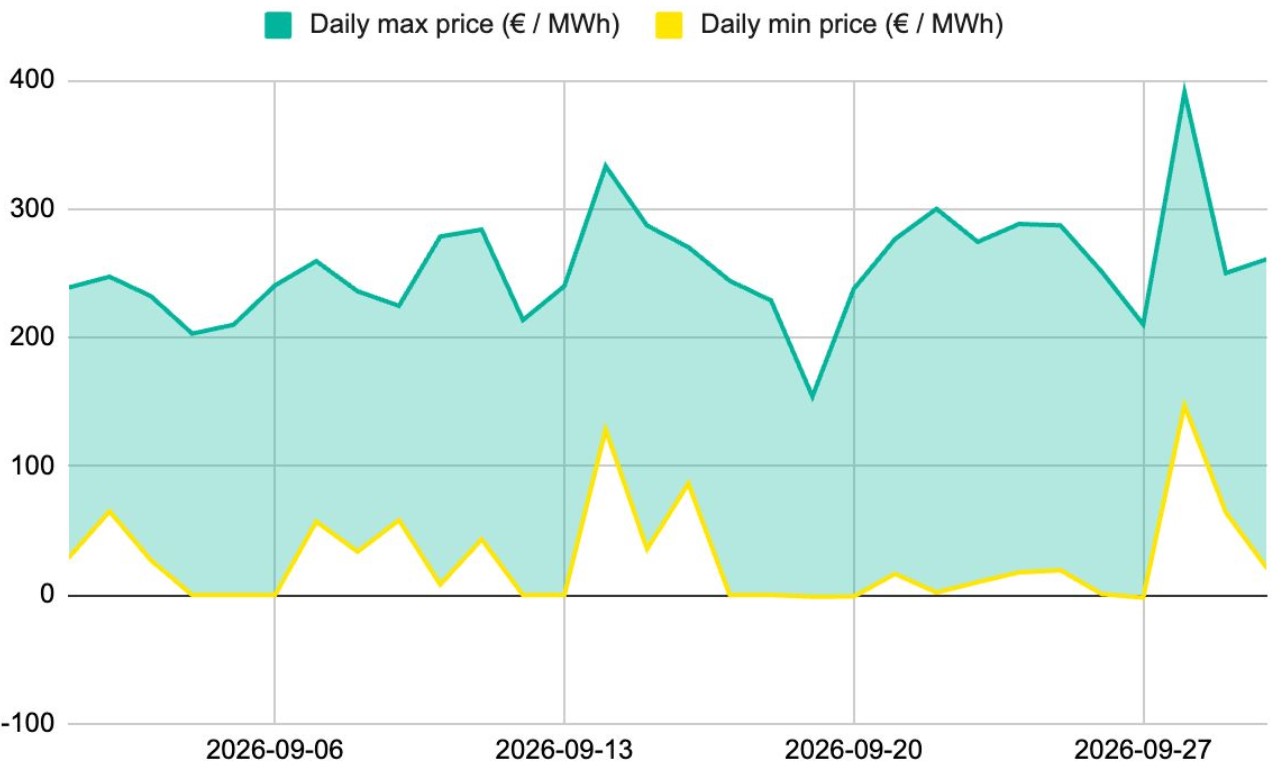
Price volatility on the French electricity market has risen sharply in 2026, as tighter conventional generation coincides with increasingly frequent periods of excess renewable output. The widening gap between low and high intraday prices is creating increasingly favorable conditions for battery storage and energy arbitrage.
“Price volatility is skyrocketing,” B2B energy storage company Storio Energy said in its September price monitor. The average daily spread on the French spot market reached €214 ($240.7)/MWh, a level not seen since 2022. Prices fluctuate daily between average lows of €32/MWh and average highs of €247/MWh.
Since the start of 2026, day-ahead spot prices have averaged €143/MWh, tracking higher gas prices amid geopolitical tensions and uncertainty ahead of winter. At the same time, French electricity generation has declined. Compared with September 2025, nuclear availability is down 3.7 GW, wind generation by 2.3 GW and hydropower by 1.5 GW. Higher solar generation, up 1.8 GW, and gas-fired generation, up 1 GW, have only partially offset the declines.
France remains a significant net electricity exporter, although at lower levels than a year earlier, at 8 GW compared with 10 GW. “The reduced availability of nuclear and hydropower is a direct consequence of the summer drought,” Storio said.
France has already recorded around 800 hours of negative or zero electricity prices in 2026, an all-time high. Against this backdrop, Storio said a 1 MW/2 MWh battery charged at an average price of €73/MWh in September and discharged at €232/MWh, completing around 1.5 cycles per day.
“It generated 135% more spot revenue compared to September 2025. For the year, its cumulative revenue is up 50% compared to 2025 and has more than doubled compared to 2024,” the company said.
Negative electricity prices occur when available generation exceeds demand and wholesale market participants effectively pay to keep electricity flowing onto the grid. The phenomenon has become increasingly common in France as renewable capacity has expanded alongside the recovery of nuclear generation. In 2024, France recorded 359 hours of negative electricity prices, more than double the 147 hours registered in 2023, according to French transmission system operator RTE. As pv magazine previously reported, rising daytime renewable output, particularly solar, has contributed to the increase in negative-price periods.
The trend accelerated further in 2026. In May, the country was experiencing a sharp increase in negative electricity prices. The French spot market subsequently reached a low of -€498/MWh on May 1, with low holiday demand and reduced nuclear flexibility contributing to the extreme price event. The growing frequency of such periods is strengthening the economic case for flexible assets such as battery storage, which can charge when electricity prices are low or negative and discharge when prices rise.
This content is protected by copyright and may not be reused. If you want to cooperate with us and would like to reuse some of our content, please contact: [email protected].

Please login to comment