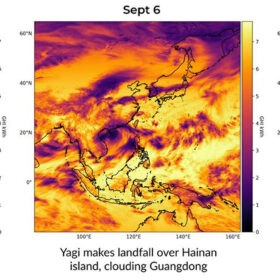
Typhoon Yagi triggers significant drop in solar production across Southeast Asia
In a new weekly update for pv magazine, Solcast, a DNV company, reports the Typhoon Yagi caused a significant reduction in solar power generation across key cities in Vietnam, China, and the Philippines, with some areas reporting their lowest irradiance days on record for September.

Taiwan installs 2.7 GW of new solar in 2023
Taiwan’s Ministry of Economic Affairs (MoEA) says the island added 2.7 GW of new solar capacity last year, bringing its total capacity to 12.41 GW by December 2023. Feed-in tariffs for installations up to 100 kW continue to drive the market.

European Investment Bank invests in solar, wind in South Africa
The European Investment Bank (EIB) and Development Bank of Southern Africa (DBSA) are each investing €100 million ($110.8 million) in small- and medium-scale solar and onshore wind projects in South Africa. Together, they have now committed €600 million under South Africa’s Embedded Generation Investment Programme (EGIP).

Amea Power to build 1 GW of solar, 900 MWh of storage in Egypt
Dubai-based developer Amea Power has agreed to build a 1 GW solar plant with a 600 MWh battery energy storage system (BESS) and an additional 300 MWh BESS. This follows the signing of two power purchase agreements (PPAs) with Egyptian Electricity Transmission Co.

Chinese solar module prices fall despite price hikes in upstream segment
In a new weekly update for pv magazine, OPIS, a Dow Jones company, provides a quick look at the main price trends in the global PV industry.

Lebanon launches tender for 8 MW solar plant
Lebanon’s Minister of Energy and Water has opened a tender for an 8 MW solar plant that will be publicly funded and connected to the medium-voltage grid to supply power to Electricité du Liban.

POLO back junction solar cell built with PECVD achieves 24.2% efficiency
A group including scientists from Insititute for Solar Energy Research Hamelin (ISFH) and German PV equipment manufacturer Centrotherm has developed a POLO back junction solar cell by using an industrial plasma enhanced chemical vapor deposition (PECVD) system with a low-frequency plasma source. The device achieved a slightly higher efficiency than a reference device fabricated via more expensive atomic layer deposition (ALD).
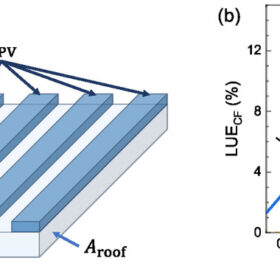
Freeware tool predicts light transmission, power generation of PV materials used in agrivoltaics
A research paper from scientists at Swansea University describes their tool for analyzing thermodynamic limits of organic semiconductor-based photovoltaics (OPVs). One of the findings was that semi-transparent solar PV deployed in greenhouses may deliver comparable performance to conventional crystalline silicon PV.
Using surplus PV power for seasonal underground thermal storage
Scientists have proposed a new system that uses surplus PV energy in the spring and the autumn to charge up underground thermal energy storage for later use in the summer and winter. They have simulated it on a school facility in Seoul, with a few optional configurations for thermal storage. Power savings were up to 39%.

Italy’s first agrivoltaic tenders draws bids for 1.7 GW
Italy’s Ministry of the Environment and Energy Security (MASE) says it has received 643 bids totaling 1.7 GW in its first agrivoltaic tender. About 56% of the proposals have come from the country’s sunny southern regions.
