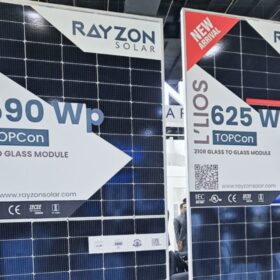
Rayzon Solar to expand PV module capacity to 12 GW by September 2025
Rayzon Solar currently has 4 GW of PV module manufacturing capacity and plans to add 3 GW by December, followed by another 5 GW by September 2025. This will increase its cumulative module capacity to 12 GW per year. The company also plans to build a 1.2 GW cell line by the end of 2025.

MCPV moves forward with 4 GW solar cell factory in the Netherlands
MCPV, a Netherlands based cell manufacturer, has secured €4.2 million ($4.6 million) of Dutch government support for a 4 GW solar cell plant to be built in the town of Veendam. It has also obtained electricity supply commitments for initial production lines and future expansion.
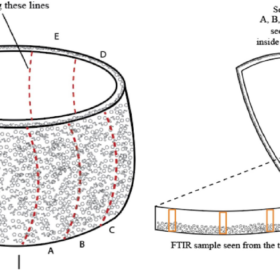
Quartz crucible quality key to reducing impurities in silicon ingot manufacturing
Researchers from Norway and Germany investigated the influence of impurities in fused quartz crucibles used in silicon PV ingot production. The results suggest that the key factors influencing crucible uniformity are sand quality, sand particle size, and aspects of the manufacturing process.

Heliene secures $54 million investment to expand US manufacturing
Heliene has obtained a $54 million investment from Transition Equity Partners to expand its solar cell and module production in the United States.
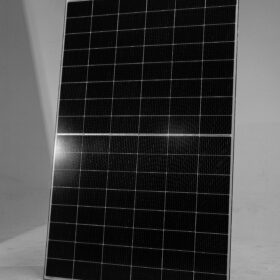
Cando Solar unveils frameless 450 W heterojunction PV panels with 22.6% efficiency
The Chinese manufacturer says its new frameless heterojunction panels rely on busbarless technology and 210 mm wafers. The new products also feature a temperature coefficient -0.29%/C and weigh only 12.3 kg.
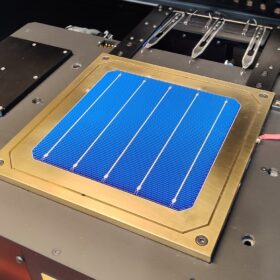
The impact of sodium, moisture on heterojunction PV module performance
Researchers in France have investigated heterojunction solar module reliability in damp heat environment and have found that sodium ions are the main source of degradation.
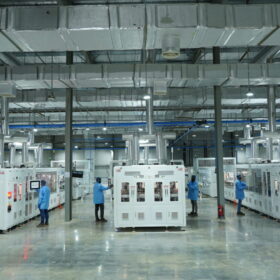
India adds 11.3 GW of solar module capacity, 2 GW of cells in H1 2024
India added 11.3 GW of solar module and 2 GW of cell manufacturing capacity in the first half of 2024, bringing the country’s cumulative production capacities to 77.2 GW for modules and 7.6 GW for cells, according to Mercom India.
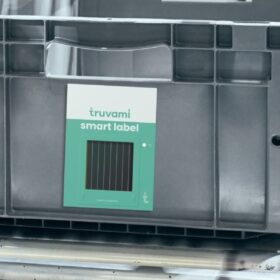
Swiss startup offers organic PV-powered asset tracker
Truvami has launched an organic PV-powered asset tracker equipped with localization and sensor technology for battery-free use indoors and outdoors, targeting logistics and manufacturing applications.
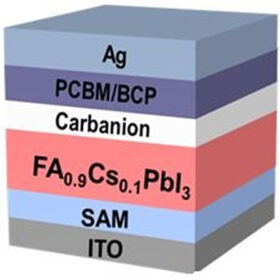
Inverted perovskite solar cell based on lead carbanion achieves 25.16% efficiency
Developed by Scientists in China, the solar cell reportedly achieved the highest open-circuit voltage ever recorded for an inverted perovksite PV device. The lead carbanion layer was responsible for reducing defects at the interface bewteen the perovskite layer and the electron transport layer.
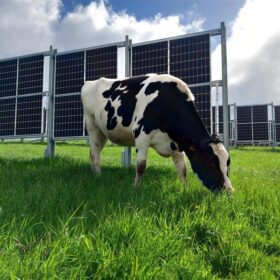
Engie reveals results of French vertical agrivoltaic demonstrator
The French energy company said its 100 kW agrivoltaic facility linked to cow farming in France’s Puy-de-Dôme region has not modified meadow functioning and animal behavior.
