Storage Highlights 2020 – Megawatt Winner: m-Bee

Built in partnership with Messe Düsseldorf and Energy Storage Europe, pv magazine’s annual Energy Storage Highlights 2020 special edition is hot off the press. Celebrate this year’s top five awardees at our Insight panel session with discussion among our Gigawatt winners and panel of expert jurors.
Introducing Megawatt Winner… 
m-Bee
A cascade for more efficient battery systems
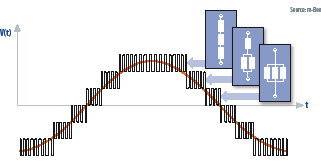
m-Bee’s system eliminates the strict separation between power electronics and batteries. While this seems revolutionary in a battery inverter, it is well-known in the field of high voltage direct-current transmission. With this approach, the company wants to achieve higher efficiencies over a wide performance range.
M-Bee’s story started by accident. In 2007 Nam Truong began his studies at the Technical University of Munich. Just two days after the start of the semester, he happened to sit next to fellow student Arthur Singer. Now, after having completed their doctorates, both of them are working on the new startup, which they founded with two other former students. They want to develop a completely different battery inverter technology, which to the jury is worth placing among the megawatt winners of this year’s pv magazine storage highlights.
pv magazine Storage Highlights Ceremony
Now as a Webinar!
You are invited to join us online for the pv magazine Storage Highlights Ceremony on March 11, 10am – 11:30am (CET)!
The Energy Storage Europe Düsseldorf has been postponed indefinitely due to Coronavirus. Consequently, we will not be able to host our Insight event live onsite. However, in the age of digitalization we will host the Storage Highlights Ceremony as a webinar.
The five Gigawatt Winners will pitch their winning applications to the expert jury panel with a subsequent discussion by the independent leading analysts.
“We are eliminating the strict separation between batteries and power electronics,” explains Truong, who also acts as the company’s managing director. Instead, they ingeniously connect the batteries together to form a swarm so that alternating current at the correct voltage is produced at the end.
This “multi-level approach” can have several advantages, says Truong. Ultimately, it can offer greater flexibility – by allowing different types of batteries or second-life batteries to be interconnected, for instance – or it can achieve higher efficiency over a wide power range at similar cost, thereby reducing overall costs. This has been demonstrated by experience with high-voltage direct current transmission. “This technology is standard for inverters in that field,” says Truong.
In conventional battery systems, battery blocks with 48 volts, for instance, are connected in series, so that inverters can be operated at high input voltages, sometimes exceeding 700 volts. At this voltage, the electronic components switch the current flow on and off at a high frequency. Downstream filters smooth the curve until the desired sinusoidal AC voltage at 220 volts, or 380 volts for three-phase systems, is produced.
In m-Bee’s innovative “Stabl” system, the individual batteries are instead connected directly to electronic switches. These determine which batteries are connected in parallel at one moment and which are perhaps connected in series at another moment. This allows direct generation of the sine wave for the AC voltage. As a result, the components operate at the battery voltage instead of the higher system voltage, and also at a lower frequency. You need more components, says Truong, but they are cheaper. And the field-effect transistors m-Bee uses would also have lower losses at lower voltages than the IGBTs used in conventional inverters.
The software controlling the switches also ensures battery balancing. This term refers to compensation for different battery characteristics if components age differently or are of different types. The use of this concept can even compensate for the failure of individual PV panels. During maintenance, a further advantage is that only the low battery voltage is applied, rather than the high system voltage as in conventional battery systems connected in series.
Singer has already proven the concept in his doctoral thesis at the Bundeswehr University Munich. There, the technology was developed in partnership with storage EPC Smartpower. In the startup’s laboratory there is also a system that Truong says is ready for operation. The company founders are currently measuring and optimizing the circuit and efficiency based on this system. The preliminary measurement results are promising, Truong says. Conventional systems would often have poor efficiencies at low loads, but their prototype is different, he claims.
Recently, the company took its next big step. “We just equipped a pilot system at Smartpower comprising of 115 kilowatt-hours of second-life batteries with a 50 kVA inverter,” says Truong. The next task will be to obtain the necessary certifications. By the end of the year, the company plans the market launch of components with which storage systems can be built according to the new concept. The founders have their sights set on systems larger than 60 kilowatts.
Jury comment
Nina Munzke: “Interesting approach to achieve high efficiencies.”
Gigawatt Winners

Cornelius Armbruster | Project Manager Efficient and High-Frequency Power Electronics, Fraunhofer ISE
Thomas Chrometzka | Head of Strategy, Enapter

Julius Holsten | Project Manager PEM Electrolysis & Hydrogen Infrastructure, ArevaH2Gen

Sascha Koppe | Country Director DACH, sonnen

Bernhard Rindt | CEO, egrid

Thomas Speidel | CEO, ADS-TEC Group
Thomas Speidel hat Elektrotechnik an der Universität Stuttgart studiert. Das mittelständische und inhabergeführte Familienunternehmen, das heute rund 300 Mitarbeiter beschäftigt, hat seinen Hauptsitz in Nürtingen und einen Produktionsstandort nahe Dresden.
Die ADS-TEC Energy GmbH ist ein Unternehmen mit einer Beteiligung von BOSCH. Auf Basis jahrzehntelanger Erfahrung mit Lithium-Ionen-Technologien werden Batteriespeicherlösungen und Schnellladesysteme inklusive deren Energiemanagementsysteme für Privathäuser, öffentliche Einrichtungen und Gewerbebetriebe entwickelt und produziert. Die skalierbaren Batteriespeichersysteme ermöglichen Industrie- und Infrastrukturlösungen sowie autarke Energieversorgungen. Die neue Schnellladetechnik für die Elektromobilität ist wegweisend und weltweit einzigartig.
This content is protected by copyright and may not be reused. If you want to cooperate with us and would like to reuse some of our content, please contact: [email protected].

Please login to comment