Hoymiles uses ESIE 2026 to press broader storage push

At ESIE 2026 in Beijing, Hoymiles used the exhibition not simply to add another product to its lineup, but to sharpen the market’s understanding of what the company is trying to become. Best known internationally for microinverters, the Chinese manufacturer launched a 460 kW string PCS and a 1725 kW grid-forming PCS at the show, framing the move as a further step into utility-scale storage and broader power electronics solutions. The company also signed a cooperation agreement with TÜV SÜD focused on testing, certification and standards work for grid-forming storage products.
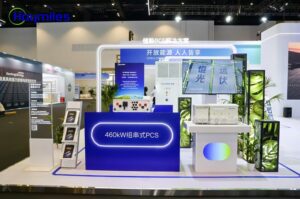
In an interview on the sidelines of the exhibition, Vice President Guy Rong argued that the company’s move from microinverters toward a fuller solar-plus-storage portfolio should not be read as a sudden pivot. In his account, storage had been on Hoymiles’ roadmap for years, with research and development under way well before the recent acceleration of the market. “What changed,” he said, “was the pace.” Since 2025, the company has moved more quickly to bring together product, system and application capabilities across residential, commercial and industrial, and utility-scale storage.
That distinction matters. Mr. Rong repeatedly drew a line between Hoymiles’ approach and the faster route taken by some companies that enter storage with off-the-shelf or white-label solutions. Hoymiles, he said, has preferred a slower but more solid build: develop the products, iterate them over several years, and only then push them more aggressively into the market. At ESIE, that message was visible in the company’s emphasis on both new hardware and system-level capability. The utility-scale PCS launches were the most obvious headline, but the larger point was that Hoymiles wants to be seen less as a single-product specialist and more as a supplier with a widening storage stack.
Residential storage remains one of the clearest signs of that transition. In February, Hoymiles officially launched its HiOne all-in-one home battery system in Amsterdam, positioning it as a major step in its European expansion. The company said the product integrates inverter, battery and EMS in one system and marked the debut with distribution agreements in Europe. Mr. Rong said the product’s early traction in Europe was driven less by price than by practical considerations: faster installation, cleaner design and a warranty structure that channel partners and end customers could trust. In his telling, the appeal was not discounting, but product execution.

That in turn shapes Hoymiles’ channel strategy. Mr. Rong said the company has been careful not to chase short-term volume through aggressive low pricing or an overly dense distributor network. For residential storage in particular, he said, channel health matters alongside product performance. Distributors care not only about product quality but also about margin protection, regional order and the risk of price disruption. In that sense, Hoymiles appears to be trying to preserve the discipline it built in microinverters while expanding into more complex storage categories.
The company’s near-term constraint, however, may be less about market access than execution. Mr. Rong said demand has risen faster than deliveries, leaving Hoymiles under pressure on fulfillment, inventory and supply chain coordination. That pressure spans both residential and commercial and industrial storage and reflects a common challenge for companies moving from product validation to larger-scale commercialization. Once orders rise, he noted, the bottleneck shifts quickly from front-end sales to manufacturing rhythm, component availability and organizational capacity.
Commercial and industrial storage remains another important part of the story. In February, Hoymiles said its HoyUltra 2 liquid-cooled C&I storage system had achieved noise certification at no more than 60 dB(A), a specification it presented as relevant for projects in commercial districts, industrial parks and residential-adjacent environments. While that announcement was separate from ESIE, it reinforces the broader message that the company is trying to compete with differentiated product attributes rather than with price alone.
Geographically, Mr. Rong said Europe remains central but no longer sufficient on its own. He identified Latin America, parts of Asia-Pacific, the Middle East, Central Asia and Canada as expansion priorities, while describing the US as more difficult this year because of policy factors. He also singled out India as a market where Hoymiles has been investing significant management attention. That focus is consistent with the company’s January announcement of a 360 MW microinverter supply agreement with Kosol Energie, which Hoymiles described as the largest single microinverter deal in India to date.
Over the next two years, Mr. Rong expects utility-scale storage to be the fastest-growing part of the business. Large-scale storage, he said, is a project business rather than a consumer-style product business, and its profit logic will differ from residential storage or microinverters even if volumes scale more quickly. That may be the clearest takeaway from Hoymiles’ ESIE showing. The company is broadening its reach, but it is doing so with a relatively sober thesis: product first, global layout second, and no assumption that every segment will behave the same way.