Danish consortium builds 1 MW/20 MWh molten salt thermal storage facility

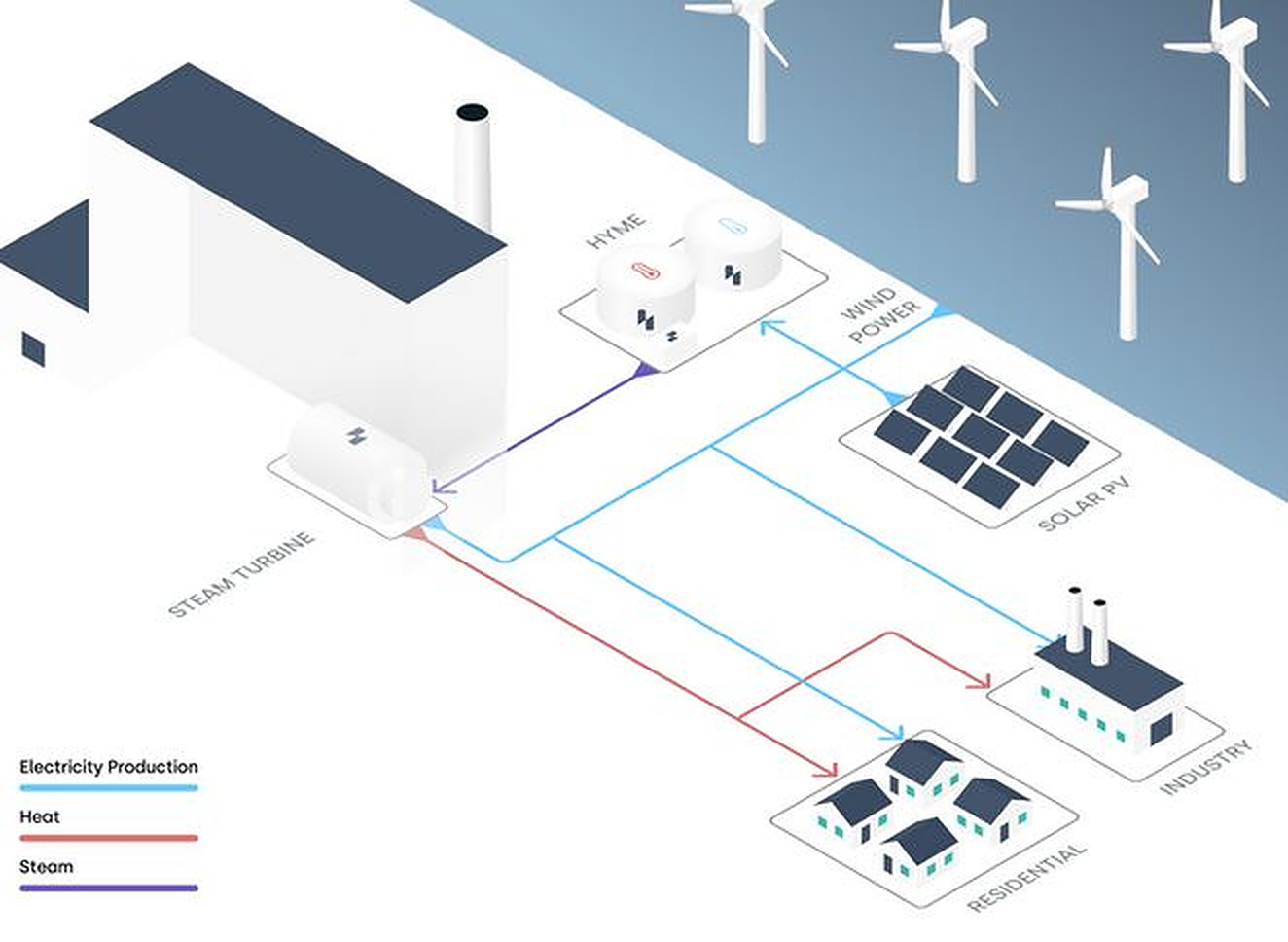
Hyme Energy ApS, a unit of Denmark’s Seaborg Technologies, is partnering with Bornholms Energi & Forsyning (BEOF) to build its first molten salt thermal energy storage demonstrator on the Danish island of Bornholm.
“The plant is to be built in the Baltic Sea on Bornholm, close to all the planned wind turbine parks,” a company spokesperson told pv magazine. “The facility, however, will not be connected directly to a renewable energy source, it will be connected to the normal electric grid. We will store cheap ‘excess’ electricity and that will mostly be from renewable sources – and as our national grid is going towards 100 % renewables, our plant will be powered more and more by renewables.”
The storage facility is scheduled for completion in 2024 and will have a capacity of 1 MW/20 MWh. It will provide heat, power, and ancillary services to the local network.
“After the completion of the plant, Hyme will be ready for commercial deployment of plants of up to 1 GWh or more,” said Hyem.
The company’s storage technology uses renewable energy to heat the salt using electrical heaters. It is based on two-tank molten salt storage designs developed for concentrated solar power (CSP) plants. It said it has a scalable storage capacity from 250 MWh to 5 GWh. A 1 GWh facility with sodium hydroxides should be able to store heat to produce power and heat for around 100,000 households for 10 hours of discharge.
The two tanks are able to store electricity as heat at 700 C. The high temperature provides large flexibility for how energy can be extracted back out, including Rankine cycle combined heat-and-power production, Brayton cycle heat-to-power, heat storage for district heating, and industrial process heat. The technology also uses immersion heaters to store excess electricity as heat, while pumps control the flow for discharging through salt to steam heat exchangers for producing steam to drive steam turbines for co-generation in the simplest setup.
Seaborg Technologies, which makes molten salt nuclear reactors, said the storage system could have a maximum heat loss of 0.5% to 1% per day. Costs should be between 30% and 50% lower than conventional molten salt storage. Hyme said it believes it could halve the price of long-term and large-scale energy storage facilities, regardless of geographical location.

Please login to comment

[…] TES has largely failed to scale to date, solutions have emerged to deliver on the technology’s promise to decarbonize heat and […]
[…] 参考:pv magazine「Danish consortium builds 1 MW/20 MWh molten salt thermal storage facility」 […]
[…] 参考:pv magazine「Danish consortium builds 1 MW/20 MWh molten salt thermal storage facility」 […]
[…] TES has largely failed to scale to date, solutions have emerged to deliver on the technology’s promise to decarbonize heat and […]