NREL updates interactive chart of solar cell efficiency

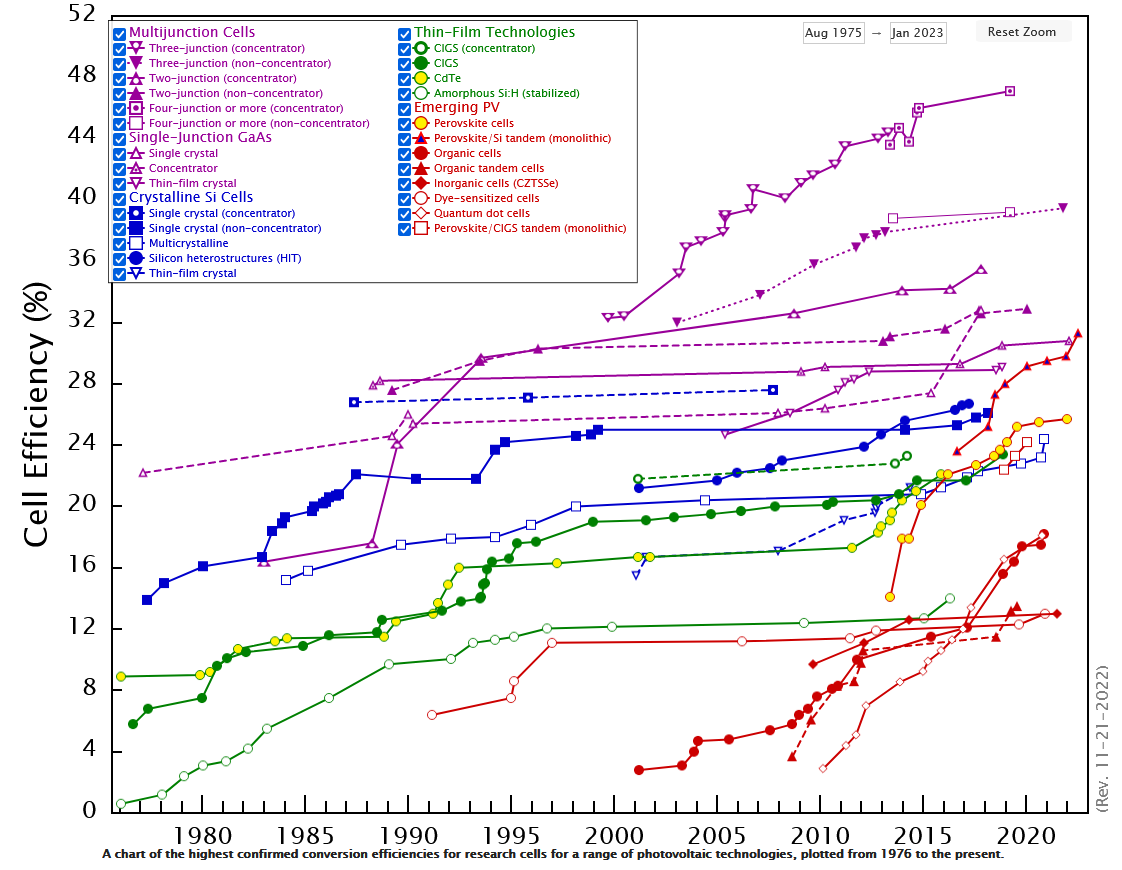
NREL has unveiled a new version of its Best Research-Cell Efficiency Chart. The tool highlights the highest confirmed conversion efficiencies of research cells for a range of PV technologies.
With the new interactive version, users can pull up decades of research data and compare custom charts that focus on specific technologies or time periods, NREL said in a statement. They can now find data on a cell’s current, voltage output, and fill factor, in addition to efficiency. The availability of those details will depend on the information in NREL’s records.
The highest research cell efficiency recorded in the chart is 47.1%, for a four-junction cell. Its interactive nature allows users to visualize the recent jump in conversion efficiencies for emerging technologies like perovskite solar cells. That contrasts with the steady improvement of silicon solar cell efficiency since the 1980s.
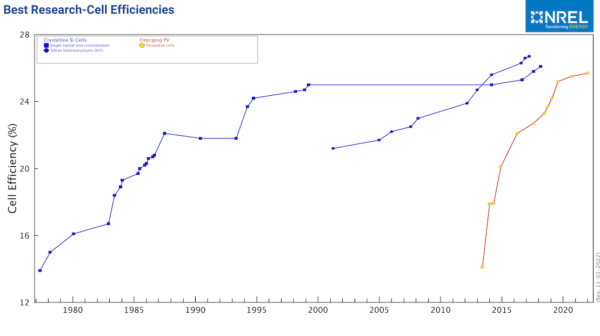
Image: NREL
“It’s possible that the NREL efficiency chart is the most presented graph that you can find at the annual PV Specialists Conference and similar conferences,” said Sarah Kurtz, senior research fellow at NREL. “But it has gotten so full that it’s difficult to see the data. With the new interactive chart, researchers will be able to still use the data, but present it in a way that communicates better for their talk.”
The cell efficiencies are measured by independent testing centers, including NREL, before earning a spot on the chart. All of the figures are also available as a downloadable file.
Join the pv magazine Webinar with NREL on Dec. 1: Understanding utility-scale solar and storage operations and maintenance cost drivers.
This content is protected by copyright and may not be reused. If you want to cooperate with us and would like to reuse some of our content, please contact: [email protected].

Please login to comment

[…] include bellow of Seventy 9.8%, which had been all certified by the US Department of Energy’s Nationwide Renewable Energy Laboratory […]
[…] from NREL and the University of Louisville have built an inverted perovskite picture voltaic cell with an […]
[…] team presented LCoE models developed by the US Department of Energy’s National Renewable Energy Laboratory (NREL) and the UK Department for Business, Energy and Industrial Strategy (BEIS), among others, to […]
[…] NREL scientists have developed a mesoscopic building energy model to compare next-generation building glazing technologies. They have found that PV glazing technologies can be easily integrated into existing double- or triple-glazed substandard windows to significantly reduce building energy use and carbon emissions. […]
[…] NREL scientists have developed a mesoscopic building energy model to compare next-generation building glazing technologies. They have found that PV glazing technologies can be easily integrated into existing double- or triple-glazed substandard windows to significantly reduce building energy use and carbon emissions. […]
[…] from pv magazine global […]
[…] from pv magazine global […]
[…] US Department of Energy’s National Renewable Energy Laboratory (NREL) has developed a proof of concept that helps cut the use of polymers by making direct […]