Incat powers up world’s largest battery-electric ship


Australia-headquartered shipbuilder Incat Tasmania has achieved a world first with the largest battery-electric ferry yet built, completing its first e-motor propulsion trial on the River Derwent.
The 130-meter vessel, identified as Hull 096, operated 100% on battery power on 14 December after Incat activated what is described as the largest battery-electric propulsion system yet installed on a ship.
The vessel’s energy storage system comprises more than 250 tonnes of batteries capable of delivering more than 40 MWh of installed capacity – four times larger than any previous maritime battery installation in the world.
Incat Chairman Robert Clifford said the powering up of Hull 096 represents a world first in battery-electric shipping.
“This is the first time a ship of this size, anywhere in the world, has been trialled under 100% battery-electric propulsion,” he said, adding that the milestone marks a breakthrough for the global maritime industry.
“This ship will stand as a flagship for what’s possible when industry, design, and clean-energy technology come together,” he said.
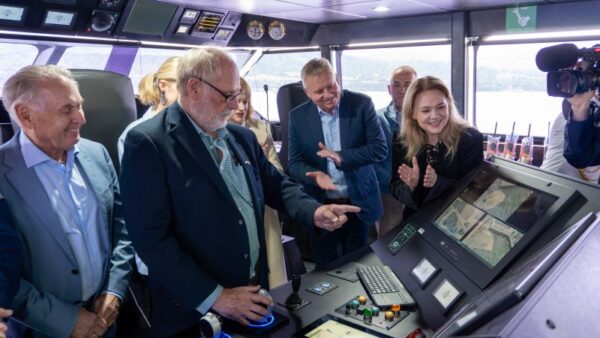
Hull 096, which has been constructed for South American ferry operator Buquebus, was officially launched in May at Incat’s shipyards and will now complete a series of trials before it departs for South America in the coming months.
When it enters service between Argentina and Uruguay, it will operate entirely on battery-electric power, carrying up to 2,100 passengers and 225 vehicles across the River Plate. The batteries on Hull 096 are expected to keep the vessel operating for 90 minutes and chargers will be installed at the ship’s berths in Argentina and Uruguay, with a full charge expected to take 40 minutes.
The Hull 096 milestone comes just days after Incat signed a contract to build a third 100% battery-electric high-speed ferry for Danish operator Molslinjen.
Incat penned a contract earlier this year to design and build two battery-electric ferries for Molslinjen and, earlier this month, announced it would build a third electric ferry for the company.
Each of the three 129-metre vessels will be 100% battery powered, featuring a 45 MWh battery system and carrying capacity for up to 1,483 passengers and 500 cars while operating at speeds of more than 40 knots.

Please login to comment
For reference, I think the P&O Pioneer is larger. About 230m long, and 40,000 tons.
They are plug in hybrids, and at the moment Rin on diesel due to lack of infrastructure at Dover and Calais. But they can run on pure battery