Medium-voltage series regulator enables 260% more PV capacity in German distribution grids

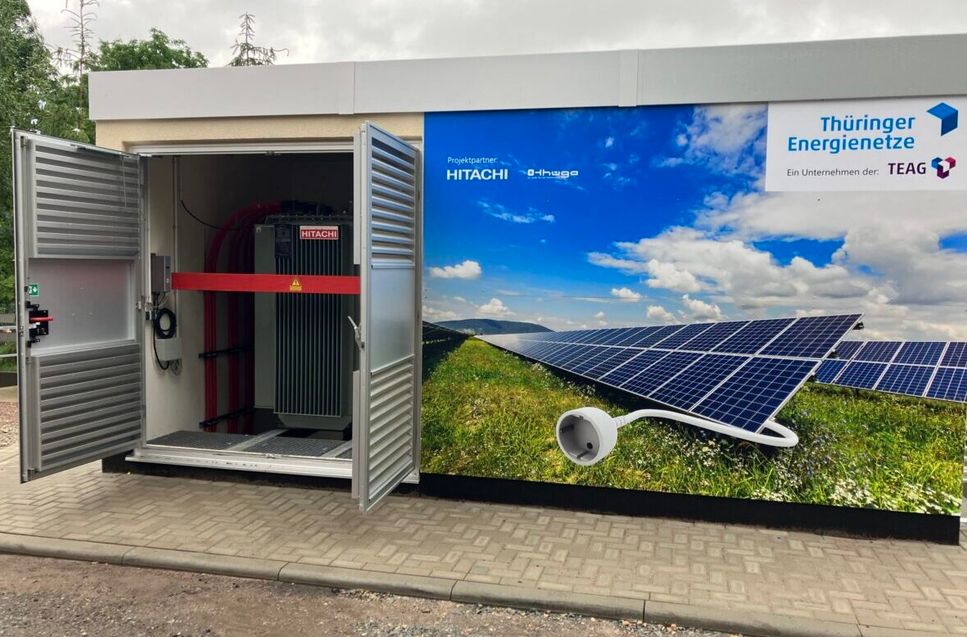
Should existing power lines be used more efficiently, or should the grid be expanded? This is a central question facing grid operators as deployment of photovoltaic systems, wind farms, and battery storage, with each technology requiring grid connection, continues to accelerate across Germany.
A pilot project in Thuringia aims to demonstrate how additional capacity can be integrated into the distribution grid without immediate expansion. To this end, a compact medium-voltage series regulator (MSLR), developed jointly by Thüga Aktiengesellschaft, TEN Thüringer Energienetze, and Hitachi Energy, has been installed in Hopfgarten, near Weimar.
According to Thüga, the system was commissioned on Wednesday. The compact medium-voltage series regulator actively controls grid voltage, thereby increasing the capacity of existing power lines. This allows TEN’s distribution network to accommodate significantly more electricity from photovoltaic systems. Model calculations indicate that integrating around 260% more PV capacity could be possible using this approach.
Serial production in Poland
The initiative originated from Thüga AG in Munich, which defined technical requirements based on findings from its subsidiaries. These companies have been experiencing structural bottlenecks in distribution grids, particularly in rural areas, due to the rapid expansion of rooftop solar installations.
In TEN’s service area, 17 medium-voltage sectors are currently “full,” meaning no additional solar feed-in can be accepted. The MSLR is intended to address this constraint. In the pilot region of Hopfgarten alone, it could enable the integration of around 2,750 additional balcony photovoltaic systems without requiring grid expansion.
Following the pilot launch, Thüga plans to make the technology available to distribution system operators across Germany and Europe. Orders can already be placed. Hitachi Energy will manufacture the devices in series at its transformer plant in Łódź, Poland, enabling scalable production.
The regulator is standardized according to Thüga specifications and is roughly comparable in size to a distribution transformer, allowing installation in existing transformer stations without additional construction work, according to the company.
Complementing grid technologies
Based on pre-series testing, Thüga describes the technology as robust and operationally simple, with handling comparable to conventional grid components. Unlike traditional grid expansion, the MSLR reportedly offers a faster and potentially more cost-effective way to increase capacity.
Thüga CEO Constantin Alsheimer stated that deploying such regulators could save individual grid operators hundreds of millions of euros in expansion costs by 2035, provided they are used where appropriate. He added that grid operators within the Thüga Group alone are planning multi-billion-euro investments in power infrastructure in the coming years.
Thüga positions the compact medium-voltage series regulator as a complement to existing solutions such as controllable distribution transformers, battery storage systems, and redispatch measures. The company emphasized that its strategic value lies in system interaction rather than standalone deployment: grid expansion, digitalization, and flexible grid technologies must work together to integrate rising volumes of renewable energy efficiently.
This content is protected by copyright and may not be reused. If you want to cooperate with us and would like to reuse some of our content, please contact: [email protected].

Please login to comment