Mounting system for photovoltaic installations on gabions

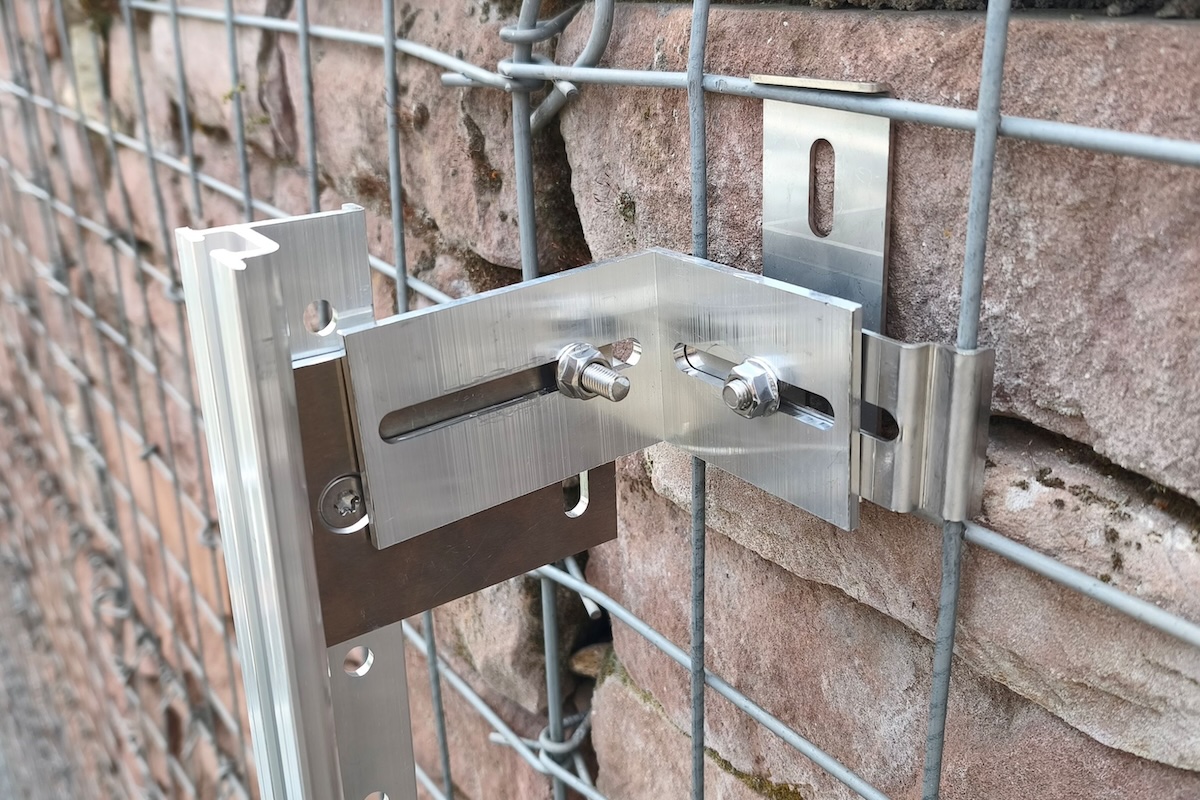
Wi Solar, a developer of commercial photovoltaic systems, and Karl Ditandy GmbH, a company specializing in natural stone, water engineering, and gabion construction, have partnered with mounting system manufacturer Diconal to develop a solution for installing solar modules on gabion structures.
Diconal presented the new system at this year’s Intersolar Europe trade show in Munich and sees potential applications, including solar installations on noise barriers. The first field test, however, was carried out on a smaller scale with a nine-module array installed at the former State Garden Show site in Bingen, Germany.
The main challenge was adapting a standard mounting system to the irregular geometry of stone-filled wire mesh gabions. Despite these constraints, the Bingen installation was completed successfully, according to Sven Endris, owner and managing director of Wi Solar.
“We are delighted that the practical field test was successfully completed. Our clamping design now allows photovoltaic modules to be mounted easily on gabions and installed in different sizes, making the clamps a scalable system solution,” Endris said.
According to the companies involved, Karl Ditandy was initially looking for a way to install PV modules on its gabion structures and approached Wi Solar for support. Based on the project requirements, Diconal – a sister company of Alutecta GmbH & Co. KG – developed a prototype that was subsequently tested and optimized in collaboration with the partners.
A key focus of the development process was ensuring dimensional accuracy between the substructure and the modules while keeping module spacing to a minimum. This required a mounting clamp that could be positioned flexibly, as gabion walls – especially taller structures – often have dimensional variations.
Unlike conventional mounting surfaces, gabion baskets cannot be aligned with millimeter-level precision. Their mesh grids may be slightly offset or vary in size, while protruding stones can block access to individual openings. The clamping system therefore needs to accommodate both vertical and horizontal deviations. This is achieved, among other features, through elongated holes aligned along both axes.
At the same time, the mounting solution must withstand potentially high wind-induced pressure and suction forces depending on the installation location. The design also needs to allow cable routing behind the modules and enable maintenance work with reasonable effort.
Wi Solar sees potential applications in any project where gabion walls are designed to accommodate PV modules, typically with a height of at least three meters. These include retaining walls, noise barriers, heavy-duty walls, slope stabilization structures, and privacy screens.
This content is protected by copyright and may not be reused. If you want to cooperate with us and would like to reuse some of our content, please contact: [email protected].

Please login to comment