Solar for Ukraine campaign continues to save lives

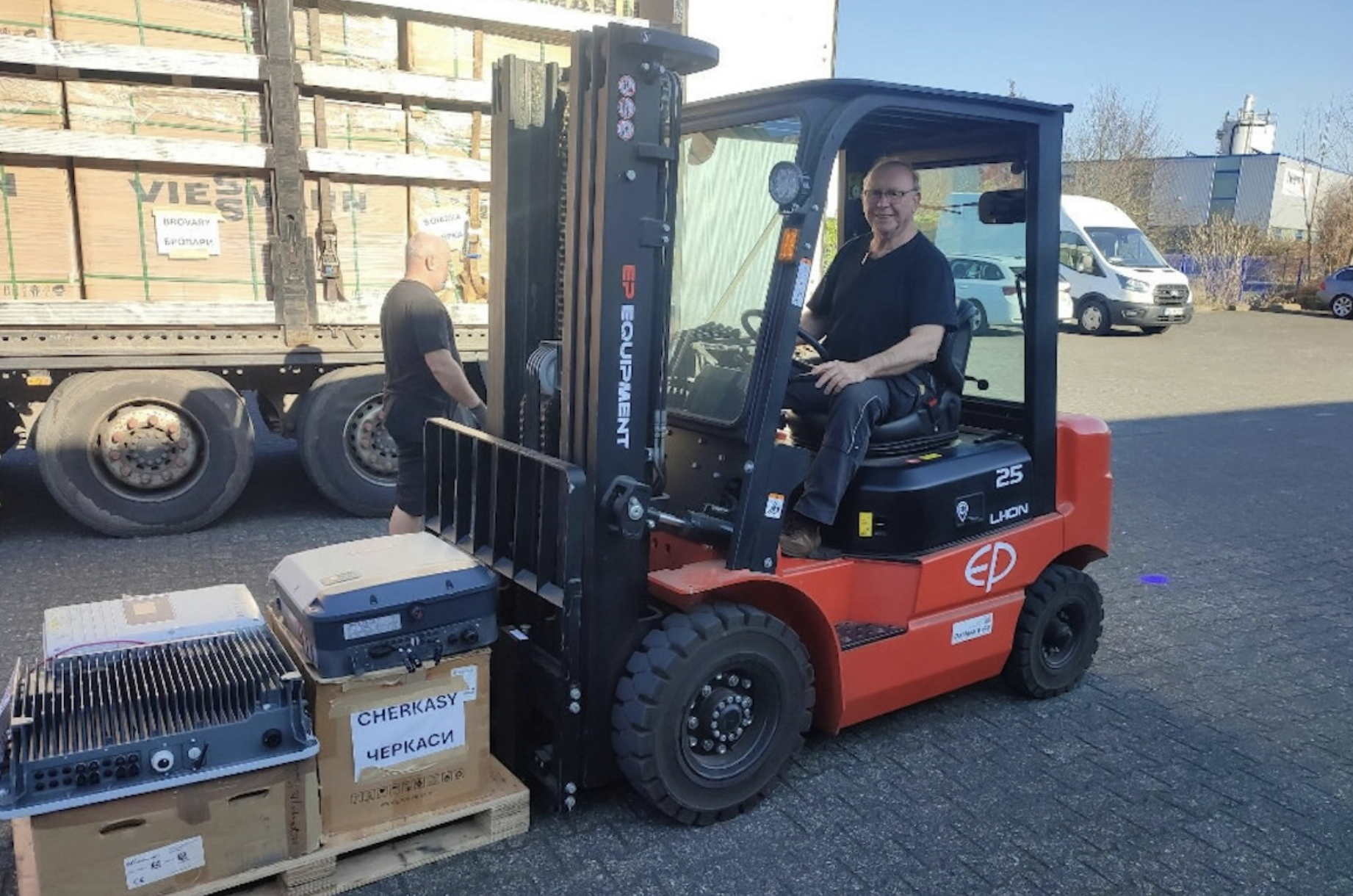
By the end of this year, the Solar for Ukraine campaign aims to help at least a dozen hospitals in Ukraine obtain photovoltaic systems capable of providing emergency power. “If donations allow, even more,” says the Biohaus Foundation, which has been organizing the campaign together with Greenpeace Germany and Greenpeace Ukraine since mid-2024.
It doesn’t take much imagination to grasp what’s at stake: power outages in a hospital that last hours rather than minutes, and strike almost daily rather than once every few years. Where emergency generators are overwhelmed or unavailable due to lack of fuel, it’s no exaggeration to say that a photovoltaic system on a hospital can save lives.
Yet despite, or perhaps because of, those high stakes, the campaign takes a surprisingly pragmatic approach, one shaped by the need to use available funds as effectively as possible.
“We no longer want to send used modules to Ukraine” is one statement that might seem puzzling at first. However, Willi Ernst, who co-founded the Biohaus Foundation with Dagmar Schmidt-Gold in 2009 and was previously among Germany’s solar pioneers with his company Biohaus PV, which he sold in 2006, can explain the logic behind it.
While no one wants to give the cold shoulder to people who would like to put such used modules to good use, Ernst explained that one of the biggest and, above all, costliest problems is transportation and old modules with their low efficiency ratings increase the cost per kilowatt.
The campaign has benefited from the fact that at the end of last year and the beginning of this year, many photovoltaic companies still had 400 W modules in stock, brand new but hard to sell. Quite a few of these are now in use in Ukraine.
Every bit of help is also a market entry
Ernst points to other pragmatic considerations shaping the campaign, such as the search for sponsor companies willing to help with training, system planning, or other support. These companies, he notes, are also likely to benefit themselves, since “every bit of help is, in a sense, a market entry.” He’s not alone in believing Ukraine will be an important long-term market: its solar sector was already gaining momentum before the Russian invasion in February 2022, and the war has only reinforced, for many Ukrainians, the value of decentralized power.
The emphasis on decentralization explains another pattern: the Solar for Ukraine campaign is often offered inverters, but has to turn down many of them, and in particularly grid-connected models.
“Because of the situation in Ukraine, we can hardly build grid-connected systems anymore,” Ernst says, pointing to the Russian military’s repeated attacks on the country’s infrastructure. That’s why the hospitals selected by Solar for Ukraine are equipped with systems capable of providing emergency power, with a typical set up consisting of 60 kW module capacity, a 40 kW hybrid inverter and a 72 kWh battery storage system.
A solar company for after the war, too
Every installed system has to be tailored as much as possible to the needs of its specific location. It also has to be installed and maintained.
These practical demands helped give rise to another initiative connected to the campaign: SolarWomen4Ukraine, which aims to build its own company. Around 30 women have already completed basic training with Greenpeace’s support. Here, too, the reasoning is pragmatic rather than symbolic: women aren’t the focus because the foundation wants to open up the solar installer profession to them specifically, but because so many men are away at war.
In any case, according to Ernst, the company should by no means be limited to the hospital projects, but should also “look for customers in the regular market.”
Companies willing to help, for example, by supporting the training of a female installer in Germany, are actively being sought after, as is anyone able to donate materials, including tools ranging from I-V curve tracers to screwdrivers. And underlying all of this, as always, is the need for money. Reaching the current goal of twelve hospitals equipped with solar power isn’t the end of the effort — it’s just the start, since, as Ernst puts it, there are “about 100 more now waiting.”
This content is protected by copyright and may not be reused. If you want to cooperate with us and would like to reuse some of our content, please contact: [email protected].

Please login to comment