PVcase adds key export option to its solar design software

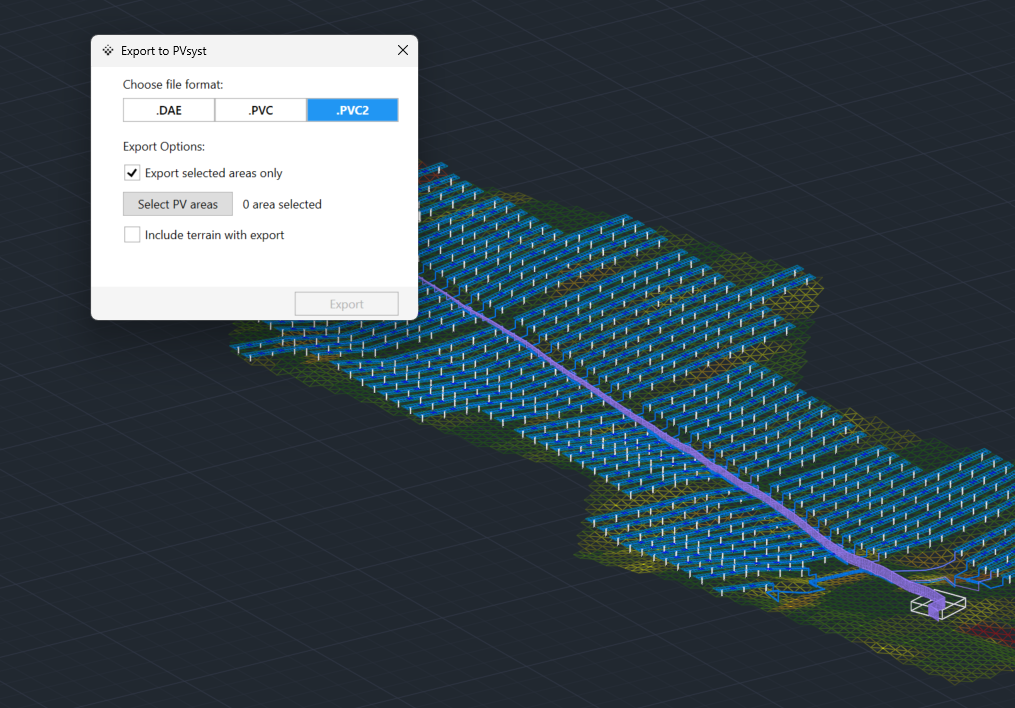
Lithuanian PV software provider PVcase has announced that its Ground Mount solar design software now allows users to export project files in PVC 2.0, an open, standardized file format designed to enable seamless sharing of project design data between solar software tools without manual reformatting.
The feature addresses a common challenge for solar engineers, who often transfer project data between multiple design and simulation tools, including PVsyst. Previously, this process could require manual file conversion or data re-entry, adding time and increasing the risk of errors. With PVC 2.0, engineers can transfer designs directly to compatible simulation tools without having to recreate or correct project data.
“The current PVcase Ground Mount implementation of PVC 2.0 focuses on geometry,” the company’s Global Communications Manager, José Herráez, told pv magazine. “It exports the 3D project layout, including tracker torque tube geometry, joint and motor gaps, the terrain mesh, and overhang geometry across frame types. The terrain is embedded directly in the .pvc2 file, which also helps avoid the alignment issues associated with separate terrain files. At this stage, the release is focused on geometry. Broader mechanical and electrical model data are planned for future development.”
The interoperabilty of the new feature with PVsyst was already assessed. “PVcase and PVsyst validated interoperability through direct testing during development,” Herráez went on to say. “PVcase tested its PVC 2.0 export against PVsyst’s implementation, with both teams exchanging feedback on issues identified on either side of the workflow. This included internal testing at PVcase as well as iterative testing with PVsyst, where each team could flag problems in the other implementation and work through them before release. The approach was therefore based on practical file-exchange testing and an ongoing development feedback loop between the two teams.”
PVcase explained that PVC 2.0 can reduce manual file preparation and discrepancies during software handovers while enabling more consistent design-to-simulation workflows, depending on the data supported by the exporting and importing applications. The accuracy and completeness of each transfer depend on the data implemented and supported by both applications.
“Reliable project decisions begin with reliable data,” PVcase CEO, David Trainavicius, said. “Open standards give our industry an opportunity to solve interoperability challenges collectively. By supporting PVC 2.0 in Ground Mount, PVcase is helping move that work from industry discussion into the everyday workflows of solar engineers.”
This content is protected by copyright and may not be reused. If you want to cooperate with us and would like to reuse some of our content, please contact: [email protected].

Please login to comment