China TOPCon cell prices jump on firmer upstream sentiment and rising export demand

Free-On-Board (FOB) China cell prices rose sharply this week, supported by firmer upstream pricing and stronger export buying.
According to the OPIS Global Solar Markets Report released on Aug. 18, FOB China TOPCon M10 cell prices rose 13.09% week on week to $0.0458/W, while FOB China TOPCon 210R cell prices increased 12.03% to $0.0447/W.
Upstream prices also strengthened as market sentiment improved following a series of policy and industry developments in China. On Aug. 7, eight major polysilicon producers, representing more than 90% of China’s effective capacity, pledged to stop selling below full cost and phase out inefficient capacity.
According to market participants, the pledge weakened expectations of further upstream price declines, providing additional support for cell producers to defend higher prices. The shift in upstream pricing expectations has also supported higher wafer prices, creating more direct cost pressure for cell manufacturers.
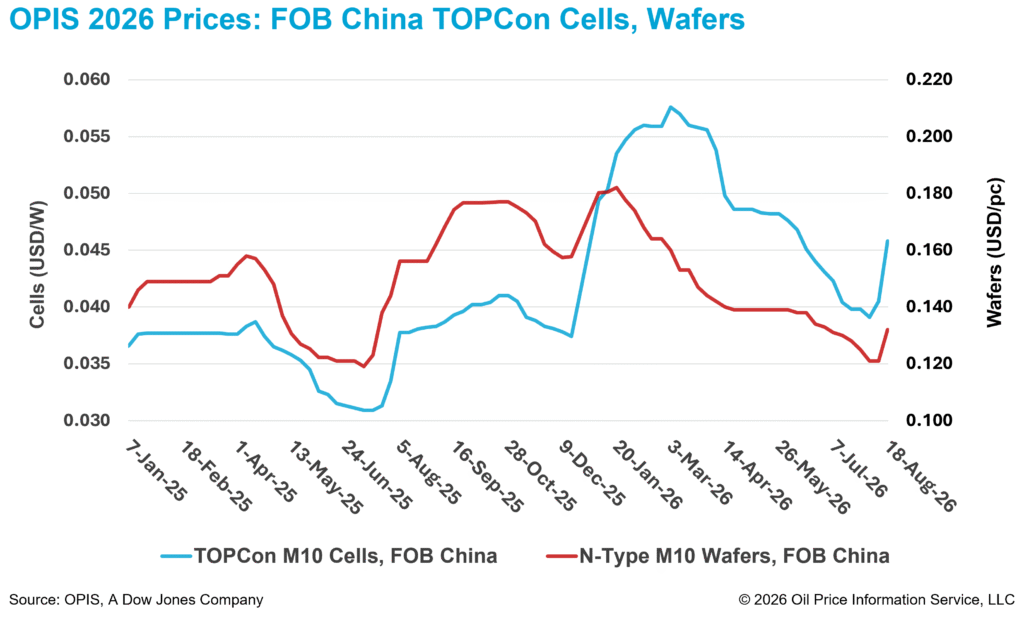
FOB China M10 and 210R wafer prices rose 9.09% and 11.19% week on week, respectively, to $0.132/piece (pc) and $0.149/pc, according to the same OPIS report.
China’s upcoming consumption tax on solar cells has added another potential source of support for domestic pricing and market sentiment. Under a July announcement jointly issued by the Ministry of Finance, the General Administration of Customs and the State Taxation Administration, China will impose a 2% tax on solar cells from April 2027, before raising the rate to 4% from April 2028.
A top-10 producer source said the policy could support domestic cell prices in the run-up to implementation by encouraging buyers to bring purchases forward ahead of the April 2027 deadline.
Export buying also strengthened, particularly from India, amid a policy-driven procurement rush. The Approved List of Models and Manufacturers (ALMM) List-II requirement for solar cells took effect on June 1, 2026, requiring covered projects to use modules made with cells from enlisted domestic manufacturers.
However, the government subsequently extended an exemption for qualifying net-metering and open-access projects, allowing projects commissioned by Dec. 31, 2026, to continue using India-assembled modules made with imported cells.
An Indian module supplier said it expects the current surge in orders to continue over the next couple of months as developers accelerate procurement ahead of the year-end deadline.
Further downstream, module market participants remain largely in a wait-and-see stance, assessing whether recent regulatory measures will meaningfully lift upstream polysilicon and cell prices and, in turn, translate into higher module costs.
One top-tier manufacturer said domestic module prices had recently moved in tandem with fluctuations in cell prices, while export module prices remained comparatively stable. The manufacturer added that as long as capacity remains oversupplied, the scope for module price increases is limited, meaning any broader market recovery is likely to be gradual.
Another industry source was more skeptical of the polysilicon pledge, noting that an earlier industry-led effort to acquire and retire obsolete polysilicon capacity had failed to materially rebalance the market. While recent regulatory measures may help establish a firmer cost floor, persistent overcapacity and weak end-user demand continue to constrain producers’ pricing power, particularly in export markets, according to market participants.
OPIS, a Dow Jones company, provides energy prices, news, data, and analysis on gasoline, diesel, jet fuel, LPG/NGL, coal, metals, and chemicals, as well as renewable fuels and environmental commodities. It acquired pricing data assets from Singapore Solar Exchange in 2022 and now publishes the OPIS APAC Solar Weekly Report.
The views and opinions expressed in this article are the author’s own, and do not necessarily reflect those held by pv magazine.
This content is protected by copyright and may not be reused. If you want to cooperate with us and would like to reuse some of our content, please contact: [email protected].
Please login to comment