China TOPCon solar module prices rise on upstream cost pressure as deals lag offers

Free-On-Board (FOB) China TOPCon mainstream PV module prices rose this week, as firmer upstream prices increased production costs and prompted module manufacturers to raise their offer indications.
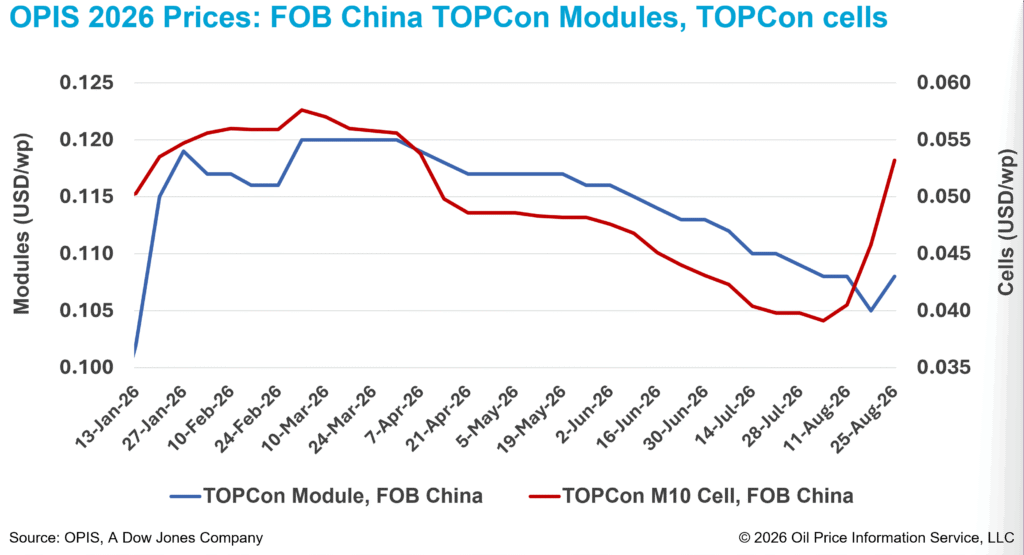
According to the OPIS Global Solar Markets Report released on Aug. 25, the Chinese Module Marker (CMM), the OPIS benchmark assessment for TOPCon modules below 645W from China, rose 2.86% week on week to $0.108/W FOB China.
The OPIS FOB China TOPCon module forward curve showed sharper price increases for earlier loading periods. Prices for Q1 2027 and Q2 2027 loading rose 1.90% and 0.95% week on week to $0.107/W and $0.106/W, respectively. Meanwhile, Q3 2027 loading prices were adjusted 0.95% lower to $0.105/W.
One module buyer attributed the recent price increases largely to the U.S. Section 232 tariffs, which have lifted prices across the supply chain. Set to take effect on Dec. 4, the measures will establish minimum import prices of $100/kg for ingots and wafers, $0.22/W for cells and $0.38/W for modules, alongside a 15% tariff on covered polysilicon derivatives.
However, the source said module pricing for overseas utility-scale projects remains largely flat, including for 2027 delivery, with the recent increases lacking long-term fundamental support and driven more by short-term market sentiment and tariff expectations.
A top-10 module manufacturer told OPIS that despite higher guidance and offer prices from major producers, transacted prices for mainstream modules have yet to follow. Some producers have raised offers for overseas projects, but negotiated deal levels continue to fall short of those indications.
The producer added that there is industry consensus that module prices cannot be sustained at recent highs, with asking prices elevated but actual deals concluding lower due to weak demand and buyers’ understanding of the underlying cost drivers.
Another tier-1 module producer said the recent firmness in upstream prices was linked to short-term U.S.-related demand. Higher input prices have pushed module production costs higher, prompting the manufacturer to pause cell purchases while monitoring market developments.
FOB China TOPCon M10 cell prices rose 16.16% week on week to $0.0532/W, while 210R cell prices increased 17.00% to $0.0523/W, according to the same report. Prices for both cell formats have risen about 34% since Aug. 4.
While persistently elevated cell prices could provide some near-term support for module prices, the producer said upstream prices appeared to be nearing their peaks, limiting the scope for further significant increases.
Another downstream producer echoed a similar view, noting that the upstream price movements of recent weeks have been significant but are likely to be short-lived. The company has temporarily suspended offers for medium-to-long-term orders due to the heightened cost uncertainty.
According to a market analyst, the outlook will also hinge on whether Chinese module manufacturers absorb the higher costs or pass them on to buyers. With module prices remaining broadly flat, manufacturers may be forced to continue selling below production costs, while passing higher costs through to end-users could undermine project economics for solar developers, adding further pressure to already weak demand.
OPIS, a Dow Jones company, provides energy prices, news, data, and analysis on gasoline, diesel, jet fuel, LPG/NGL, coal, metals, and chemicals, as well as renewable fuels and environmental commodities. It acquired pricing data assets from Singapore Solar Exchange in 2022 and now publishes the OPIS APAC Solar Weekly Report.
The views and opinions expressed in this article are the author’s own, and do not necessarily reflect those held by pv magazine.
This content is protected by copyright and may not be reused. If you want to cooperate with us and would like to reuse some of our content, please contact: [email protected].
Please login to comment