Multi-source heat pump test bench explores coupling with solar, thermal storage

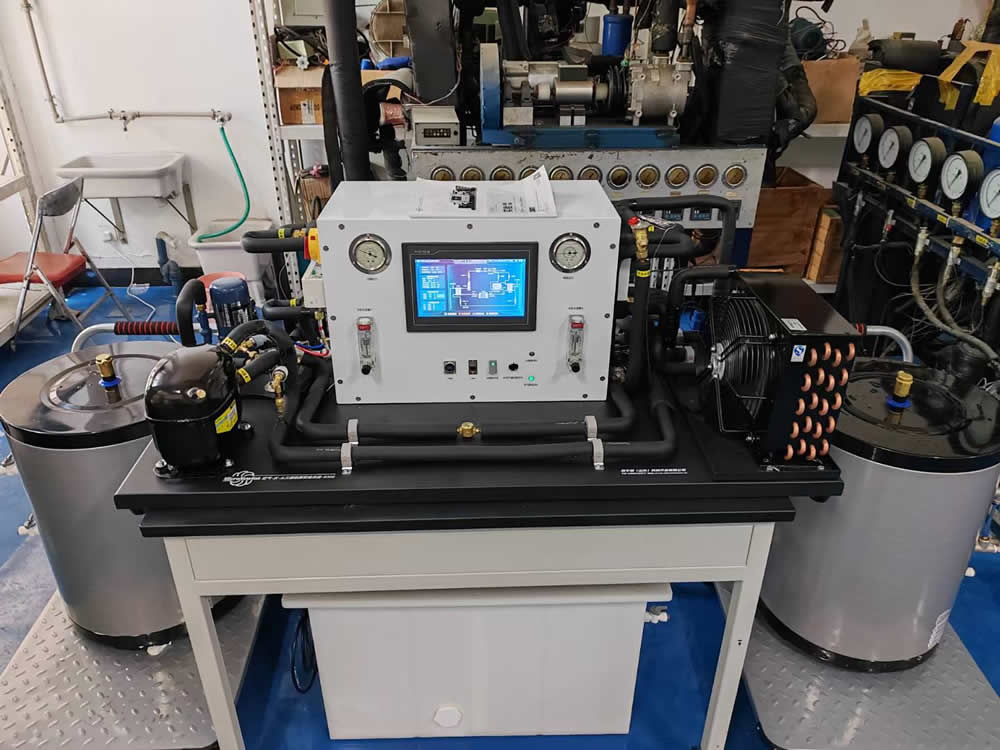
Chinese educational and research laboratory equipment manufacturer Micronewton Technology Development has delivered a multi-source energy laboratory system to an undisclosed research institution in China. The system is designed for university-level teaching and research into heat pumps, solar energy and thermal storage.
At the center of the installation is the company’s R306 Water-to-Air Heat Exchangers Apparatus, an experimental heat pump platform that allows users to switch between air-source, water-source and simulated ground-source operating conditions on a single test bench.
The system operates on a vapor-compression refrigeration cycle and uses 1,1,1,2-tetrafluoroethane (R134a) as the refrigerant. Its compressor has a rated power of 276 W, while the system has a stated cooling capacity of 304.8 W.
The test bench incorporates a fin-and-tube evaporator for air-source operation, a plate heat exchanger for water-source operation and a soil-source simulation unit with adjustable electric heating.
The water-source simulator features an adjustable heater rated from 0 W to 2,000 W, while the soil-source simulator has an adjustable capacity of up to 1,200 W. These components allow researchers to vary source-side temperatures and evaluate their effects on heat pump performance.
The platform measures refrigerant pressure, temperature and flow, as well as water temperature, water flow and compressor electricity consumption. According to the manufacturer, the measurements can be used to determine the heating coefficient of performance (COP), analyze compression ratios and compare heat pump performance at different evaporation and condensation temperatures.
The R306 system has a condensing heat-transfer area of 0.47 m². The source-side heat-transfer areas are 4.5 m² for air, 0.47 m² for water and 1.8 m² for the simulated ground source. The maximum stated outlet water temperature is 75 C.
The equipment is intended primarily for university teaching and energy research rather than commercial building heating. The broader laboratory installation, however, extends beyond the heat-pump test bench. MicroNewton said it combines solar panels, phase-change thermal storage, insulated hot-water storage, additional heat exchangers, circulation pumps and a centralized data-acquisition and control system.
The configuration allows researchers to investigate interactions between solar generation, heat pumps, thermal storage and energy demand. Experiments can include solar-assisted heat pump heating and the coordinated operation of heat pumps and thermal storage.
This content is protected by copyright and may not be reused. If you want to cooperate with us and would like to reuse some of our content, please contact: [email protected].

Please login to comment