U.S. sees 14% increase in contested renewable projects

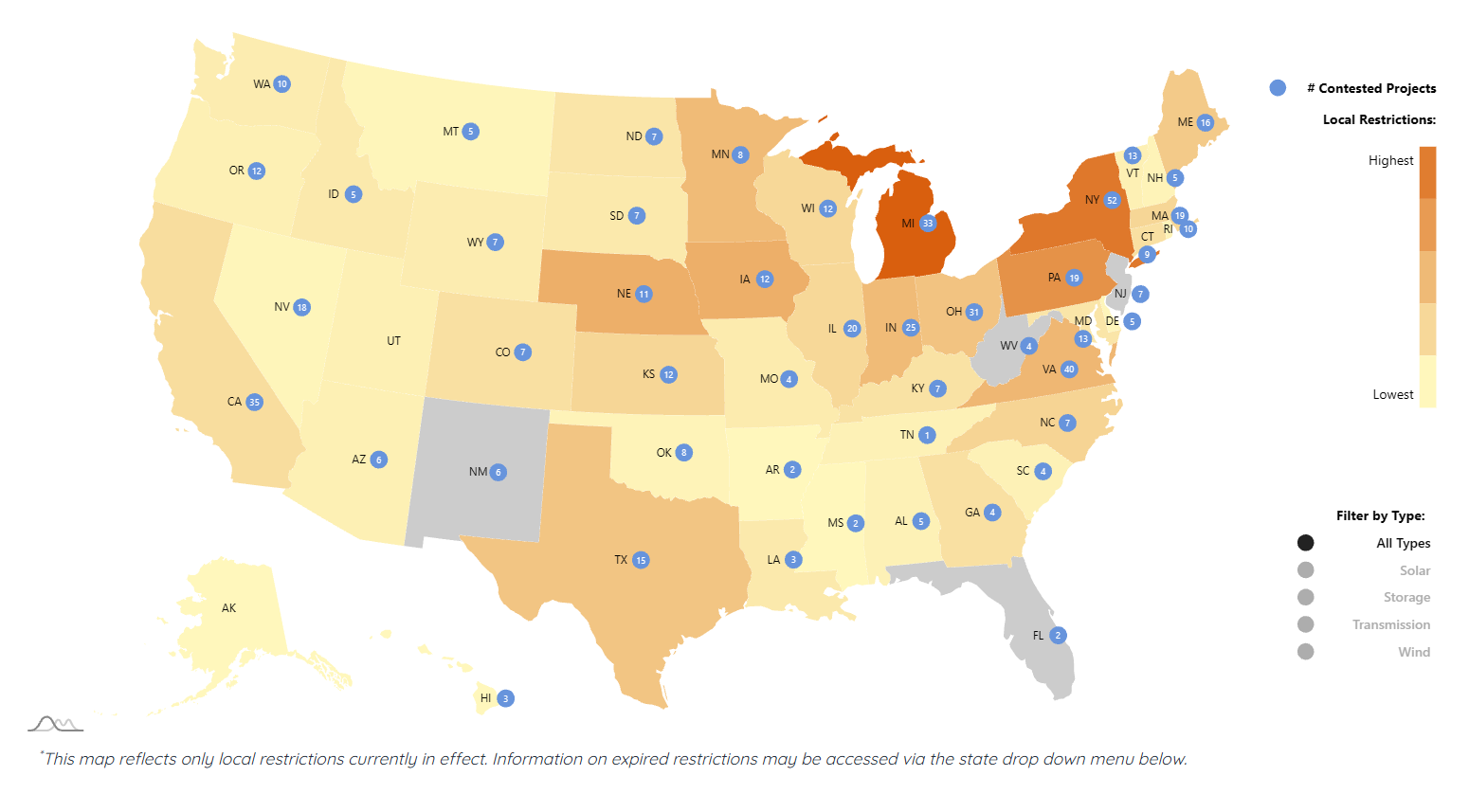
At least 70 state-and local restrictions on renewable energy projects were added in 2025, according to the September 2026 edition of the Opposition to Renewable Energy Facilities in the United States report, released each year by researchers at Columbia Law School’s Sabin Center for Climate Change Law.
In total, the report now tracks 865 local restrictions on renewable development, alongside 23 state-level actions across 19 states. While the number of restrictions has reached a new high, the rate at which new restrictions are being adopted has slowed down, dropping from 165 new restrictions in 2023 to 112 in 2024 and 70 in 2025.

In addition, the researchers tracked 567 contested projects, stretching back as far as 2004. Of those projects that encountered organized opposition, 322 had a solar component, compared to 217 with a wind component, 41 with a battery storage component, and 17 with a transmission component.
Digging into the report data reveals 22 canceled projects in 2025, totaling nearly 9.8 GW in capacity. The largest of these projects was the 6.2 GW Esmeralda 7 Solar Project in Nevada, which was canceled by the Bureau of Land Management in October 2025.
New York and Virginia lead the nation in contested projects, with 52 and 40, respectively. California, Michigan and Ohio round out the top 5, with more than 30 contested projects each. Only two states (New Mexico and New Jersey) had no identified state or local restrictions, though both had contested projects.
Of the 567 total contested projects since 2004, at least 227 (approximately 40%) have been canceled. The canceled capacity of 9.8 GW in 2025 is by far the largest capacity canceled in a single year, with the previous high being 3.26 GW in 2024. While local opposition was a major factor, the report notes that cancellations may also be influenced by other project-related issues.
The Sabin Center for Climate Change Law’s annual report is part of its Renewable Energy Legal Defense Initiative (RELDI). Launched in 2019, RELDI conducts independent research on issues related to siting renewable energy infrastructure and facilitates. It also provides pro bono legal representation to community groups and local residents who support renewable energy projects in their communities that are facing opposition.
Key state-level laws
The report mentions several important state-level laws that have functioned to either increase or decrease restrictions on siting of renewable projects.
Among the laws that have increased restrictions are Ohio’s House Bill 483 of 2014, which sets a strict minimum buffer of 1,125 feet between wind turbine tips and the nearest adjacent property lines and Senate Bill 52 of 2021, which authorizes counties to veto specific utility-scale projects and designate “restricted areas” where wind projects of 5 megawatts (MW) or larger and solar projects of 50 MW or larger are prohibited. The report says the latter law has resulted in 30 of Ohio’s 88 counties enacting bans on development.
In addition, state-level laws like the Arkansas Wind Energy Development Act of 2025, Louisiana House Bill 459 of 2025 and Maryland Renewable Energy Certainty Act added new restrictions on project siting in 2025.
Notable state laws that give state bodies the authority to override local restrictions include Delaware Senate Bill 159 of 2025, Michigan Public Act 233 of 2023 and the Minnesota Energy Infrastructure Permitting Act of 2024.
In addressing the report’s findings in a post on LinkedIn, former SEIA president Abby Hopper urged developers to build strong community engagement strategies and work to build “impactful community benefit agreements that reflect the needs” of the communities in which projects are slated to be built. She also called for political action, writing:
[O]ur industry must grow our political power. We need to show up, in our political engagement and our political giving, in local and state elections. Our businesses are on the line and we can not win these battles unless we behave as a mature industry. Every single one of those 888 laws was passed by elected officials who will be up for re-election.
This content is protected by copyright and may not be reused. If you want to cooperate with us and would like to reuse some of our content, please contact: [email protected].

Please login to comment