How grid-forming and AI technologies are helping overcome barriers to renewable growth

At the 2026 Global Low-Carbon Industry Forum (GLIF2026), co-hosted by the Global Solar Council, China Energy Research Society, World Alliance for Low Carbon Cities, Tsinghua Shenzhen International Graduate School, and Huawei Digital Power, industry leaders explored how the integration of grid-forming and AI technologies can help overcome barriers to large-scale renewable deployment.
Improving grid resilience
As the global energy transition accelerates, the increasing share of renewable generation places grid stability under significant pressure. Huawei’s grid-forming technology is enabling energy storage systems to provide inertia response and transient support for strained grids. Field data show that, in an extremely weak grid environment with a short-circuit ratio (SCR) below 1.5, Huawei’s Grid-Forming ESS can limit the rate of change of frequency (RoCoF) to within 0.5 Hz/s and shorten post-fault voltage recovery to the hundred-millisecond range, outperforming conventional synchronous condensers.
Grid-forming capabilities extend from energy storage to photovoltaic generation and loads. Huawei’s Grid-Forming ESS provides short-circuit capacity support, inertia response, wideband oscillation damping, primary frequency regulation, black start, and seamless on/off-grid switching.
Huawei’s smart string grid-forming ESS solutions have been deployed in nearly 100 benchmark projects across China, Asia Pacific, Europe, the Middle East, and other regions. For example, in China’s Ngari Prefecture, Huawei’s Gertse project – which combined a 30 MW PV with the manufacturer’s 6 MW/24 MWh grid-forming ESS – stabilized the regional grid and enhanced system damping, suppressed wideband oscillations, improved stability, and increased power generation efficiency.
Boosting project economics
By introducing long-range weather forecasting and machine learning algorithms, Huawei’s energy management system (EMS) can forecast PV output and load curves, enabling its ESS to support the grid while dynamically implementing strategies like peak shaving, valley filling, and scheduled curve tracking. High-precision state-of-charge (SOC) management, high round-trip efficiency (RTE), and high availability can improve project lifecycle returns by more than 10%.
At AHS business park in Germany, Huawei’s one-fits-all solution – which integrates PV, BESS, EV chargers, and AI scheduling – enabled a 10% increase in revenue after just two years of operation. In Spain, use of Huawei’s one-fits-all solution reduced the electricity bill of a Carrefour supermarket by almost 40%, resulting in a payback period of only five years.
Expanding access to energy
In remote regions where the grid is weak or unavailable, Huawei’s strategy is to deliver a stable, plug-and-play power supply to users. The manufacturer’s microgrid solution combines all core components – including inverters, the battery management system (BMS), and the EMS – which are commissioned and tested before shipment, leaving only basic civil works and electrical connections on site.
A cloud-edge platform enables remote checking and maintenance, with more than 90% of common faults addressed through remote diagnosis and firmware upgrades. The solution has been deployed in Africa, Southeast Asia, and remote areas of western China. Compared with diesel generators, it reduces LCOE by 40%-60% and enables zero-carbon power generation.
As grid-forming technologies, including Huawei’s smart string grid-forming ESS solutions, support grids to overcome barriers to large-scale renewable deployment, they are proving their value in providing stable energy for scenarios from basic household electricity to healthcare, education, and small commercial and industrial activities.
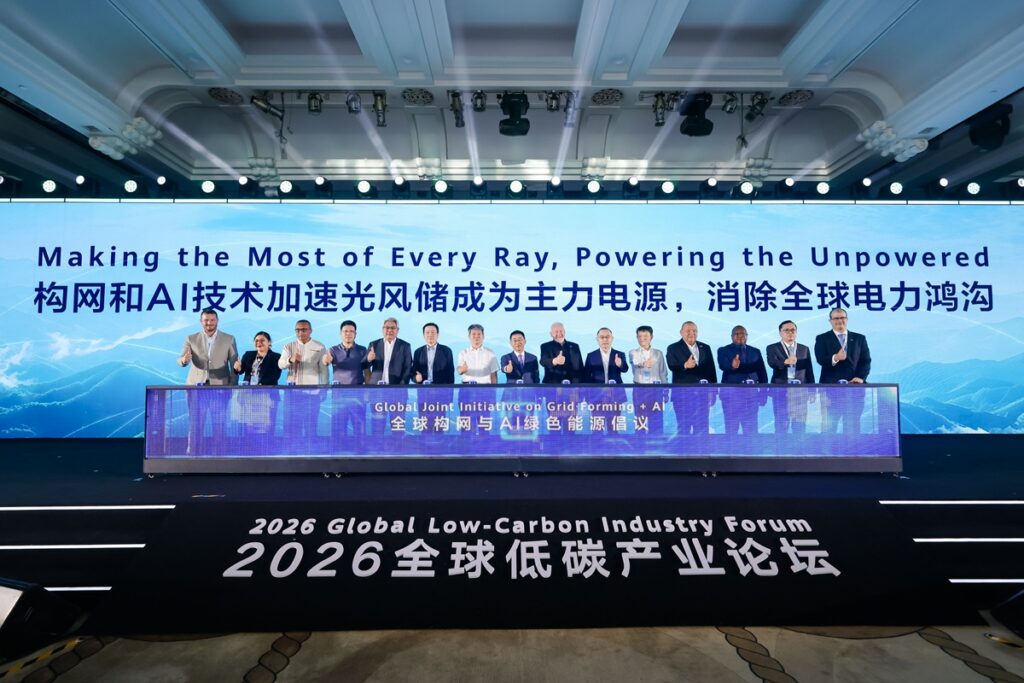
This direction was reinforced at the 2026 Global Low-Carbon Industry Forum, where industry organizations and technology leaders jointly launched the Global Joint Initiative on Grid Forming & AI. The initiative aims to accelerate collaboration on standards, validation, and deployment, reflecting growing industry recognition that the integration of grid-forming and AI will be critical to enabling solar, wind, and storage to evolve into stable, reliable, and dispatchable primary power sources.
This content is protected by copyright and may not be reused. If you want to cooperate with us and would like to reuse some of our content, please contact: [email protected].

Please login to comment