India adds 50.6 GW of solar module and 9.7 GW of cell manufacturing capacity in 1H


India added 50.6 GW of solar module and 9.7 GW of cell manufacturing capacity in the first half (1H) of 2026, taking its cumulative solar module manufacturing capacity to 261.7 GW and cell manufacturing capacity to 36.6 GW as of June 2026, according to Mercom India’s recently released report, State of Solar PV Manufacturing in India 1H 2026.
As of the report’s release, cumulative module capacity under the Approved List of Models and Manufacturers (ALMM) List-I stood at 225.5 GW, against nearly 35.5 GW of cumulative cell capacity under ALMM List-II.
“Domestic cell shortages have become the biggest near-term challenge for India’s solar market. Module capacity has expanded rapidly, but cell supply has not kept pace, tightening availability and pushing up prices for compliant modules and sharply slowing project activity. Many module manufacturers are struggling to maintain production because of limited domestic cell availability,” said Raj Prabhu, CEO at Mercom Capital Group.
Prabhu said that the installed cell capacity overstates actual availability, as new lines take months to reach stable commercial production. ALMM List-II has intensified the pressure by increasing dependence on domestic cell supply before enough capacity was commercially available.
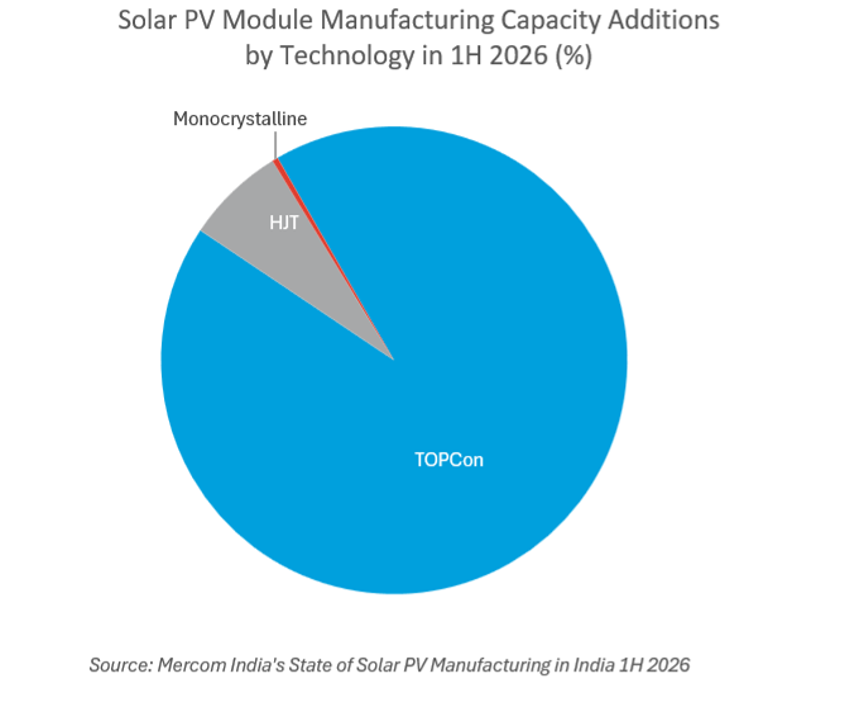
TOPCon accounted for 80% of the total ALMM-listed module manufacturing capacity as of June 2026, followed by monocrystalline PERC/TOPCon at 11% and mono PERC at 4%. HJT accounted for 3%, while thin-film technology represented 2% of the total ALMM-listed capacity.
“Until commercially available cell supply catches up with demand, the entire industry will remain under pressure, with manufacturers facing production constraints and developers facing commissioning delays,” added Prabhu.
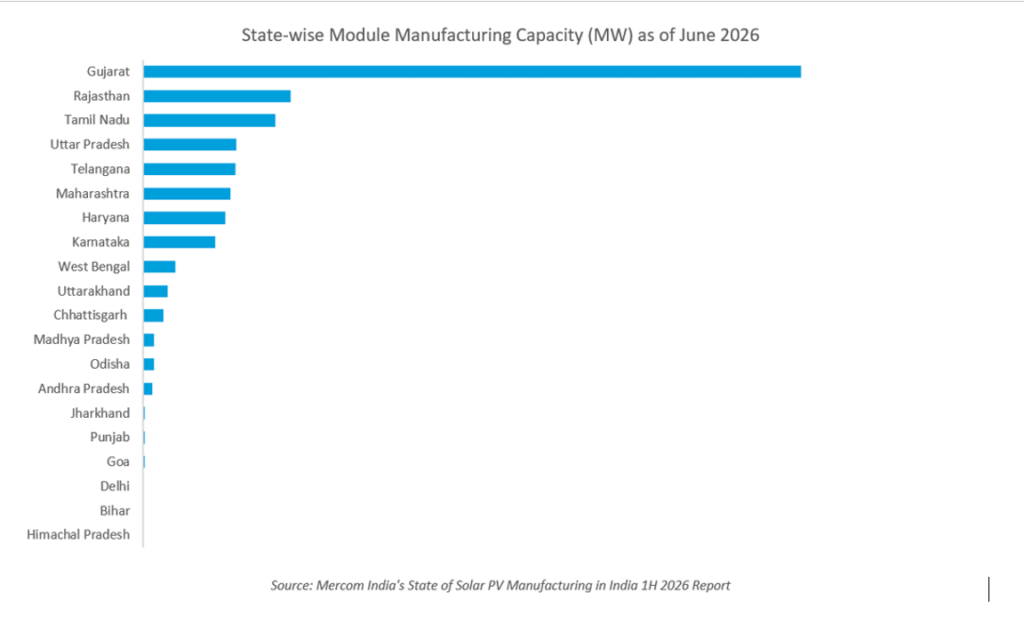
Gujarat remained the most favorable destination for solar module manufacturing, accounting for nearly 45% of the cumulative capacity as of June 2026. Rajasthan and Tamil Nadu followed with module production capacities of 26.1 GW and 23.4 GW.
Gujarat also held the largest annual solar cell production capacity at 37%. Tamil Nadu and Telangana were other top states, with capacities of 4.3 GW and 4.2 GW, respectively.
In 1H 2026, India’s imports of solar cells and modules increased 18% compared to 1H 2025. Cells accounted for 81% of total imports, while modules accounted for 19%.
The U.S. remained India’s largest solar export destination in 1H 2026, accounting for 92% of total exports.
This content is protected by copyright and may not be reused. If you want to cooperate with us and would like to reuse some of our content, please contact: [email protected].

Please login to comment