New 85 W solar shingle adds low-profile power to roofs

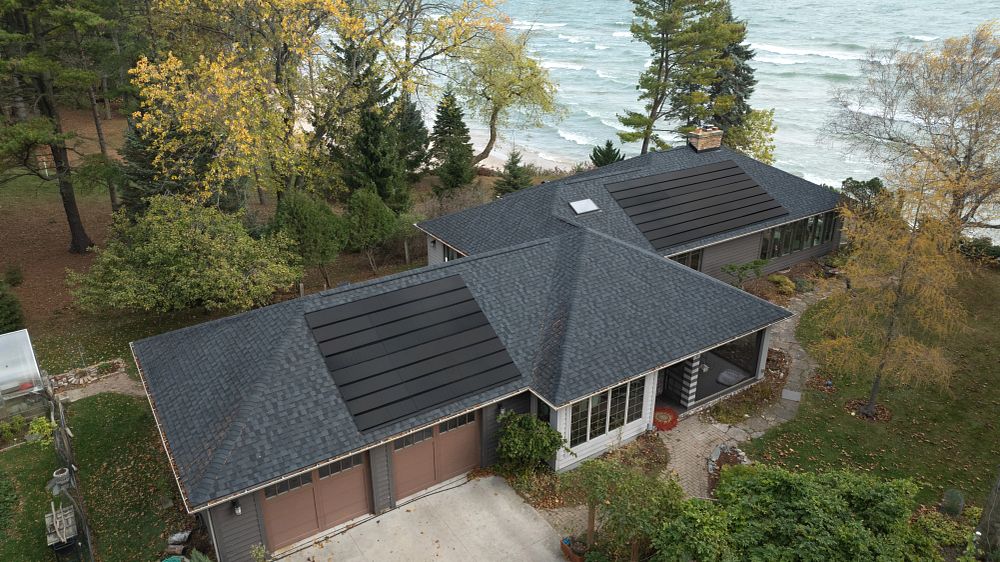
Building products manufacturer CertainTeed has launched Landmark PWR, a direct-to-deck building-integrated photovoltaic (BIPV) roofing system designed to replace conventional rack-mounted solar arrays.
Designed to blend with traditional asphalt shingles, the system combines solar shingles with a specialized fire-barrier underlayment to provide Class A fire protection and wind resistance.

The system is based on an 85 W frameless laminate shingle featuring 24 series-connected M10R half-cut monocrystalline cells. The cells have an efficiency of 21.1%.
Each solar shingle incorporates two bypass diodes to reduce losses from localized shading. The system has a maximum voltage of 600 V and a maximum series fuse rating of 15 A.
The shingle measures 121.1 cm by 45.0 cm, with an exposed active area of 121.2 cm by 41.0 cm, or approximately 0.50 m². Each unit weighs 24 pounds and has a power density of approximately 171 W/m².
The laminate face is 0.69 cm thick, while the rear junction box increases the maximum thickness to 5.66 cm. Electrical connections use 12 AWG PV wire and Stäubli MC4 connectors. Lead wires measure 88.9 cm from the junction box to the connector ends. The shingles require a minimum roof pitch of 4:12.
CertainTeed pairs Landmark PWR with its Protect FR underlayment for fire and weather protection. The self-adhering, fiberglass-reinforced underlayment complies with ASTM D1970 requirements for ice and water protection and serves as a fire barrier, enabling UL 790/ASTM E108 Class A ratings on combustible roof decks.
Protect FR is rated for application temperatures from -40 F to 265 F and features a double-sided split release liner. It can withstand up to 180 days of UV exposure.
The underlayment is supplied in 60-pound rolls measuring 90.2 cm by 22.6 m. Each roll provides approximately 18.6 m² of net coverage when installed with the required 7.6 cm side laps and 15.2 cm end laps.
The system is designed to allow individual shingles to be removed and replaced without disturbing adjacent roofing materials or affecting warranties on the surrounding roof.
According to CertainTeed, the system has been tested to design loads of +2,400/-1,600 Pa. It has FM 4473 Class 3 hail impact resistance and ASTM D3161 Class F wind resistance for wind speeds of up to 110 mph.
The product is pending listing by the California Energy Commission, Florida Building Code High Velocity Hurricane Zone approval for peak wind speeds of up to 194 mph, and UL 3741 certification for photovoltaic hazard control.
Landmark PWR is compatible with third-party module-level power electronics, including power optimizers and microinverters, as well as adjacent roofing materials up to 2.54 cm thick.
CertainTeed provides a 25-year limited power warranty, guaranteeing 98% of nominal output in the first year and annual degradation of no more than 0.55% through year 25. The system also carries a 25-year limited workmanship warranty and a 10-year limited wind warranty covering wind speeds of up to 110 mph.
Landmark PWR will be available from Nov. 1, 2026.
The product datasheet is available here.
This content is protected by copyright and may not be reused. If you want to cooperate with us and would like to reuse some of our content, please contact: [email protected].

Please login to comment
Up until now. Tesla had the Premium Luxury Solar Roof, but Tesla just announced they would no longer be manufacturing and installing Solar Roofs because of the higher than average installation costs for their package. I owned one and it was a great product but the only reason I got one, was that I needed a New Roof anyway and the price they offered was “Below Their Cost” as a “Beta Tester”. The biggest problem on a mixed materials system is the integration of two materials into one roof. Tesla had a mix of Active Tempered Glass tiles, non-active Tempered Glass tiles and black enameled steal tiles. The underlayment made the system work so I believe in the case of this new system being offered, the underlayment for the whole roof would need to be made of the same 50-year life and over it, the other roofing materials could be layered. This could include Asphalt, slate, metal or flat terracotta tiles.
The fragility to snow, hail or wind needs to be addresses if replacements are needed. My Tesla Solar Glass Roof, after a garage fire, was to be replaced with all new tiles and metal instead of glass dummy tiles and was unfixable and had to be totally replaced since there was no fixing the two-year-old system when the product change occurred. When the shape or output of the tiles change, there is little chance of integrating repairs unlike solar panels that can just be replaced on the installed tracks. Now Tesla has no replacement tiles at all so anyone with the Tesla Solar Roof could have a roof with no electrical output when it becomes damaged or unworkable. I eventually had to go back to solar panels over an asphalt roof because the General Contractor would not work with Tesla and Tesla returned my deposit. I miss the Tesla Solar Roof concept, but for me, my contractor and now even Tesla, solar roofs are just to0 hard to build and maintain.