The case for vertical BIPV
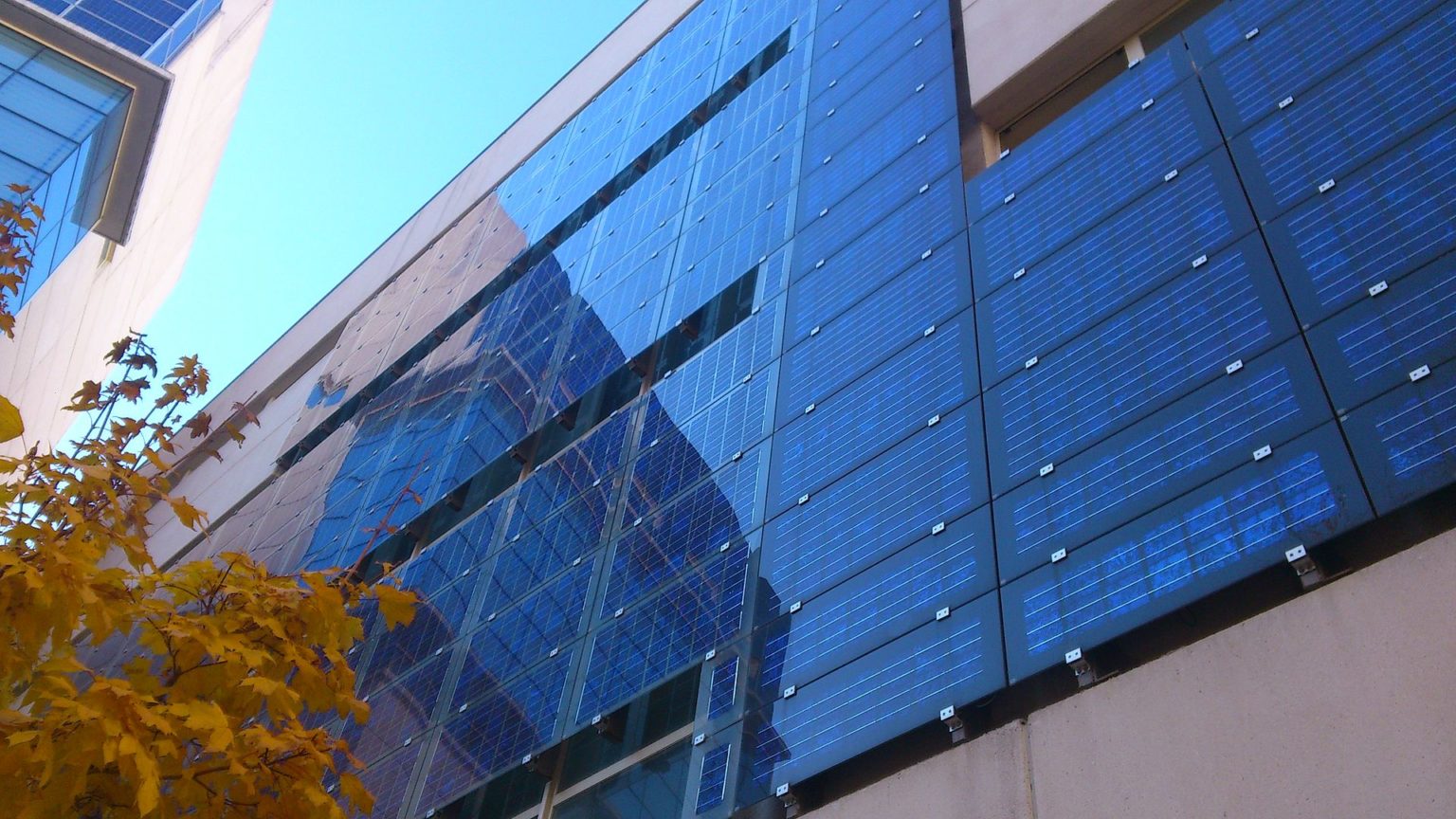
A new study from IEA PVPS Task 15, published in Energy & Buildings, sets out to correct a persistent bias in how the industry thinks about building-integrated photovoltaics: that rooftop-style, optimally tilted arrays are the benchmark against which every other BIPV configuration should be judged, and that vertical façade systems are a compromise at best.
The publication, titled “Multi-objective assessment of BIPV yield, complementarity, and economic feasibility“, asks under what conditions does BIPV actually pay off, and how much do façade orientation choices really cost in area.
The study delivers one of the most extensive comparative datasets yet assembled on building-integrated photovoltaics (BIPV): 357 design configurations tested
The researchers built a standardized 1 m² BIPV module and ran it through simulations across 44 cities in 12 countries on six continents, leading to 357 configurations tested.
Rather than fixing on one “best” angular configuration per city, the team tested a broad spread of tilts and orientations for each of eight BIPV application types — continuous and discontinuous roofs, skylights, curtain walls, rainscreens, double-skin façades, balustrades, and shading devices — and paired that with efficiencies spanning today’s commercial range.
Vertical BIPV vs. Rooftop solar
As expected, rooftop BIPV systems peak around solar noon. But when the researchers modelled east- and west-facing vertical façades alongside a rooftop system, using a genetic algorithm to optimise azimuth for temporal alignment and smoothness rather than raw output, a clear pattern emerged: east-facing vertical BIPV generates earlier in the day, west-facing generates later, and the combination of the two with a rooftop array flattens the aggregate generation curve considerably.
The authors frame this as a real design lever — not a fallback for buildings without roof space, but a genuine strategy for reducing ramp rates, improving how well solar generation lines up with a building’s own demand profile, and lessening the burden that concentrated midday peaks place on grids.
The study found that chasing this smoothness and complementarity doesn’t come at much cost to total yield. Vertical façades do require more surface area than an optimally tilted roof to generate the same amount of electricity, but the authors describe the resulting area penalty as staying “within the reasonable building surface” for most projects.
They also note that optimising for complementarity and smoothness barely moves that area requirement compared with a system optimised purely for yield. In other words, architects don’t have to choose between a stable, well-distributed generation profile and a reasonably compact footprint.
The study also pushes back gently on the conventional design rule that panel tilt should simply match local latitude. Across the cities studied, the optimal tilt for maximum annual yield consistently deviated from this convention, particularly at higher latitudes and in places with substantial cloud cover or diffuse radiation, where shallower tilts captured more sky and performed better than the “textbook” latitude-matched angle would suggest.
For façade-integrated systems specifically, the researchers found that steep near-vertical tilts around 75° consistently outperformed true vertical (90°) for capturing irradiance near solar noon, though full vertical installations remained strong second-place performers, especially at higher latitudes where the sun sits low in the sky for much of the year.
Many high-performing façade configurations weren’t even equator-facing, with east- and west-facing surfaces proving valuable for capturing morning and afternoon sun and offering architects more design flexibility without a meaningful energy penalty.
The economics of BIPV
Where the paper is most pointed is in how it treats BIPV’s economics. Conventional NPV and LCOE calculations, the authors argue, systematically undervalue BIPV because they treat it purely as a power-generation asset like ground-mounted solar, ignoring the fact that a BIPV skylight, curtain wall, or rainscreen also replaces a conventional, non-generating building material that the owner would have had to pay for regardless.
By building “effective” versions of NPV, LCOE, and payback period that credit BIPV for this avoided material cost, the study finds BIPV viability is far more attainable than the technology’s “expensive niche” reputation implies.
The paper also highlights a pattern across application types that developers will find intuitive but rarely see quantified: double-skin façades and skylights consistently performed best economically, precisely because they displace expensive conventional materials, while shading devices lagged because the conventional alternative they replace is comparatively cheap.
That gap, the authors note, means the same module technology and price point can look economically attractive on one building element and marginal on another.
One of the report’s most remarkable findings is about what actually drives BIPV’s economic performance over time. The correlation analysis singled out electricity price growth as having the strongest relationship with long-run project value — stronger than the influence of electricity generation itself, the electricity price at the outset, or the price of the BIPV product.
The sensitivity analysis reinforces this by showing that no single input variable drives outcomes in isolation whether that’s module cost, discount rate or generation. Instead, it’s the interaction between variables, such as how long a system operates weighed against the material-replacement benefit it locks in, or how electricity price trends interact with the discount rate applied to future savings, that determines whether a project pencils out.
The authors draw a direct conclusion from this: cutting BIPV product prices alone, without addressing financing assumptions, installation costs, and local electricity market conditions together, is unlikely to be sufficient to unlock large-scale adoption.
A screening tool, not a final answer
The authors are careful to frame their findings as comparative and scenario-based rather than predictive for any specific project. The model deliberately uses uniform assumptions regarding temperature coefficient, albedo, and loss factors across every application type and city to keep the cross-regional comparison consistent.
That means it doesn’t capture real-world variables like rear-ventilation conditions, self-shading between building elements, or mounting-specific thermal behaviour that would differ meaningfully between, say, a rainscreen and a curtain wall.
The paper positions itself explicitly as a macro-level screening tool for early investment decisions and policy design, calling for future work that builds in application-specific detail. It also calls, notably, for better-coordinated international data-sharing on BIPV costs, arguing that fragmented, city-specific datasets have held back exactly the kind of cross-regional evidence base this study tries to provide.
Author: Ignacio Landivar
For more information on IEA PVPS Task 15 and BIPV please click here.
The third phase of Task 15, to extend the activities for four years, started in 2024. Participating in Task 15 can be one way of influencing BIPV standardization without the formal membership of a standardization committee. In case you are a potential participant of Phase 3 of Task 15, please contact the Phase 2 Task Co-Managers Francesco Frontini (for contributions relating to the topics of “Challenges and opportunities of BIPV in a de-carbonized and circular economy”, “BIPV in the digital environment”, “BIPV products, projects and demos: innovation and long-term behavior” and “BIPV training, dissemination and stakeholders’ collaboration”) and Helen Rose Wilson (for contributions relating to the topic of “BIPV characterization & performance: pre-normative international research”)
This article is part of a monthly column by the IEA PVPS programme. It was contributed by IEA PVPS Task 15 – Enabling Framework for the Development of BIPV.
The views and opinions expressed in this article are the author’s own, and do not necessarily reflect those held by pv magazine.
This content is protected by copyright and may not be reused. If you want to cooperate with us and would like to reuse some of our content, please contact: [email protected].
Please login to comment