UNSW study finds bushfire risks to PV assets extend far beyond direct fire damage

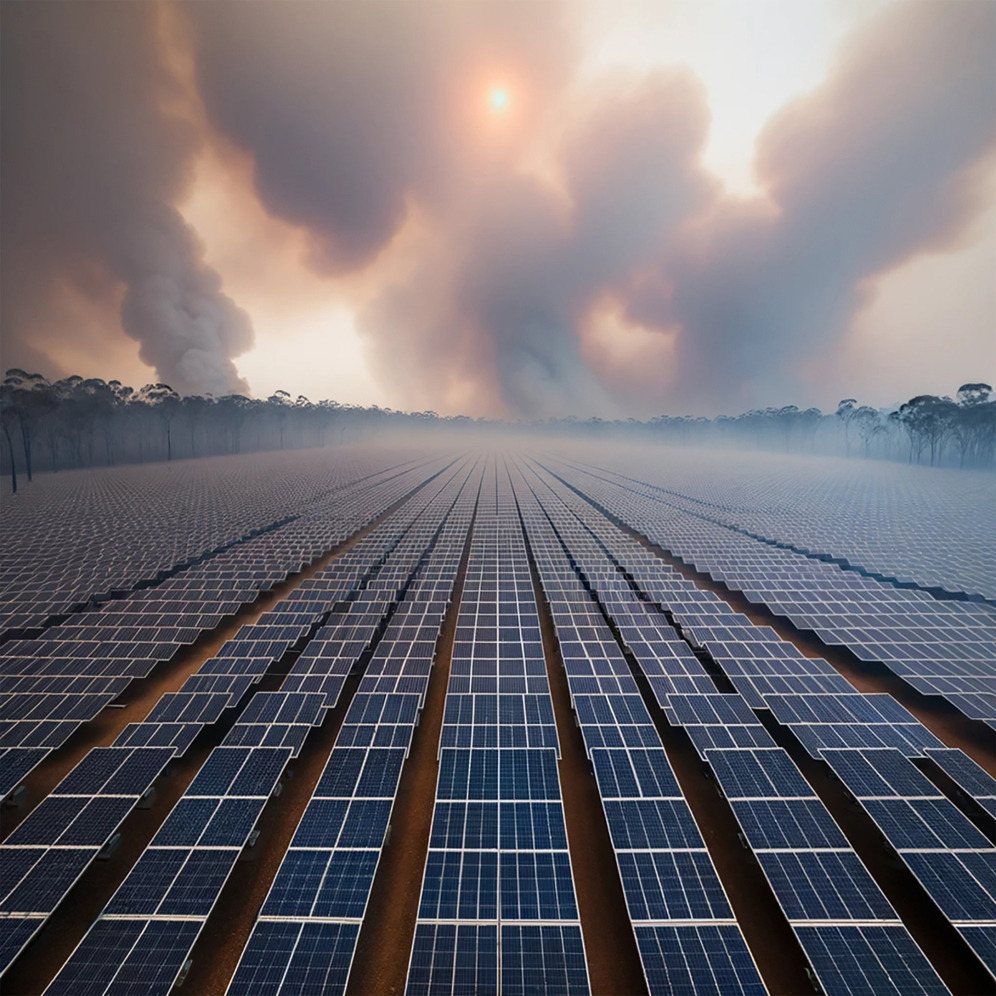
A research team from the University of New South Wales (UNSW) has investigated the impact of bushfires on PV power generation and long-term module reliability, finding that their effects extend well beyond fire-affected areas.
“Using 20 years of atmospheric and satellite data (2003–2024), we quantify the impact of bushfire smoke transport, elevated operating temperatures, and associated degradation, focusing on Australia’s major Black Summer and Black Saturday bushfires,” corresponding author Bram Hoex told pv magazine.
The Black Summer bushfires of 2019–2020 and the Black Saturday bushfires of 2009 were among Australia’s most devastating natural disasters. Black Summer burned more than 24 million hectares, destroyed thousands of homes, and killed or displaced billions of animals. The Black Saturday fires in Victoria claimed 173 lives and destroyed more than 2,000 homes. Both disasters caused widespread environmental damage and loss of life, highlighting the risks associated with extreme heat, drought, and climate change.
The researchers explained that bushfire smoke contains aerosols, including fine particulate matter (PM2.5), which reduce air quality and attenuate sunlight. These particles scatter and absorb solar radiation, significantly reducing PV electricity generation. Aerosol deposition on solar panels also causes soiling, reducing efficiency and potentially creating hotspots, while elevated temperatures during bushfires can accelerate module degradation and shorten their service life.
The scientists used the European Centre for Medium-Range Weather Forecasts’ ERA5 reanalysis dataset to obtain hourly meteorological data and the Copernicus Atmosphere Monitoring Service (CAMS) to assess smoke pollution using aerosol optical depth (AOD) data. They also used observations from the Moderate Resolution Imaging Spectroradiometer (MODIS) to identify active bushfire hotspots with a detection confidence greater than 75%.
To isolate aerosol effects, the researchers selected clear-sky conditions using a daily clear-sky index (DCI) greater than 0.95. They defined solar generation lulls as periods when irradiance remained below 180 W/m² for at least two consecutive hours. The Python Photovoltaic Library (pvlib) and PVWatts model were used to simulate electricity generation under clean and smoke-polluted conditions, while the Sandia temperature model estimated PV module temperatures based on solar irradiance, ambient temperature, and wind speed.
The researchers also assessed thermal degradation by analyzing temperature fluctuations and cyclic thermal stress in PV modules. They used the Hybrid Single-Particle Lagrangian Integrated Trajectory (HYSPLIT) model to track smoke dispersion and evaluate its impact on solar power generation across different regions.
The analysis showed that during the Black Summer bushfires of 2019–2020, AOD exceeded 1.7 near fire hotspots, several times higher than typical levels. Solar power generation declined by up to 70% near the fires and by 30% to 40% in areas more than 150 km away. The researchers also found that smoke-related low-generation periods averaged up to three hours per day in affected areas and reached eight hours per day in the most severely affected locations. PV module temperatures increased by 10 C to 20 C compared with climatological levels, contributing approximately 0.15% additional thermal degradation.
During the Black Saturday bushfires of 2009, smoke reduced solar generation by up to 18% near fire hotspots, while areas more than 100 km away experienced generation losses of 5% to 10%, demonstrating the long-range effects of smoke transport. Module temperatures increased by approximately 18 C, contributing around 0.12% additional thermal degradation.
“The study demonstrates that bushfire risks to PV assets extend well beyond direct fire damage, as long-range smoke transport can significantly affect energy generation, system reliability, and grid operations,” Hoex said. “It also emphasizes the importance of incorporating bushfire-related aerosol impacts into solar resource assessments, energy yield forecasting, and long-term reliability modelling.”
The researchers recommended several mitigation measures, including improved smoke forecasting, vegetation management, regular module cleaning, thermal monitoring, and predictive maintenance.
“The findings also provide a framework for evaluating bushfire exposure during solar farm site selection and strengthening operational resilience in fire-prone regions,” Hoex said.
The researchers said the findings could also be relevant to other bushfire-prone regions, including California, southern Europe, and South America.
The research work was presented in “Understanding non-localised impacts of bushfires on photovoltaic performance, reliability, and management strategies,” recently published in Solar Energy.
Other UNSW researchers have also investigated the impact of bushfires on solar power generation. In a 2023 study, they found that smoke from the Black Summer bushfires caused significant PV generation losses, resulting in estimated financial losses of up to AUD 29 million ($20.4 million). The researchers also demonstrated that rooftop PV systems could serve as early bushfire warning and monitoring tools by detecting changes in electricity generation caused by smoke.
This content is protected by copyright and may not be reused. If you want to cooperate with us and would like to reuse some of our content, please contact: [email protected].

Please login to comment