From Negative Prices to Flexible Revenues: ROBESTEC Unveils Solar-Storage Integrated Solution at The Smarter E Europe

Europe’s Solar Industry Faces a New Economic Reality
Europe’s solar industry is entering a new phase of development. While renewable deployment continues to accelerate, the economics of solar assets are being reshaped by a growing challenge: the widening mismatch between electricity generation and value.
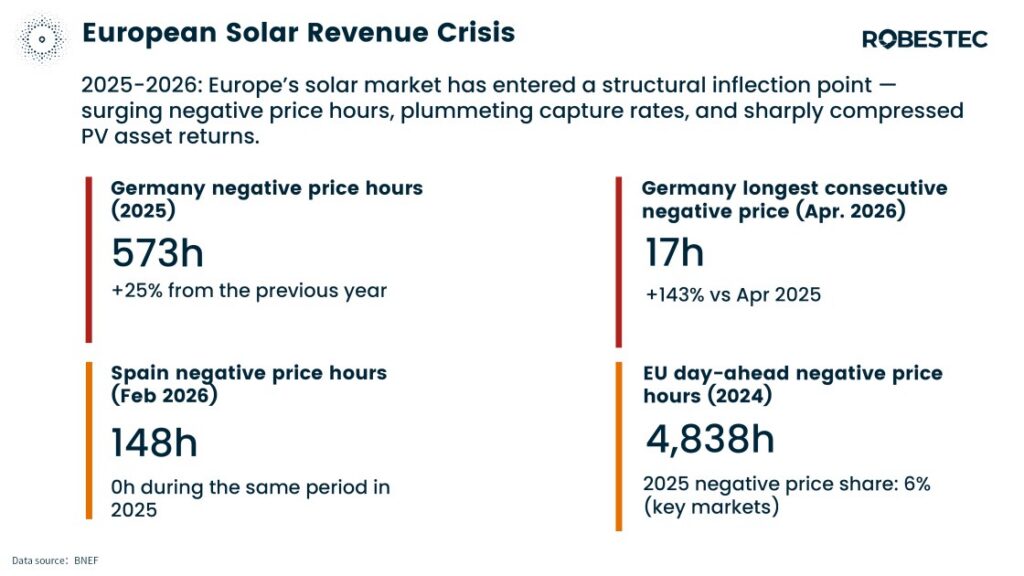
Over the past two years, negative electricity pricing has become an increasingly common feature across major European power markets. Germany alone recorded more than 570 hours of negative pricing in 2025, while declining capture rates and rising curtailment have continued to erode project revenues. As solar penetration reaches new highs, a growing number of PV assets are finding that generating more electricity no longer necessarily translates into generating more value.
The industry is therefore confronting a structural question: how can renewable assets remain profitable in an increasingly saturated and volatile electricity market?
Turning Market Volatility into Revenue Opportunities
At The Smarter E Europe 2026, ROBESTEC presented its answer through a solar-storage integrated solution designed specifically for overseas markets. Rather than viewing storage solely as an energy asset, ROBESTEC positions it as a revenue optimization tool capable of transforming market volatility into long-term value creation.
The economics behind this transition are becoming increasingly compelling. Across Europe’s major electricity markets, widening price spreads between low-price and high-price periods are creating new opportunities for flexible assets. Energy storage allows excess solar generation to be shifted away from periods of oversupply and deployed when market prices recover, helping asset owners reduce exposure to curtailment and negative pricing while accessing additional revenue streams.
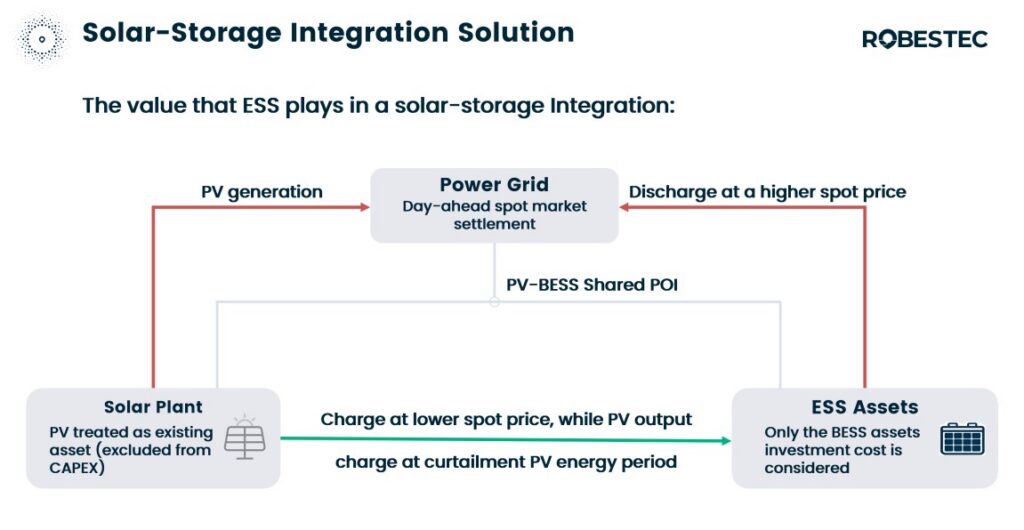
Policy developments are further accelerating this trend. Germany’s forthcoming MiSpel framework is expected to permit bidirectional charging between solar and storage assets while preserving existing EEG subsidy eligibility. The policy is widely viewed as an important regulatory milestone that strengthens the business case for solar-storage integrated projects and enables more efficient participation in electricity markets.
At the same time, ancillary service markets are emerging as another important source of value. ROBESTEC’s solar-storage integrated project in Hungary has already completed the application process enabling ESS participation in ancillary services, marking a significant step forward in our European flexibility-market strategy. As grid operators across Europe seek greater balancing resources to accommodate rising renewable penetration, ancillary services are increasingly becoming a meaningful contributor to project revenues.
Quantifying the Economic Value of Solar-Storage Integration
Market analysis conducted by ROBESTEC across four representative European countries (Germany, Hungary, Spain and Poland) further illustrates the financial impact of solar-storage integration. Using a standardized 50 MW solar project as a benchmark, we compared the economics of standalone PV with solar-storage integrated projects. Across all four markets, standalone PV projects typically generated internal rate of return (IRR) below 5.5%, with investment payback periods extending beyond 10 years. Following the addition of energy storage, all evaluated projects showed clear improvements in economics. In Hungary, project IRR exceeded 16%, while payback periods fell below 6 years, demonstrating how flexibility assets can fundamentally reshape renewable project economics.
Beyond Hardware: ROBESTEC’s Operational Revenue Platform
Yet hardware deployment alone is only part of the equation. As power markets become increasingly dynamic, asset performance is increasingly determined by operational strategy, market participation and real-time optimization capabilities.
To address this challenge, ROBESTEC has developed an operational revenue platform integrating AI-powered forecasting, market analytics, trading optimization, virtual power plant (VPP) aggregation and intelligent dispatch capabilities. The platform is designed to support participation across multiple value streams, including energy arbitrage, ancillary services and flexibility markets, while continuously adapting strategies to changing market conditions.
This approach reflects a broader transformation underway across Europe’s renewable sector. Asset owners are no longer focused solely on maximizing energy output; they are increasingly focused on maximizing asset value throughout the entire project lifecycle.
ROBESTEC complements its technology offering with a full-lifecycle service framework covering full spectrum: data analysis, valuation, modeling, market forecasting, strategy formulation, and trade performance review. Through a closed-loop management model that integrates technology, operations and market participation, ROBESTEC aims to support long-term asset performance in increasingly complex electricity markets.
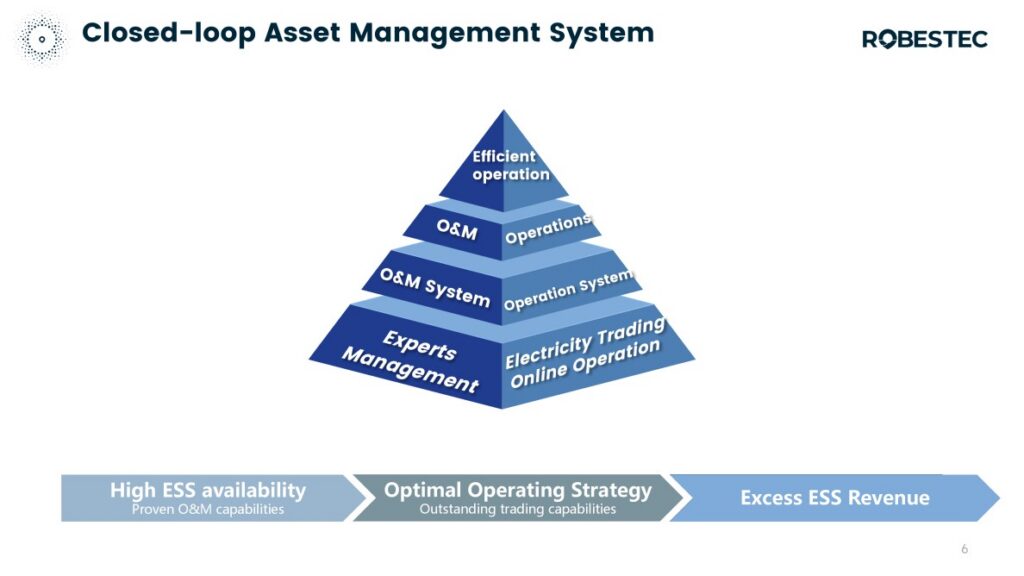
Practical results are already beginning to emerge. At one of our projects in Hungary, a comprehensive optimization strategy implemented by ROBESTEC identified approximately €10.65 million in additional revenue potential for the power plant. The project demonstrates how coordinated optimization across storage operation, market participation and asset management can unlock incremental value that would otherwise remain unrealized.
The Next Phase of Renewable Asset Management
As Europe moves beyond an era defined primarily by renewable deployment and enters one increasingly shaped by flexibility and market responsiveness, the role of energy storage is evolving rapidly. The next generation of renewable assets will be judged not only by how much electricity they produce, but by how effectively they respond to market signals, participate in grid services and optimize lifetime returns.
Against this backdrop, ROBESTEC’s solar-storage integrated solution is emerging as a critical pathway toward sustainable renewable profitability. The latest launch at The Smarter E Europe reflects this industry transition, bringing together storage technology, digital operations and market expertise to help renewable assets navigate Europe’s changing energy landscape.