TrinaTracker’s next frontier: AI, robotics and local service

At SNEC 2026 in Shanghai, where solar manufacturers again competed to demonstrate higher efficiency, larger-scale production and increasingly integrated energy solutions, TrinaTracker used the show to frame the tracker business in broader terms. For Álvaro García-Maltrás, President of TrinaTracker, the next stage of competition in utility-scale PV will not be defined only by steel, motors or controller hardware. It will increasingly be shaped by engineering intelligence, terrain adaptability, automation and the ability to support customers locally across complex global markets.
In an interview during the exhibition, Álvaro said the tracker industry has already moved beyond a simple mechanical-product logic. As utility-scale PV matures, developers are paying closer attention to soil conditions, pull-out tests, wind resistance, corrosion, construction quality and long-term asset reliability. In this environment, trackers have become highly engineered, project-specific systems rather than standardized components.

That complexity is also why artificial intelligence is beginning to enter the tracker business. According to García-Maltrás, AI is first being applied inside the company to accelerate engineering workflows and improve design optimization. Unlike module quotations, which are relatively straightforward, tracker quotations require project-specific engineering studies. Each project involves variables such as topography, wind speed, wind direction, soil conditions, structural configuration, layout, row spacing and expected meteorological conditions.
AI can help engineering teams iterate among different design options, compare alternative layouts, assess profile selection and optimize tracker configurations according to the specific site. The goal is not to replace engineers, but to support them with faster and more data-driven design processes.
“We are getting closer to a point where we will be able to upload the topography of a site, and AI — together with our engineering parameters and human supervision — will provide different optimized solutions,” Álvaro said.
This development is particularly relevant for terrain-following trackers. In many mature solar markets, the best flat land has already been depleted. New utility-scale projects are increasingly being built on more complex sites, where developers must choose between extensive earthworks and tracker systems that can better adapt to existing terrain.
For TrinaTracker, this is an area where AI-assisted design can create direct project value. By modelling different scenarios, the company can compare the cost of cut-and-fill works against the cost of using a terrain-adapted tracker solution. A tracker may not always be cheaper as a standalone product, Álvaro noted, but the overall project solution can reduce total costs if it lowers earthworks, shortens construction time and preserves long-term reliability.
This shows a noticeable shift in tracker value: the product is no longer evaluated only on price per watt or mechanical cost. It is increasingly judged by its contribution to total project economics, energy yield, execution efficiency and risk reduction.
Smart control is another central element of TrinaTracker’s strategy. Álvaro highlighted the SuperTrack as a smart tracking algorithm designed to maximize energy generation. Rather than moving all tracker rows at the same angle, the system can optimize the angle of each tracker line independently. This is especially important during early morning and late afternoon periods, when low sun angles create row-to-row shading. By adjusting individual tracker rows, the system can reduce shading losses and increase useful irradiation on the module surface.
The system can also respond to cloudy conditions. Under diffuse light, the conventional position that follows direct radiation may not always produce the highest generation. A smart algorithm can evaluate conditions and move trackers to a more suitable angle.
The spread of bifacial modules has made this kind of optimization more important. In the past, tracker control focused largely on the front side of the module. Today, rear-side generation, albedo, reflected irradiation and inverter-level generation data can all become part of the optimization logic. For Álvaro, this is one reason AI, and smart control will become more valuable as project owners seek incremental yield improvements from already highly optimized PV plants.
TrinaTracker also sees intelligent control as a tool for asset protection and preventive maintenance. Álvaro said the company is developing services that use forecasting and plant data to move trackers into stow position before severe wind conditions arrive. In addition, monitoring current patterns and other operating parameters can help identify components with a higher probability of failure, allowing preventive replacement before faults lead to generation losses.
The potential next step is integration with energy storage and wider plant-level energy management. Álvaro said trackers could communicate with storage systems and other plant components. In a market with high solar penetration, generation maximization may not always be the optimal operating objective. If a battery is full, or if the grid cannot absorb additional output, the tracker system could adopt a more conservative operating mode and prioritize asset safety. In this sense, trackers may evolve from generation-maximizing devices into active elements within a broader smart energy system.
Beyond AI and control software, robotics is becoming a key part of TrinaTracker’s differentiation strategy. Álvaro said the company is working with two main robotic applications: cleaning robots and installation robots.
Cleaning robots, in his view, need close communication with tracker control units because tracker angles directly affect robot operation. A third-party robot may need to communicate through the plant SCADA system before interacting with the tracker, which can introduce delays or interruptions. TrinaTracker is developing an approach in which the cleaning robot can communicate directly with the tracker control unit, allowing the tracker and robot to understand each other’s position and operating status in real time. This could improve response speed, reduce operational risk and allow more coordinated cleaning.
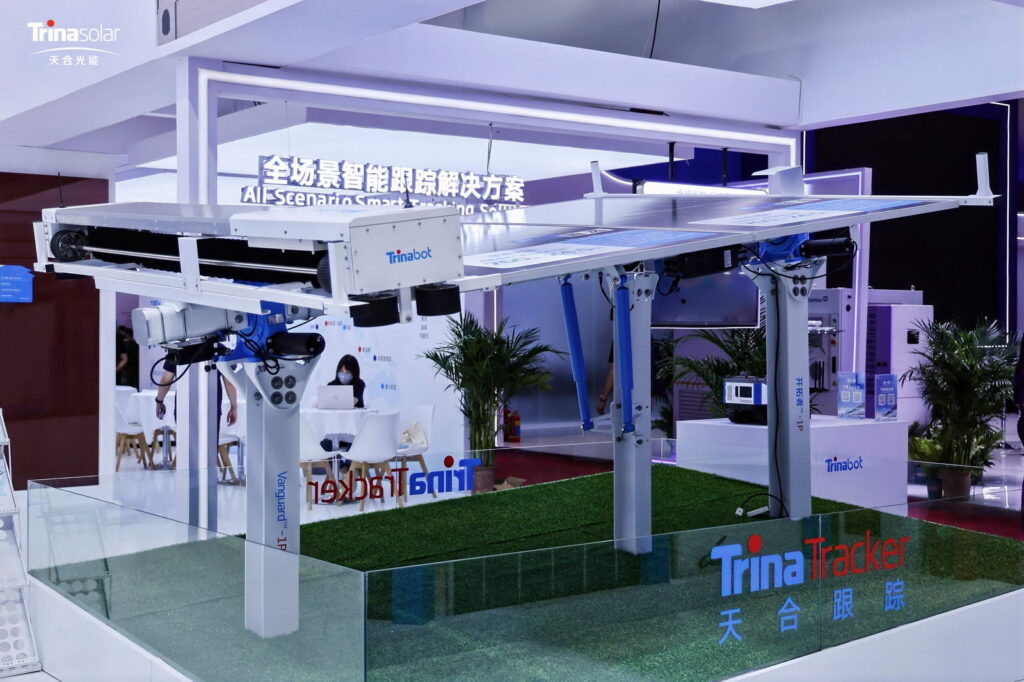
The second application is module installation. Álvaro said TrinaTracker is already promoting installation robots in international markets and has started partnerships in Europe. Such devices can accelerate module installation on trackers, reduce module breakage, lower labor requirements and improve worker safety. This is becoming more important as module formats grow larger and heavier. In markets such as Northern Europe, where regulations limit how much weight workers can carry, robotic assistance can also help EPCs comply with labor and safety standards while improving construction efficiency.
For TrinaTracker, robotics is not a distant concept but a practical extension of its tracker system. It is also closely linked to the company’s view that future LCOE reduction will depend increasingly on automation. Solar costs have already fallen sharply over the past decade, leaving less room for conventional cost reduction. Further optimization, Álvaro said, must come from AI-assisted design, reduced operating expenses, more efficient O&M, faster construction and lower execution risk.
This also shapes the company’s global strategy. Álvaro described TrinaTracker’s basic strategic objective as growth, supported by a broad product portfolio that includes 1P trackers, 2P trackers, fixed structures, terrain-adapted systems, smart controls and robotics. While China remains the group’s domestic base, he said fixed-tilt structures still dominate many Chinese utility-scale PV projects, making overseas markets especially important for demonstrating the value of tracker technology.
Europe, Latin America and the Middle East are TrinaTracker’s key strategic markets. These are regions where the Trina brand is well recognized, where large-scale projects often involve demanding technical requirements, and where local service can become a decisive competitive factor.
Localization, García-Maltrás said, is essential. TrinaTracker has built teams in Latin America, Europe and the Middle East, while maintaining its largest team in China. Its R&D activities are centralized in China and Europe, but customer service is localized in individual markets. This structure allows the company to combine centralized product development with local knowledge of technical specifications, project execution practices and service expectations.
This, he argued, is one of TrinaTracker’s core advantages. In volume terms, Álvaro said the company keeps the position of top six in recent years, although thanks to its new technology developments, strong reputation and competitiveness, and excellent service standards, it is expected that Trina Tracker will be amongst the global top five tracker manufacturers by this year 2026. In more comprehensive rankings that evaluate not only shipment volume but also R&D, financial stability, supply-chain capacity, experience and service capability, he said TrinaTracker performs top two globally. Its strongest competitive points, he added, are product capability, R&D and local service.
Taken together, TrinaTracker is positioning itself for a tracker market with focus not only on hardware, but also on AI, robotics and service. Álvaro said that is where the next value frontier lies. The future tracker will be safer, more reliable, better adapted to terrain and more deeply connected to the rest of the PV plant. It will be supported by AI and robotics that will reduce both internal engineering costs and customers’ lifetime project costs.
At a time when the solar industry is voraciously searching for new sources of margin and differentiation, TrinaTracker’s message at SNEC was clear: the tracker business is becoming a system business. Companies can combine mechanical reliability, intelligent control, automation and local service to help developers lower LCOE and improve project bankability in the next phase of global utility-scale solar.