Cells & modules
All Cells & modules news

Superhydrophobic nanocomposite coating boosts PV power output by 16%, outperforms manual cleaning
An Indian research team developed a transparent, nanocomposite coating that makes solar panels superhydrophobic, enabling self-cleaning and reducing dust-related performance losses. Six months of outdoor testing showed coated panels produced 16% more power than dusty panels and 7% more than manually cleaned panels, while also lowering temperature and improving stability.
Jul 24, 2026

Dutch student team develops solar-powered ambulance
A student team at the Eindhoven University of Technology has developed what it says is the world’s first solar-powered ambulance, designed to deliver healthcare services to remote communities. The vehicle combines a 50 kWh battery with 542 solar cells, offering a claimed range of up to 715 km on paved roads while powering onboard medical equipment.

Advertisement

Halocell teams with South Korean company to scale flexible perovskite solar cell production
Australian clean technology company Halocell Energy will team with South Korea-based flexible transparent electrode manufacturer MSWay as it works to fast-track the commercialisation of its lightweight, flexible perovskite solar cells.

Periodic groove glass boosts high-angle light capture for facade PV
A research team in China has developed a periodic groove glass structure to improve light capture in facade-mounted PV modules.
The proposed design was found to reduce reflection at high incidence angles while maintaining compatibility with large-scale glass manufacturing.

Advertisement

Technology & Products
Autowell showcases latest PV and energy storage solutions at The smarter E 2026
Johnny Wang, International Sales Deputy General Manager for Autowell (ATW), highlighted multi-cut and multi-busbar (0BB) stringing technology, as well as advanced analytical system in smart manufacturing.
Sponsored

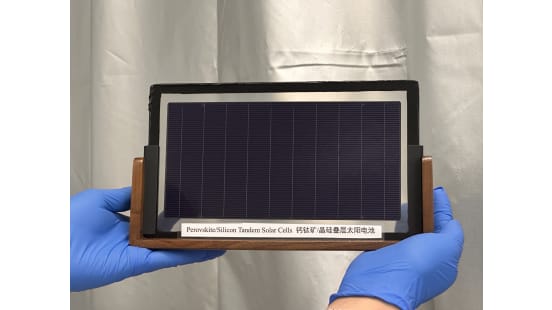
Scientists build 31%-efficient indium-free tandem perovskite silicon mini-module via reactive plasma deposition
Researchers have developed an indium-free perovskite-silicon tandem solar cell using a low-damage reactive plasma deposition process to produce tin oxide layers, achieving certified efficiencies of 33.6% for a small-area device and 31.0% for a mini-module.
Advertisement


Advertisement

- Don’t miss out on key industry events, deadlines, and gatherings that shape the future of the energy transition.
- Visit our comprehensive Events Calendar to mark your schedule with the latest happenings in the photovoltaic and energy storage sectors.
Advertisement
Advertisement
Advertisement