Singapore’s NUS researchers develop alternative ethylene production using solar energy

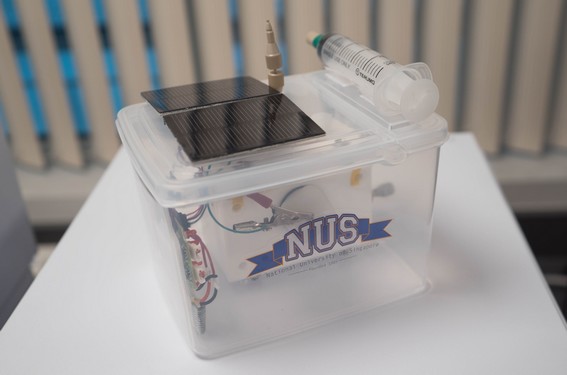
An artificial photosynthesis device developed by a team of of scientists from the National University of Singapore (NUS) could provide a greener alternative to current ethylene production, employing a completely renewable energy source, while simultaneously converting CO2 with the help of copper catalysts.
According to the findings published in ACS Sustainable Chemistry & Engineering, NUS achieved an unprecedented 1.5% solar-to-ethylene energy efficiency (the total solar-to-carbon-fuels energy efficiency is 2.9%).
Current industrial production of ethylene employs steam cracking of saturated hydrocarbons at 750°C to 950°C, which translates to an enormous consumption of energy, emitting about two tons of carbon dioxide for every ton of ethylene produced.The process, developed by the NUS team, takes place at room temperature and pressure, with only the use of benign chemical reagents.
The researchers have also added a battery to store excess solar energy, thus ensuring stable and continuous production of ethylene, and are now developing suitable catalysts that can be used in similar systems to produce liquid fuels such as ethanol from CO2 and H2O.
“We believe that our work, which is a product of efforts for the last two years, will play a crucial role to address key challenges in the realization of a scalable artificial photosynthesis system to produce clean fuels sustainably,” said assistant Professor Jason Yeo Boon Siang.
This content is protected by copyright and may not be reused. If you want to cooperate with us and would like to reuse some of our content, please contact: [email protected].

Please login to comment

[…] group of scientists from the National University of Singapore (NSU) has developed a prefabricated BIPV wall for applications in tall […]
[…] group of scientists from the National University of Singapore (NSU) has developed a prefabricated BIPV wall for applications in tall […]
[…] National University of Singapore (NUS), which houses SERIS, will provide expertise in design and components selection, as well as the implementation and operation of the floating solar platforms. NTU will create tidal models of tidal flow conditions to assess the power density of the turbines and paddles. […]