Solar Frontier hits new thin film cell efficiency record

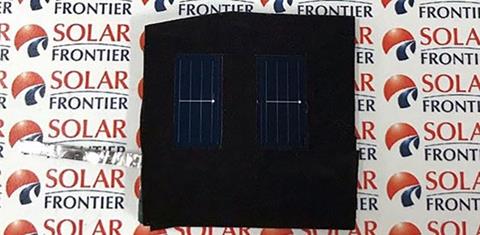
Solar Frontier has set a new efficiency record for its Copper/Indium/Selenium (CIS) based cell technology. The company worked with the Japanese Government’s Energy and Industrial Technology Development Organization (NEDO) to achieve a conversion efficiency of 22.9% on a 1cm² cell.
This record has been confirmed by the National Institute of Advanced Industrial Science and Technology in Japan, and adds 0.3% to the previous record, set by the Center for Solar Energy and Hydrogen Research, Baden Württemberg (ZSE) in February 2016, and 0.6% to Solar Frontier’s previous record of 22.3%, achieved in December 2015.
The record is in line with Solar Frontier’s reported plan to focus on R&D and products for the Japanese residential market, where limited space make efficiency a key consideration. The development was made possible, says Solar Frontier, thanks to CIS absorber engineering, and enhanced surface treatments of the absorber layer.
Solar Frontier previously reported stable demand for its products in 2017, but has struggled with falling module prices. It is currently undergoing a process of consolidation to bring all production to its flagship 900 MW facility, and focusing on selling its products in Japan, where it can achieve greater profits.
This content is protected by copyright and may not be reused. If you want to cooperate with us and would like to reuse some of our content, please contact: [email protected].

Please login to comment
[…] Solar Frontier hits new thin film cell efficiency record – Solar Frontier has set a new efficiency record for its Copper/Indium/Selenium (CIS) based cell technology. The company worked with the Japanese Government’s Energy and Industrial Technology Development Organization (NEDO) to achieve a conversion efficiency of 22.9% on a 1cm² cell. The panel will end up in the upper teens – and I think there’s a place for thin-film solar panels most anywhere at this efficiency. We ought to learn something about them on this site – if anyone has a residential thin-film we should review, please suggest. Most interesting was the final paragraph – the company is consolidating and focusing sales efforts in Japan to combat lower priced hardware globally. The sales pitch of thin-film, generally, is that it is the low price leader. […]