High-efficiency solar module upgrades from REC and Trina

A common argument from the solar power price decrease naysayers is that pretty soon modules won’t go down in price anymore, because the base commodities (aluminum, copper, plastic and silicon) will stomp the brakes.
While this argument does have some truth in an absolute dollar sense, the naysayers miss out on a fundamental detail. We don’t price our industry in commodity pricing, we price it in terms of output of electricity per solar module. And the price per watt — powered by increasing efficiency — moves, to a degree, independently of commodity pricing. As such, pricing for solar power can continue to fall, as the silicon’s electricity output increases and our base commodities are more efficiently used. Which means the ride ain’t yet done, folks.
To underscore this, REC Group and Trina Solar have released new solar modules.
REC: N-Peak Black
From REC, the N-Peak Black Series now reaches up to 325 watts. The module based on n-type solar cells is focused on customers who highly value aesthetics, with a black flame, black backsheet – and of course – black monocrystalline solar cells. The whole of the N-Peak series uses half cut solar cells, and a twin junction box design, as seen below.
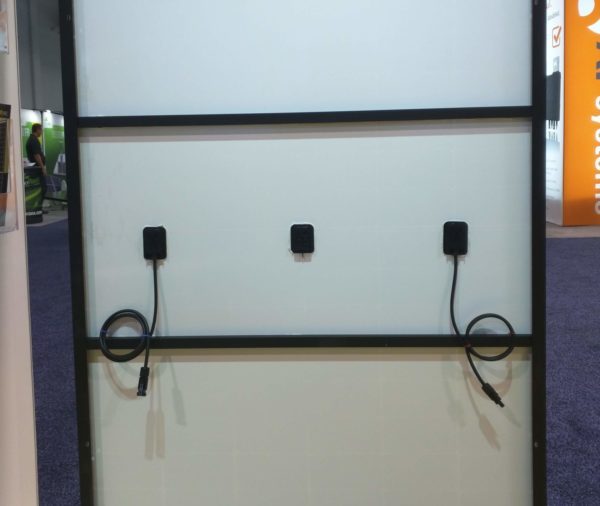
SPI 2018, REC booth
The solar module is being manufactured in the company’s fully vertically integrated factory in Singapore, and is expected to ship in April.
Trina: Tallmax, Duomax and Honey black
Trina Solar has focused its release on 72-cell solar modules, with updates to four of their module series: the TALLMAX in high-efficiency series, DUOMAX in dual-glass series, DUOMAX Twin in double-side series, and Honey black M in aesthetics series.
The company offers a broad range of modules for various applications.
Trina Solar says that modules up to 415 watts are now coming off of its manufacturing lines, an increase from the previous 370 watts. The press release wasn’t specific on the exact manner that the modules moved from 370 to 415 watts, and it might be that the backside bifacial reflection is included in that value. The company’s website didn’t list any “pure” 415 watt modules yet.
With that though, the company’s press release offered good math on the value of these efficiency increases:
An increase in the output of modules from 370W to 415W will help reduce the balance of system (BOS) cost by 4.5% to 8.5%, and reduce levelized cost of electricity (LCoE) by 2.5% to 4.6%.
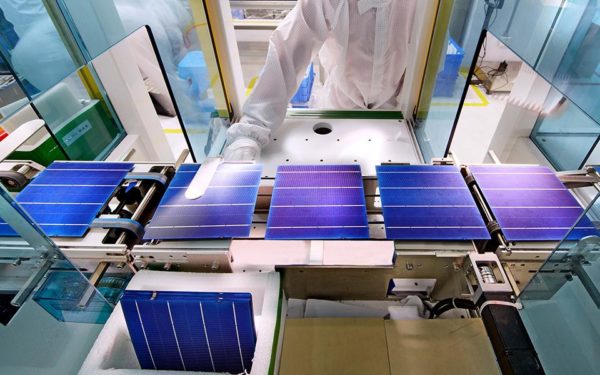
The company makes use of a multi-busbar design (MBB), double glass, dual side (bifacial), and half cut solar cells.
This content is protected by copyright and may not be reused. If you want to cooperate with us and would like to reuse some of our content, please contact: [email protected].

Please login to comment

[…] large-format categories to the global market. They included the Vertex bifacial 500W-plus modules, Duomax V and Tallmax V, and the Trina Pro Mega, another 500W-plus offering which is expected to find its […]
[…] large-format categories to the global market. They included the Vertex bifacial 500W-plus modules, Duomax V and Tallmax V, and the Trina Pro Mega, another 500W-plus offering which is expected to find its […]

Hi John, Your article doesn’t mention if the watts per square inch, or square foot has increased, only the wattage. Are these panels simply larger, dimension wise? Also, any industry word if these panels will come with micro-inverters, hence, AC panels?

Hi
We are an Electrical contracting company in Botswana in the Southern of Africa. We are interested in partnering with a company that has experience on manufacturing of PV panels. Our government is advocating for setting up of manufacturing and want the solar space to be optimized.
We wish to work on this with you.

Would be helpful to know the Watts per m2 area. Using a module doesn’t mean much as they come in different sizes making the comparison inaccurate.
[…] large-format categories to the global market. They included the Vertex bifacial 500W-plus modules, Duomax V and Tallmax V, and the Trina Pro Mega, another 500W-plus offering which is expected to find its […]