Battery storage market will be worth $13 billion by 2023


As renewable energy capacity rises around the globe, markets are changing, creating opportunities for new businesses and technologies.
One of the primary beneficiaries of the tide of renewable energy is a battery storage industry whose global market volume will rise to $13.13 billion by 2023, buoyed by necessity and falling system prices.
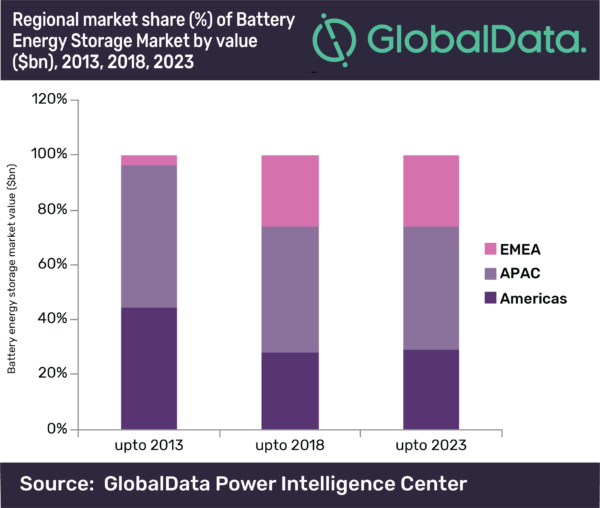
That is the prediction made by market analysis company Globaldata in its Battery Energy Storage Market, Update 2019 – Global Market Size, Competitive Landscape and Key Country Analysis to 2023 report, which states the Asia and Pacific region (APAC), as well as Europe, the Middle East and Africa (EMEA), will be the most dominant battery storage markets up to 2023.
According to the analysts, the APAC region made up 45% of the world’s installed battery storage capacity last year. The region will continue on that trajectory, said Globaldata. In China, India, Japan, South Korea and the Philippines in particular, said the analysts, significant uptake of grid connected renewable electricity generation will necessitate frequency control in grid networks to improve resilience.
The EMEA region significantly increased its battery storage market share between 2013 and 2018, to a 26% slice of the world market worth $1.72 billion. The Globaldata report adds, the European market has robust demand for flexibility and will be EMEA’s driver for new storage capacity with Africa and the Middle East to follow suit once renewable energy deployment gains traction.
The Americas battery storage market was slightly larger than EMEA with a registered value of $1.97 billion last year, to make up around 28% of the global market. Chile, Canada, Brazil and the U.S. in particular saw rapid uptake of storage.
Globaldata analyst Bhavana Sri said: “The U.S. has been the largest [national] market for battery energy storage systems, both in terms of cumulative installed capacity and by market value, for projects installed up to 2018 and is likely to continue to lead the market at the country level. The U.S. market for battery energy storage is estimated to reach $2.96 billion in 2023, accounting for 23% of the global market.”
That is due in no small part to strong incentive programs in some U.S. states and the Globaldata report’s authors highlighted California, which has already passed the 1.3 GW of energy storage capacity planned by next year. With a plan for full decarbonization of its economy by 2045 in place, the Golden State is expected to set another ambitious goal soon.
Globaldata said the trend for modernizing grids to reach the level of resilience needed to accommodate renewables is driving the storage market worldwide. The resulting need for smart grid and ancillary services, as well as consumers seeking self-sufficiency, are essential for the large-scale deployment of battery storage systems, say the report’s authors.
“Market conditions are improving and more companies are moving into a decentralized generation, leading to an increase in the on site deployment of renewables and batteries; as with micro or mini girds,” added Globaldata’s Sri. “Supportive policies and high electricity charges are also nudging the market towards renewables and/or storage plus renewables at the end consumer level. As the power sector evolves to accommodate new technologies and adapt to varying market trends, energy storage will play a central role in the transition and transformation of the power sector.”
This content is protected by copyright and may not be reused. If you want to cooperate with us and would like to reuse some of our content, please contact: [email protected].

Please login to comment

[…] a notable one for energy storage, with analysts at GlobalData predicting the market will be worth $13 billion by 2023, thanks to falling prices and the rising need to even out intermittent renewable energy flows in […]
[…] also revised up the amount of investment energy storage will attract over the next 21 years, adding $40 billion for a predicted $662 […]
[…] unwavering demand for lithium-ion batteries is expected to tighten the gap. In fact, the battery storage market is expected to be worth $13 billion by 2023, with lithium-ion batteries leading the way. […]

More than ever the shift from fossol fuels energy sources to more “green” sources is evident. Unfortunatly, battery storage while it appeals to the common audience being green, in reality it cant be any farther from being green as fossil fuels are if we consider the full life cycle of this technology.
Our demand for energy is growing exponentially due to elevating standards of living, and due to the shear population growth. This consequently necessitates unfathomed number of battery banks or should we say battery centers. Definitely manufacturing all this ammount of batteries does not come “green”! The chemicals involved in manufacturing processes and production, and the heavy metals associated, all make batteries anything but green. Not to mention secondary environmental aspects it terms of leaching batteries, and batteries disposal.
A more practical alternative until recently was hydrogen. It is abundant, conveniently storable, and used pretty much like natural gas with the advantage of zero pollution when combusted. I am aware of the existing challenges facing hydrogen in terms of extracting it from hydrocarbon sources which makes it less green. But what I dont understand is why industry dont invest in generating hydrogen from seawater. In fact, we are capable of producing pure water from seawater at large scale and at economical costs through seawater desalination, which is also used to produce potable water in many countries already.
I still believe the true future for our energy needs can be better satisfied with hydrogen rather than bulky limited energy density/capacity batteries.
[…] PV Magazine: […]
[…] The hike in demand for battery energy storage is driven by the accompanying pressure for more renewable energy capacity, with the region now accounting for more than 45% of the world’s installed battery storage capacity. […]