US added 4.2 GW of solar in H1

From pv magazine USA
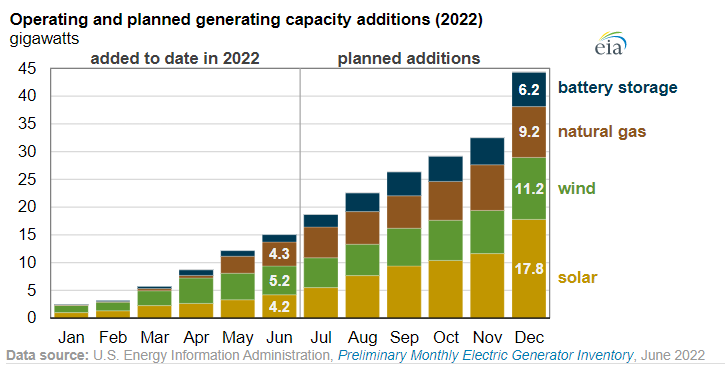
The US Energy Information Administration (EIA) has revealed that the United States added 15 GW of generating capacity in the first six months of 2022. The top three technologies were wind (5.2 GW), natural gas (4.3 GW), and solar (4.2 GW), followed by battery energy storage.
By the end of this year, solar will account for the largest share of new capacity additions at 17.8 GW, followed by wind at 11.2 GW, natural gas at 9.2 GW, and battery energy storage at 6.2 GW. This means developers may be busy in the second half of this year, adding 29 GW to the grid nationwide.
More than 40% of the wind capacity that has been activated this year is in Texas, where 2.2 GW of wind was brought online. The largest projects installed and activated this year include the 999 MW Traverse Wind Project in Oklahoma, the 492 MW Maverick Creek Wind in Texas, and the 440 MW solar and battery storage project at Slate Hybrid in California.
The EIA also tracks operable projects larger than 1 MW in size. Nationwide, there are 497 active natural gas plants, 202 coal plants, 138 wind facilities, 95 nuclear plants, 80 conventional hydroelectric dams, and 66 utility-scale solar facilities. New renewable energy projects coming online and retirements in coal fired plants, as well as natural gas and nuclear, are expected to shift these numbers.
A significant amount of capacity, 15.1 GW, is expected to be retired this year. About 8.8 GW of capacity has already been taken offline in 2022. Coal plants, due to their heavy carbon emissions, have represented the largest portion of retirements, and will account for about 76% of all retirements for the year. This is followed by natural gas (12%) and nuclear (9%). A 1.3 GW coal plant was retired in Ohio in May, and a 1.2 GW station in Maryland was retired in June. Additionally, a 769 MW nuclear plant was retired in Michigan in June.
This content is protected by copyright and may not be reused. If you want to cooperate with us and would like to reuse some of our content, please contact: [email protected].

Please login to comment

[…] was devoted to utility-scale photovoltaics throughout the world in the January-June period. The United States was the world’s second-biggest large solar market in the first half, according to BNEF, with […]
[…] “The US Energy Information Administration (EIA) has revealed that the United States added 15 GW of generating capacity in the first six months of 2022. The top three technologies were wind (5.2 GW), natural gas (4.3 GW), and solar (4.2 GW), followed by battery energy storage. “https://www.pv-magazine.com/2022/08/04/us-added-4-2-gw-of-solar-in-h1/ […]
[…] The U.S. market has always been one of the biggest that has attracted solar module suppliers. As a global manufacturer of solar modules and mounting structures, Philadelphia Solar has had its sights set on this market for years. We see the future being not just in supplying modules but in investing in the U.S. to set up domestic manufacturing capacity. We took serious steps towards this in 2020 by putting a bid on a building in Texas to set up U.S. manufacturing operations. However, we pulled back because of changes in regulation – namely the cancellation of Section 201 trade tariffs on imported bifacial solar modules. The exclusion of bifacial products from a trade tariff imposed because of the volume of imports, meant that, if we were to invest in production capacity for U.S.-made bifacial modules, we would have faced extreme pricing headwinds from imported bifacial products. In the absence of any other incentives, our return on investment would have been untenable. […]