Solar PV needs more nuanced assumptions in energy system modelling

Rooftop solar PV has been central to the global energy transition since its origins, starting with Charles Fritts’ rooftop Selenium cell in New York in 1883. The modern era began in the 1940s, when Bell Labs developed the first silicon-based PV cell, leading to niche uses in space and off-grid projects. In the 1980s, California built the first MW-scale plants, while Swiss engineer Markus Real promoted small, decentralized rooftop systems. This sparked today’s boom and push of solar PV to emerge as the central pillar to power a sustainable future in 100% renewable energy systems to marshalling our productivity to create a sustainable global civilization. Currently, rooftop PV accounts for about 40% of annual installations and is expected to hold around 25% market share into the mid-2030s, down from over 90% in 2015. Less than half include storage, but falling costs of PV and batteries are boosting self-consumption. The importance of rooftop solar PV and prosumerism has been reflected by researchers of LUT University by publishing several articles on the topic for a deeper understanding of solar PV prosumer dynamics and drivers, detailing the insights on earlier grid-parity analyses that paved the way for today’s PV prosumers’ insights despite continued underestimation in the overall international energy debate and the excellent cost development:
“Cost-optimal self-consumption of PV prosumers with stationary batteries, heat pumps, thermal energy storage and electric vehicles across the world up to 2050” is a first global contribution on the optimization of self-consumption of residential solar PV prosumers. The study presents insights beyond solar PV-battery systems, including micro sector-coupling of power, heat, and transport within the residential prosumer system. The authors conclude that maximization of self-consumption is most economical in any region of the world, enabling high power demand and heat demand cover ratios. Self-consumption ratios, despite maximization efforts, only reach ca. 50% in most regions globally, leaving room for further improvement.
In a consecutive study titled “Seasonal hydrogen storage for residential on- and off-grid solar photovoltaics prosumer applications: Revolutionary solution or niche market for the energy transition until 2050?”, the researchers included seasonal hydrogen storage technology into the improved prosumer model to further increase the self-consumption of the systems. Small-scale hydrogen storage solutions for residential households are technically well possible and, however, have considerable economic disadvantages, as the additional storage system may be a niche market for off-grid solutions, while grid balancing is more viable for on-grid systems. Nevertheless, the same paradox is true for premium cars, which are sold in large quantities.
In a collaborative article with ETIP-PV titled “Attractiveness of Photovoltaic Prosumerism in the European Electricity Market” the three prosumer PV market segments for residential, commercial, and industrial were investigated for the representative European markets in Finland, Germany, France, Italy, and Spain. All market segments in all investigated countries were found to be attractive, with financial payback periods as low as 4 years in particular segments. Key drivers of attractiveness are identified to be low cost of capital and high self-consumption.
In their latest study, “Assessing Yield Disparities: Anticipated versus Optimal Rooftop Photovoltaic Systems and Implications for Prosumer Viability,” the researchers improved the consideration of yield modelling for rooftop PV. As a reference point, fixed-tilted ground-mounted utility-scale PV yield profiles were analyzed and the yield difference of utility-scale solar PV power plants with rooftop solar PV was identified. The article concludes that residential rooftop solar PV shows, on average, 18% less yield annually, commercial systems 7%, and large industrial-scale rooftop solar PV systems 4%. The viability of solar PV prosumers is not at risk, though the improved yield input increased annualized cost by up to 20%, making it important to consider rooftop solar PV and prosumers in energy system transition modelling.
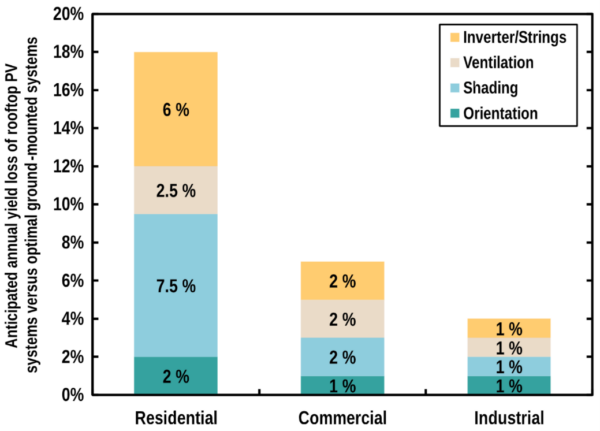
Image: LUT University
Only a handful of energy system transition models differentiate between utility-scale and distributed solar PV technology options, while prosumers are only used in three models: GCMOM/LOADMATCH, PyPSA, and LUT-ESTM. If rooftop solar PV is included, disclosure of basic assumptions on the yield differences is not yet state-of-the-art. Therefore, a lack in dedicated consideration of rooftop solar PV power plants and PV prosumers can be identified. In light of the historically leading and continuing important role of rooftop solar PV and the continued importance for homeowners in an increasing number of countries globally, researchers and industry should address this gap. Overall, the global annual potential of electricity rooftop solar PV can be estimated to about 27,000 TWh. Depending on future development, this may cover up to 10% of the global primary energy demand by the end of the century.
Shortcomings in modelling detail for the most important energy source of the 21st century are also present for utility-scale solar PV power plants. A major setback in technology consideration is the non-availability of horizontal single-axis tracking (HSAT) systems. Of all the energy system models, only three are identified to include HSAT solar PV power plants over the recent years: GCMOM/LOADMATCH, LUT-ESTM, and the ANU model, with another catching up recently: PyPSA. Therefore, the results of all remaining models do not reflect the current development in which HSAT systems cover more than 35% of the global utility-scale solar PV market as of today. HSAT systems are expected to significantly improve the efficiency of energy systems.
HSAT, however, can also be optimized. In a detailed study on the “Impact of backtracking strategies on techno-economics of horizontal single-axis tracking solar photovoltaic power plants”, the researchers from LUT University had a closer look on backtracking. An important outcome of the study is the finding that standard backtracking, which aims to avoid mutual shading of power plant rows at any cost, might not be the most economical option, since the angle of incidence is significantly worsened, leading to up to 12% lower LCOE for advanced, smart backtracking strategies considering all yield effects of the power plant.

Image: LUT University
Similarly to HSAT systems, bifacial solar PV technology is not yet reflected in energy system modelling as a standard, despite being technically available since the 1980s commercial breakthrough, which led to a market acceleration since the early 2020 and is expected to exceed 90% market share in 2025. In the latest study by the LUT researchers “Assessing the impact of bifacial solar photovoltaics on future power systems based on capacity-density-optimised power plant yield modelling” a detailed modelling of bifacial solar PV for fixed-tilted, HSAT, and vertical system setups revealed that bifacial solar PV is no game changer, however, allows for a further improvement of the total system, including a global average change in LCOE of -2%. Bifacial solar PV has an exceptional business case as agrivoltaics, especially in the form of vertical solar PV, as the electricity production profile without noon peak may support electricity grids. Furthermore, bifacial solar PV is expected to have a lower environmental impact.
Other application cases for solar PV are yet to be explored. One open question is the large-scale potential of floating offshore solar PV, which may play a significant role for small island nations, entire archipelago regions, but also as a potential upgrade for offshore wind power plants for improving overall economics. Floating offshore solar PV has been found among the three core ocean energy technologies, complementing offshore wind power and wave power. Solar PV installations break new records year after year and prove the importance of solar PV for future electricity-based energy systems. The variety and details of this technology have to be reflected in energy system modelling to allow for the right policy implications and backing industrial developments with highly granular research. We call for researchers to reflect industry developments in solar PV by implementing a variety of technologies in energy system modelling.
Authors: Dominik Keiner and Christian Breyer
This article is part of a monthly column by LUT University.
Research at LUT University encompasses various analyses related to power, heat, transport, industry, desalination, and negative CO2 emission options. Power-to-X research is a core topic at the university, integrated into the focus areas of Energy, Air, Water, and Business and Society. Solar energy plays a key role in all research aspects.
The views and opinions expressed in this article are the author’s own, and do not necessarily reflect those held by pv magazine.
This content is protected by copyright and may not be reused. If you want to cooperate with us and would like to reuse some of our content, please contact: [email protected].
Please login to comment