France sees negative spot price of -€498/MWh


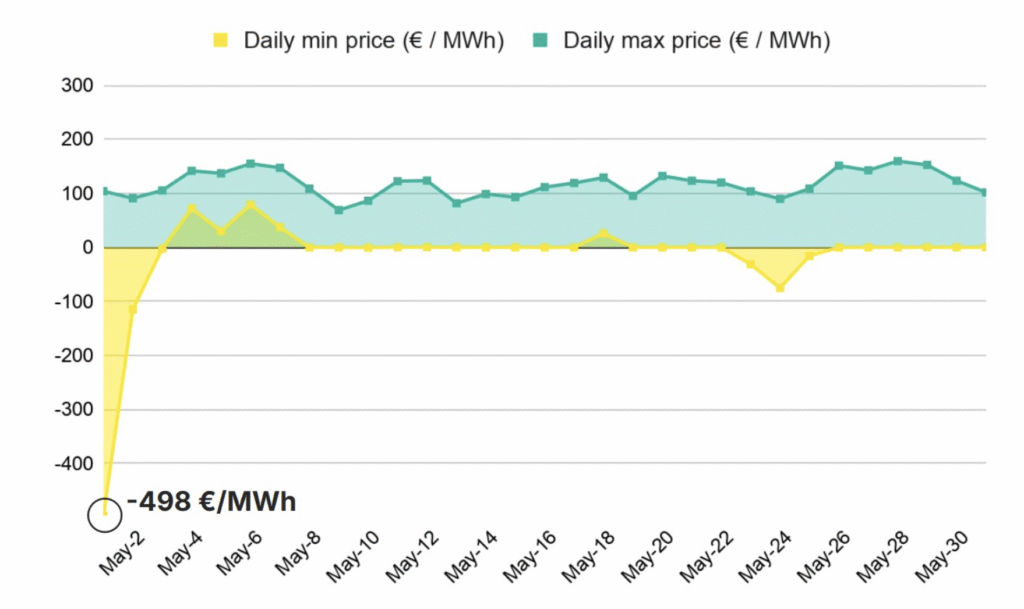
The French electricity market recorded a negative spot price of -€498/MWh on May 1, according to the price observatory of French startup Storio Energy.
The record low was recorded at 13:00 and was followed by -€471/MWh at 14:00. It has been attributed to low consumption linked to the public holiday, combined with reduced flexibility in the nuclear fleet, a phenomenon also observed in April.
For comparison, the lowest price recorded on May 1, 2025, was -€118/MWh.
The spread between the most expensive hour and cheapest hour in France during May reached €141/MWh, a level unprecedented during the month. Storio Energy’s analysis says the indicator did not exceed €100/MWh even at the height of the 2022 energy crisis when the average electricity price was around €200/MWh.

The extremely low price spike of -€498/MWh on May 1 is partly explained by reduced modulation of the nuclear fleet.
Since the beginning of the year, the French electricity market has recorded nearly 450 hours of zero or negative prices, compared with around 320 over the same period of 2025.
In May, 80% of the days were impacted by zero or negative prices, as well as nearly two thirds of hourly slots between 13:00 and 17:00.

Storio Energy’s analysis adds that in May, a 1 MW/2 MWh battery charged at an average of -€8/MWh and discharged at €111/MWh, completing around 1.2 cycles per day.
Since the beginning of 2026, the average spread has thus reached €119/MWh, more than double the levelized cost of storage. In this context, arbitrage revenues achievable by batteries in the spot market increased by 34% in 2026 compared with the January to May 2025 period.
By the end of May 2026, cumulative revenues from a 1 MW/2 MWh battery energy storage system on the spot market were up 34% on 2025 and 161% on 2024.
This content is protected by copyright and may not be reused. If you want to cooperate with us and would like to reuse some of our content, please contact: [email protected].

Please login to comment