Spain’s offshore PV potential estimated at 6.48 GW

From pv magazine Spain
Researchers from the University of A Coruña (UDC) have found that the Spanish coastline could accommodate between 4.45 GW and 6.48 GW of floating offshore solar capacity, depending on the maritime spatial planning criteria applied. The estimated capacity would be enough to supply between 6.2% and 9% of Spain’s electricity demand recorded in September 2025.
The study “Assessment of installable offshore solar power capacity in Spain based on maritime spatial planning,“, published in the Journal of Cleaner Production, is the first systematic evaluation of Spain’s offshore solar potential using the country’s Maritime Spatial Planning Plans (POEM), approved under Spain’s Royal Decree 150/2023. Although offshore photovoltaics remains at an early stage of development, the authors said the technology offers several advantages over land-based solar, including greater space availability, fewer land-use conflicts, and improved performance due to the cooling effect of seawater.
The study cites previous research indicating that this cooling effect can increase electricity generation by up to 10.2% compared with equivalent onshore installations. It also notes that some floating PV platforms have demonstrated higher energy yields than conventional systems and payback periods ranging from 2.8 to seven years. The researchers said that, in countries with strong solar resources such as Spain, offshore PV could complement offshore wind development and support hybrid projects capable of improving grid stability.
The study’s main contribution is a methodology for estimating the installable capacity of floating offshore solar based on the restrictions and permitted uses defined in Spain’s Maritime Spatial Planning Plans (POEM). Current Spanish maritime planning explicitly considers technologies such as offshore wind and wave energy but does not designate specific areas for offshore photovoltaics. To address this gap, the researchers evaluated two scenarios.
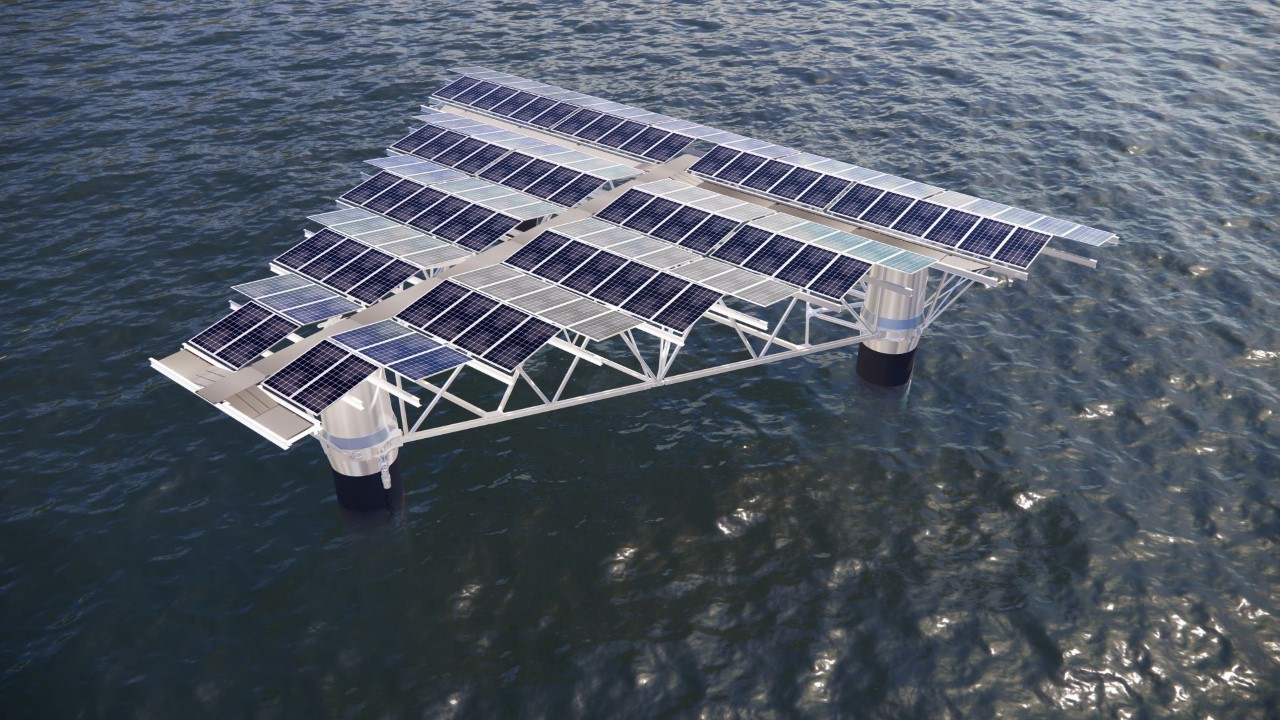
The first scenario considers only the high-potential areas identified for offshore wind development. The second expands the analysis to all compatible marine areas after excluding protected zones, shipping routes, fishing grounds, military areas, biosphere reserves, energy infrastructure, and other priority uses. For the calculations, the researchers used the Merganser floating platform developed by Dutch company SolarDuck as a reference, assuming a unit capacity of 0.52 MW.
The analysis found that the high-potential offshore wind areas could accommodate up to 6.48 GW of floating solar capacity. When the full set of restrictions defined in the POEM is applied, however, the estimated capacity falls to 4.45 GW. Although the second scenario covers a larger total maritime area, the authors explained that many of these zones are fragmented or located in deeper waters, making the deployment of large floating platforms more difficult.
Water depth was found to be a critical factor because it determines the length of mooring systems and the spacing required between platforms. As a result, a larger available area does not necessarily translate into greater installable capacity.
The analysis also revealed a highly uneven geographical distribution of Spain’s offshore solar potential.
Under the scenario based on priority offshore wind areas, more than 90% of the estimated capacity is concentrated in the Strait of Gibraltar-Alboran Sea and Canary Islands regions. When only the general maritime planning restrictions are applied, however, the Levantine-Balearic and North Atlantic regions account for most of the potential. In this scenario, the Mediterranean area alone could accommodate around 2.54 GW, making it the country’s main development hub for offshore solar.
The authors said this contrast demonstrates the methodology’s value both for complementing existing offshore wind planning and for identifying new development opportunities in areas that are not currently considered priorities.
The study also argues that offshore solar should not be viewed as a competitor to offshore wind but as a complementary technology. One of its main conclusions is that Spain should explicitly incorporate offshore solar photovoltaics into future revisions of its Maritime Spatial Planning Plans, as the current absence of designated areas creates regulatory uncertainty and may limit the technology’s development.
This content is protected by copyright and may not be reused. If you want to cooperate with us and would like to reuse some of our content, please contact: [email protected].

Please login to comment