pv magazine Focus: Quality control underpins bankable BESS projects

From ESS News
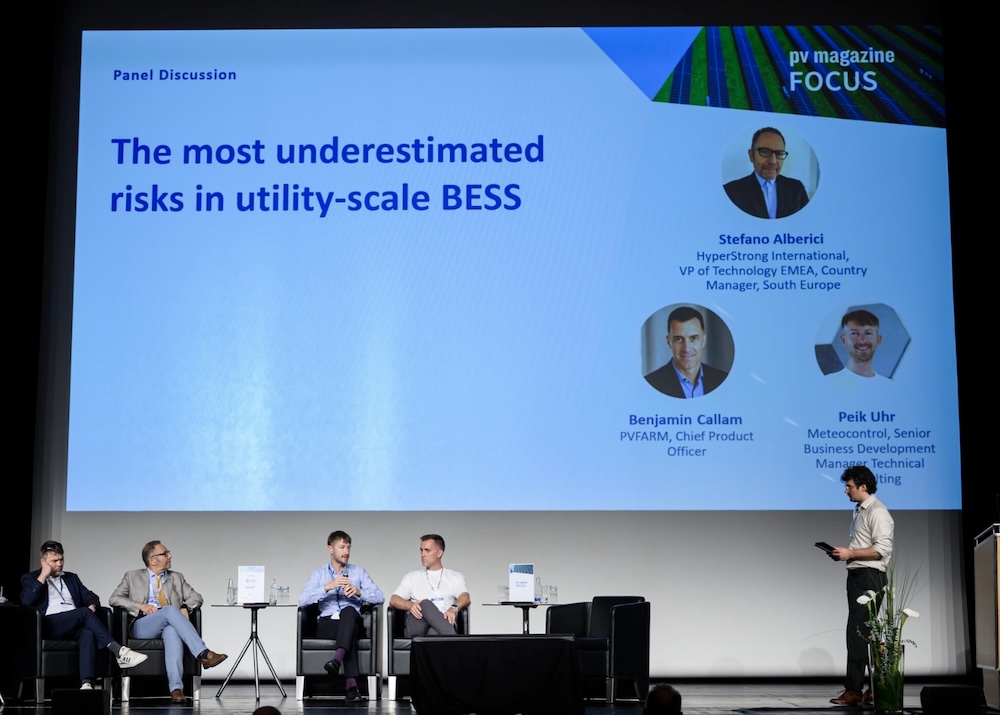
Germany and the rest of the European continent were several days into an intensifying heatwave when pv magazine Focus 2026 convened in Munich on June 24. The heat lent a measure of immediacy to a theme running through much of the session’s discussion: how battery systems, and the warranties behind them, hold up once conditions turn extreme.
Factory audits routinely uncover battery quality issues at every stage of production, including at tier-one suppliers, said Garikoitz Sarriegi Etxeberria, head of converter and storage services at German technical consultancy Kiwa PI Berlin, in the opening segment of the event.
Sarriegi Etxeberria argued that the greater risk often lies not in what manufacturers test, but in what they fail to test, citing thermal management systems validated only for cooling performance, with heating performance under cold conditions frequently left unchecked.
He said cell-level voltage and temperature data, gathered from battery management and supervisory control systems during capacity testing, often reveals abnormal distribution patterns across large battery packs.
Sarriegi Etxeberria added that these deviations can affect state-of-health and lifetime performance, and recommended that buyers contractually require full disclosure of this data before commissioning, given the 20-year operating horizons involved.
Warranty risk
During the panel discussion that followed, an incident was described in which a damaged battery component took six months to replace, raising the question of whether the cost of the delay should be split equally between supplier and buyer. The panelists said the answer typically depends on what is already defined in the contract, including liquidated-damages provisions and insurance coverage. Without those protections in place, they said, the buyer is left absorbing the bulk of the loss.
Johanna Bonilla, BESS senior business development manager EU for Shanghai-based JinkoSolar, said in the event’s first panel discussion that the Chinese company produces some of its own cells but also qualifies external suppliers to the same quality standards. She said correct integration of cells into a complete system matters as much as cell quality on its own.
Bonilla also argued that JinkoSolar’s approach of controlling full system integration gives customers a single point of warranty accountability. She said the company maintains six spare-parts warehouses across Europe to support faster replacement turnaround under its service agreements.
Bonilla said she frequently sees suppliers offer system availability guarantees of 99% or higher, which she described as unrealistic over a project’s operating lifetime. She drew a distinction between system uptime and usable energy delivered, arguing that the latter is the more meaningful metric: a system can be technically online while still falling short of the energy output a tolling or offtake agreement requires.
CEGASA Energía CEO Iñigo Atutxa described the Spanish company’s supplier verification process, which includes per-batch cell sampling, individual cell voltage testing, and cycling tests before approving new suppliers. He said inconsistent quality control practices exist across battery manufacturers, ranging from those that inspect components daily to others that do so only monthly.
Atutxa also raised the issue of replacement economics at the rack level, noting that a single underperforming cell can sometimes force the replacement of an entire rack’s worth of capacity rather than the cell alone, depending on how the system is integrated. He said this risk can be mitigated through integration design choices made before a project is built.
Financial strength
Tim Koenemann, global head green infrastructure finance at German commercial lender Commerzbank, said lenders rely heavily on independent technical advisers throughout project development, construction, and commissioning, and noted that contractual protection against underperformance matters more to financiers than directly judging supplier quality. He said counterparty financial strength and credit ratings are central to lending decisions, given that performance guarantees can run 10 to 15 years or longer.
Koenemann said he advises against concentrating an entire storage portfolio with a single integrator, citing a hypothetical 500 MW portfolio as an example of a position better split across multiple suppliers to limit counterparty risk. He echoed Bonilla’s distinction between uptime and usable energy, saying it is the latter that ultimately determines whether a tolling agreement’s terms are being met.
Stephan Rohr, CEO of battery analytics software provider TWAICE, which monitors performance across more than 130 utility-scale storage projects, said cell-related issues account for around 10% of severe incidents recorded in a database maintained jointly with a research institute.
“My experience over the last many years now, is that energy storage systems are high-touch systems,” said Rohr.
He explained that this means even a system that passes its site acceptance test cleanly can still degrade significantly if it is not actively and proactively managed afterward – minor issues such as a blocked filter or an unreplaced weak cell tend to compound over time rather than resolve on their own.
Rohr also noted that roughly 45% of those severe incidents are attributable to control and communications failures between energy management and battery management systems, with the remainder linked to components such as HVAC systems.
Fragmented certification
In a separate presentation, Bonilla outlined JinkoSolar’s energy storage business, which has operated as a dedicated unit since 2022; it became a tier-one battery manufacturer in 2024. She said the company has delivered to 50 countries and operates nine service centers worldwide, including one opening soon in Italy.
Bonilla said certification requirements for BESS remain fragmented across Europe, with different standards applied at cell, battery, system, and installation level, and no single, unified certification accepted across all markets. She said EU regulation under Annex V – which outlines safety parameters for stationary battery energy storage systems – addresses risk management rather than prescribing a single certification standard. This allows manufacturers to select among multiple accepted test methods depending on the requirements of individual banks, insurers, or grid operators.
Bonilla added that some markets layer additional national requirements on top of EU rules, citing Germany’s BVES storage association certifications as an example.
Benjamin Callam, chief product officer at California-based PVFARM, said battery storage site planning functions less as a pure engineering exercise than as a collaborative decision-making process involving engineers, developers, and engineering, procurement and construction (EPC) contractors, and all of them might define project success differently.
He said one anonymized customer told the company that “decisions break when teams optimize in isolation.”
Callam described leaving room for future capacity augmentation as one of the “dark horses” of battery storage planning, since variable, behind-the-meter revenue makes it difficult to know in advance how much additional capacity might be worth later. He said planning decisions made early – including space reserved for future augmentation – can preserve flexibility as market economics evolve. He said constructability constraints, including crane access and site geometry, are frequently overlooked in early-stage planning, particularly for retrofit projects adding storage to existing solar sites with limited available space.
Focus on co-location
Peik Uhr, senior business development manager technical consulting for German solar software provider meteocontrol, said the company’s services span permitting support, revenue forecasting, and sizing assessments for both standalone and co-located battery storage projects. He said meteocontrol’s revenue models combine third-party yield-assessment software with in-house engineering calculations to project revenue across wholesale, balancing, and ancillary service markets.
Uhr said Augsburg-based meteocontrol can also estimate optimal battery capacity and power sizing for retrofit projects at existing solar sites without performing detailed technical engineering. He said the company is working to incorporate site-specific curtailment-probability data into its revenue models to better account for grid-connection constraints, though he said no reliable database yet exists to support forward-looking curtailment forecasts.
Stefano Alberici, VP technology EMEA for Chinese industrial battery storage integrator HyperStrong, said most developers approach the company with fixed technical specifications already defined, though a minority seek guidance on optimal system configuration. He said projects involving clients open to revisiting their initial assumptions tend to become longer, more involved discussions, but often result in better-suited systems and more satisfied customers. He cited a newly launched containerized battery unit weighing around 24 tons, compared with roughly 44 tons for a standard 20-foot container, as easing compliance with European road transport weight limits.
Kai Klingenhagen, head of BESS for German solar developer Belectric, said standalone storage still accounts for the majority of projects, but co-located solar-plus-storage configurations are becoming more common as negative wholesale prices and grid-connection constraints push developers toward DC-coupled hybrid designs. He described grid-connection availability, particularly in Germany, as the primary constraint shaping that shift.
Closing the panel, the speakers agreed that whether a project is delivered under a single turnkey EPC contract or split across separate balance-of-plant agreements, reducing the number of contractual interfaces remains central to keeping battery storage projects bankable.
This content is protected by copyright and may not be reused. If you want to cooperate with us and would like to reuse some of our content, please contact: [email protected].

Please login to comment