When the rivers ran warm: how a heatwave thinned France’s nuclear export cushion
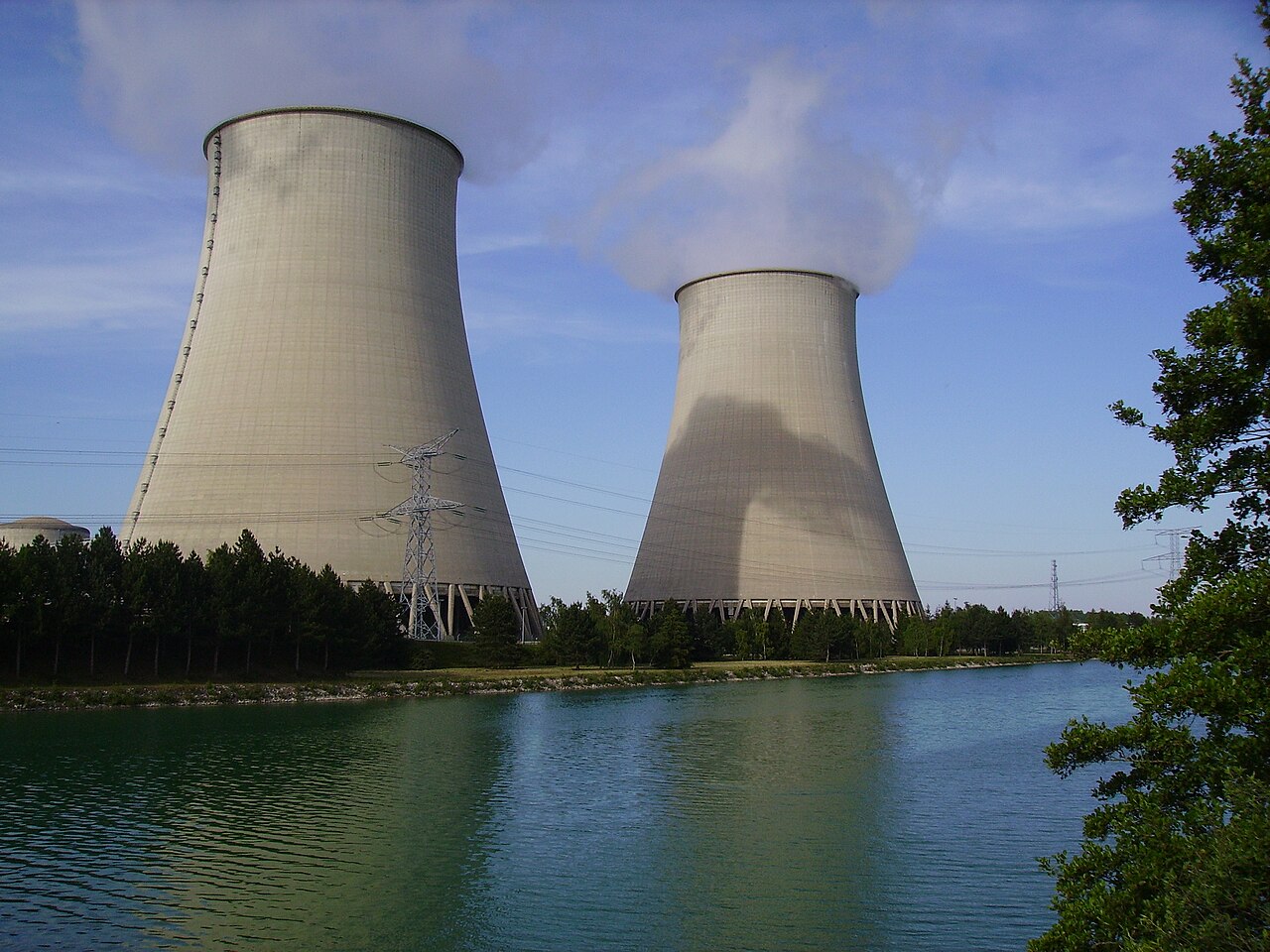
In late June 2026 a static high-pressure system settled over Western Europe and pushed riverside air temperatures in France to 42.5 C, the highest recorded across the eight river-cooled nuclear sites examined here. French nuclear reactors rely on river water for cooling and discharge it at a higher temperature, and environmental regulation limits how warm the receiving river may become. As the Garonne, the Rhône and the Seine approached their regulatory ceilings of roughly 28 C, EDF was required to reduce output at, or shut down, several reactors on those rivers. Because a river warms gradually, the reductions arrived late in the month, after the heat had persisted for nearly a week.
The effect on exports
France entered the period as a strong net exporter and remained one throughout. Hourly ENTSO-E commercial data show the country exporting every hour from 1 to 26 June, with a net balance of 7.55 TWh, and domestic supply was secure at all times. What the heat compressed was the export margin rather than the supply position. The afternoon surplus available to neighbouring markets fell from 11–12 GW in early June to 2.9 GW on 24 June, the hottest day of the month.
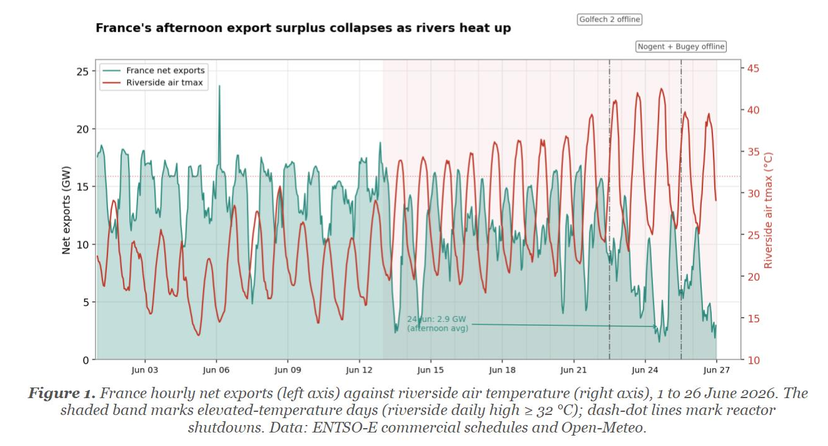
Several factors converged on the same hours. Cooling demand raised the midday load substantially, while the river-temperature limits trimmed available nuclear capacity. French reactors have also, in recent years, increasingly reduced output around midday in spring and summer as abundant European solar depresses prices; the heatwave acted on top of this established daily pattern, deepening the afternoon trough on the hottest days. Because the export surplus is simply whatever generation remains after domestic demand is met, it was the quantity most exposed when demand rose and several supply sources weakened at the same time.
Temperature and the export margin
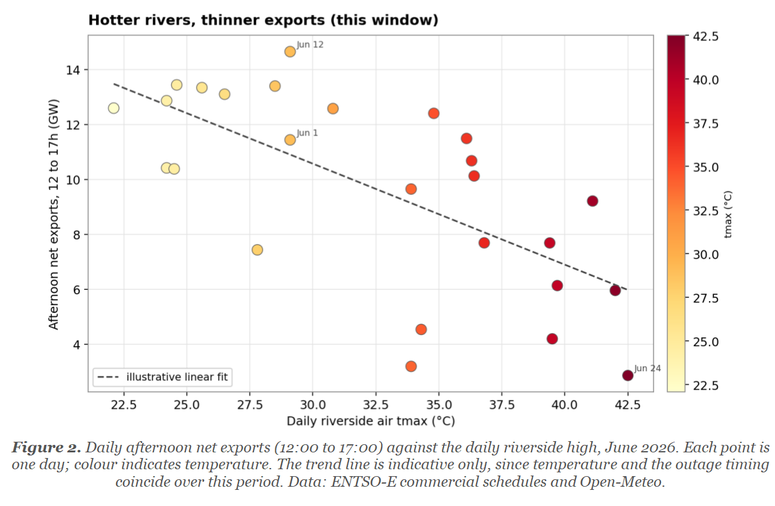
Throughout the month, daily afternoon exports declined as riverside temperatures rose, with a correlation of about −0.67. The relationship is best read as descriptive rather than causal: the hottest days were also the final days of the month, when the reactor reductions took effect, so temperature, calendar and outage timing coincide. The available data do not permit a precise estimate of the capacity withdrawn for thermal reasons, because nuclear output also varies for routine reasons unrelated to heat. What the record establishes clearly is the timing of the squeeze and its effect on the exportable surplus.
A normal month, an abnormal shape
Although the daily picture was striking, the monthly total was unremarkable. On a comparable basis, French net exports over 1 to 26 June were about 7.6 TWh in 2024, 6.9 TWh in 2025 and 7.55 TWh in 2026, and nuclear availability was in fact higher in 2026, averaging about 39 GW against roughly 36 GW in each of the two preceding Junes. The heatwave altered the timing and destination of exports within the month rather than their total.
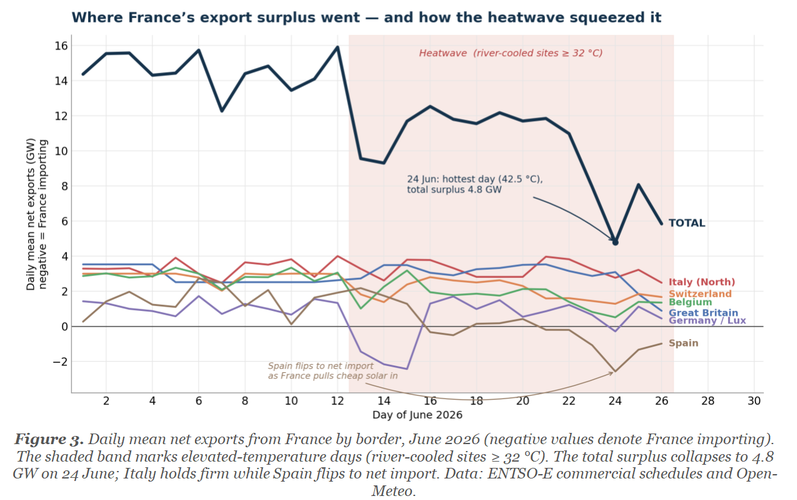
The daily flows make that redistribution visible. The total surplus held between 12 and 16 GW for the first twelve days, then fell into a 9–12 GW band once temperatures crossed the river thresholds, before collapsing to 4.8 GW on 24 June. The burden of that adjustment fell unevenly across France’s borders. Exports to Italy’s northern zone barely moved, sustained by a gas-heavy Italian market that keeps prices above France’s in almost all hours. Flows to Belgium, Switzerland and, to a lesser extent, Great Britain compressed steadily through the hot spell. Spain swung furthest: France, normally a net exporter to Iberia, became a net importer from Spain on the hottest days, drawing on cheaper Spanish solar as its own margin thinned.
Implications
The episode matters less for its scale than for what it signals. River-temperature limits are likely to be reached more frequently as summers warm, reducing the nuclear capacity available on the hottest afternoons — the hours when regional demand also peaks. For neighbouring systems that rely on French exports through summer evenings, the relevant planning quantity is no longer France’s annual surplus but the capacity it can deliver under thermal stress. June 2026 indicates that a heatwave can now produce a supply squeeze comparable to that of the cold, low-wind conditions that have traditionally defined the system’s stress case, and that the export margin is an early and visible indicator of that strain.
Author: Safa Sen, Market Engagement Lead For CWE at WSP.
WSP Group unites engineering, advisory and science-based expertise to shape communities to advance humanity. From local beginnings to a globe-spanning presence today, it operates in over 50 countries and provides solutions and delivers innovative projects across sectors: Transport & Infrastructure, Property & Buildings, Earth & Environment, Water, Power & Energy and Mining & Metals.
The views and opinions expressed in this article are the author’s own, and do not necessarily reflect those held by pv magazine.
This content is protected by copyright and may not be reused. If you want to cooperate with us and would like to reuse some of our content, please contact: [email protected].
Please login to comment