French company unveils on-site manufacturing concept for modular floating PV systems


French fastening and assembly solutions provider Araymond has presented a new approach for building floating PV systems at the Smarter E trade show, held in Munich from June 24 to 26.
The solution consists of a containerized production model for manufacturing float components directly at project sites.
“We started with a simple observation: rather than transporting floats—in other words, empty space enclosed in bulky containers—why not manufacture them directly on-site?” Quentin Rabut, floating PV business line director at Araymond, told pv magazine.
The system, called Neluma, uses mobile microfactories deployed close to project sites, typically on the banks of the water bodies where floating PV plants are installed. Housed in shipping containers, the units convert aluminum coils into six-meter tubes with a diameter of 40 centimeters that serve as floats for the platform.
ARaymond developed the manufacturing process using its expertise in metal forming and fastening technologies. The Grenoble-based family-owned company said it drew on more than 160 years of industrial experience to design the system.
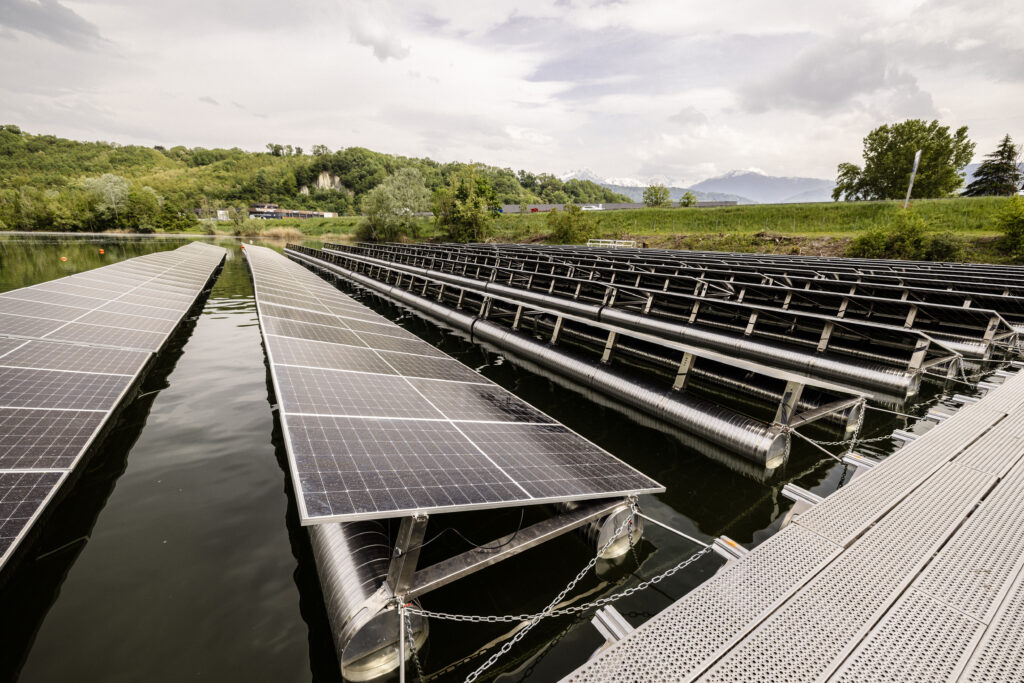
The tubes contain multilayer, air-filled balloons that provide buoyancy for the floating structure. According to Araymond, a team of 10 workers can assemble about 1 MW of floating PV capacity per week, equivalent to roughly 500 labor hours per megawatt. The company said deployment rates can be increased by adding additional assembly teams.
Reducing logistics costs and anchoring requirements
For project developers, on-site production primarily reduces the transport of bulky structures, lowering logistics costs and the project’s carbon footprint. “The benefit also lies in reducing transport costs and CO₂ emissions, as well as capex and opex,” Quentin Rabut said.
The Aaaymond design is based on floats that are lightly ballasted by water, which partially fills the tubes. According to the company, this improves stability in windy conditions of up to 160 km/h in continuous operation and gusts of up to 220 km/h, while reducing the number of anchors required by around one-third—a major cost component in floating PV projects.
The architecture also allows for a 15° tilt angle for PV modules, which supports natural cleaning and reduces maintenance needs. ARaymond adds that the design enables more efficient use of available surface area, due to more uniform coverage of the water body compared to alternative solutions.
International deployment
Already active in the solar mounting sector, Araymond says it has contributed to the installation of more than 22 GW of onshore PV capacity worldwide. With Neluma, the company aims to expand its focus toward floating PV as a strategic growth segment.
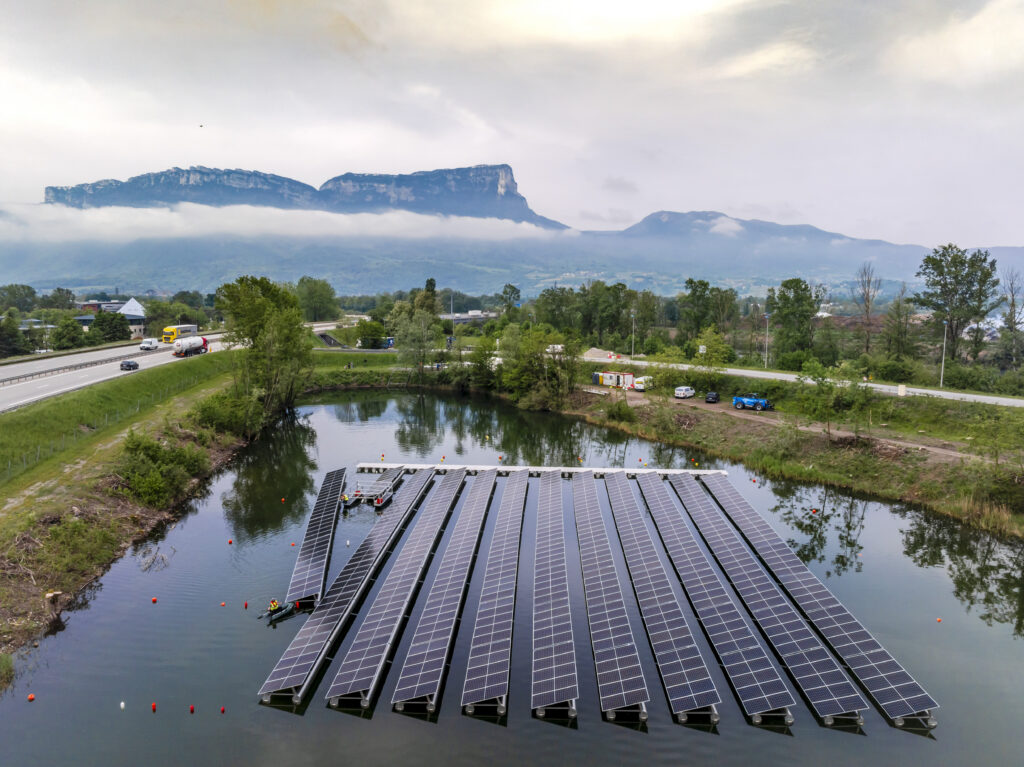
Following the installation of its first industrial demonstrator in 2024 in Montmélian, Savoie, southern France, Araymond now reports eight installations worldwide.
In Europe, the company is targeting multi-megawatt-scale floating PV plants. It is in discussions with several developers on projects located on former gravel pits and other water bodies, mainly with public entities and regulated operators.
In India, Aaaymond has commissioned a 57 kW demonstrator on the reservoir of the Jindal Power thermal plant in Dhule. The pilot was installed in around 10 days and is intended to support the development of a portfolio of several hundred megawatts, according to Quentin Rabut.
In Brazil, the company’s focus is on agricultural and agri-food applications, with medium-scale systems on private reservoirs developed in partnership with local stakeholders. The company said the objective is to generate electricity close to demand centers while contributing to water conservation.
To support its rollout strategy, Araymond plans to build local industrial ecosystems in each market, relying on regional suppliers for aluminium coils and metal components, as well as EPC partners responsible for project execution.
This content is protected by copyright and may not be reused. If you want to cooperate with us and would like to reuse some of our content, please contact: [email protected].

Please login to comment