Scientists build 31%-efficient indium-free tandem perovskite silicon mini-module via reactive plasma deposition

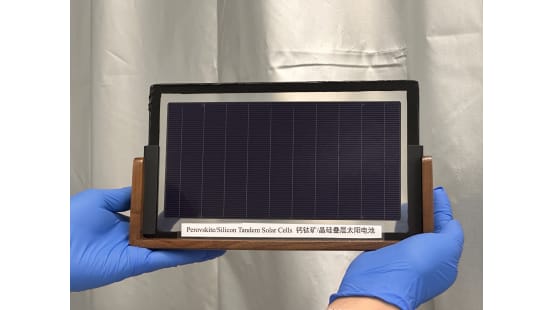
An international research team has fabricated an indium-free perovskite-silicon tandem solar cell using a low-damage reactive plasma deposition (RPD) process.
RPD is a vacuum-based thin-film coating technique in which a plasma generated from oxygen reacts with evaporated metal atoms to form a metal oxide film on the substrate. Unlike conventional sputtering, which bombards the target with high-energy ions that can damage sensitive materials such as perovskites, RPD generates lower-energy particles, allowing dense, conductive oxide films to be deposited with minimal damage to the underlying layers.
Monash University Department of Materials Science and Engineering Adjunct Professor and research co-lead Yuan Cheng said achieving more than 30% efficiency in a commercially relevant tandem mini-module represents an important technical milestone, demonstrating that high performance can be achieved without relying on scarce, high-cost materials.
“The research team developed a reactive plasma deposition (RPD) process for tin oxide (SnOx) films to serve as the recombination layer, achieving a certified efficiency of 33.6% on a 1 cm² device,” Cheng said. “By further extending the application of RPD-SnOx to both the front and rear transparent electrodes, we successfully fabricated indium-free tandem solar cells. We then scaled the technology to a 207.9 cm² mini-module, achieving a certified efficiency of 31.0%.”
The researchers said the dense and uniform tin oxide films produced by the RPD process provided an improved surface for the self-assembled monolayer used in the device, helping to reduce non-radiative recombination losses and suppress halide ion migration, two mechanisms that can limit solar cell efficiency and long-term stability.
They also explained the devices maintained strong performance after exposure to heat, humidity and more than three months of outdoor operation. “Indium-free minimodules exhibited high thermal, damp-heat, and outdoor operational stability and retained 65% of their maximum initial efficiency after 105 days of outdoor operation,” they added.
The results, published in Science, replace conventional indium-based transparent conducting oxides with tin oxide, an abundant material that the researchers said costs about 1% as much as indium. They said the approach could improve the commercial viability of tandem solar cells by reducing material costs while maintaining high efficiency.
Cheng said the work represents the first demonstration of a large-area, high-efficiency indium-free perovskite-silicon tandem solar cell, indicating that the technology can be scaled beyond laboratory-scale devices.
“Considering the cost of tin is a mere 1% of that of indium, this breakthrough provides a new materials approach and a viable engineering pathway for low-cost, sustainable and scalable tandem photovoltaics,” Cheng said. “Ultimately, this work is of strategic importance for advancing the industrialisation and terawatt-scale deployment of next-generation, ultra-high-efficiency photovoltaic technologies.”
The research was led by a collaboration involving Monash University in Australia, Soochow University and Chint New Energy Technology Co. Ltd in China, along with other research partners.
This content is protected by copyright and may not be reused. If you want to cooperate with us and would like to reuse some of our content, please contact: [email protected].

Please login to comment