Open-access framework for intraday PV power prediction

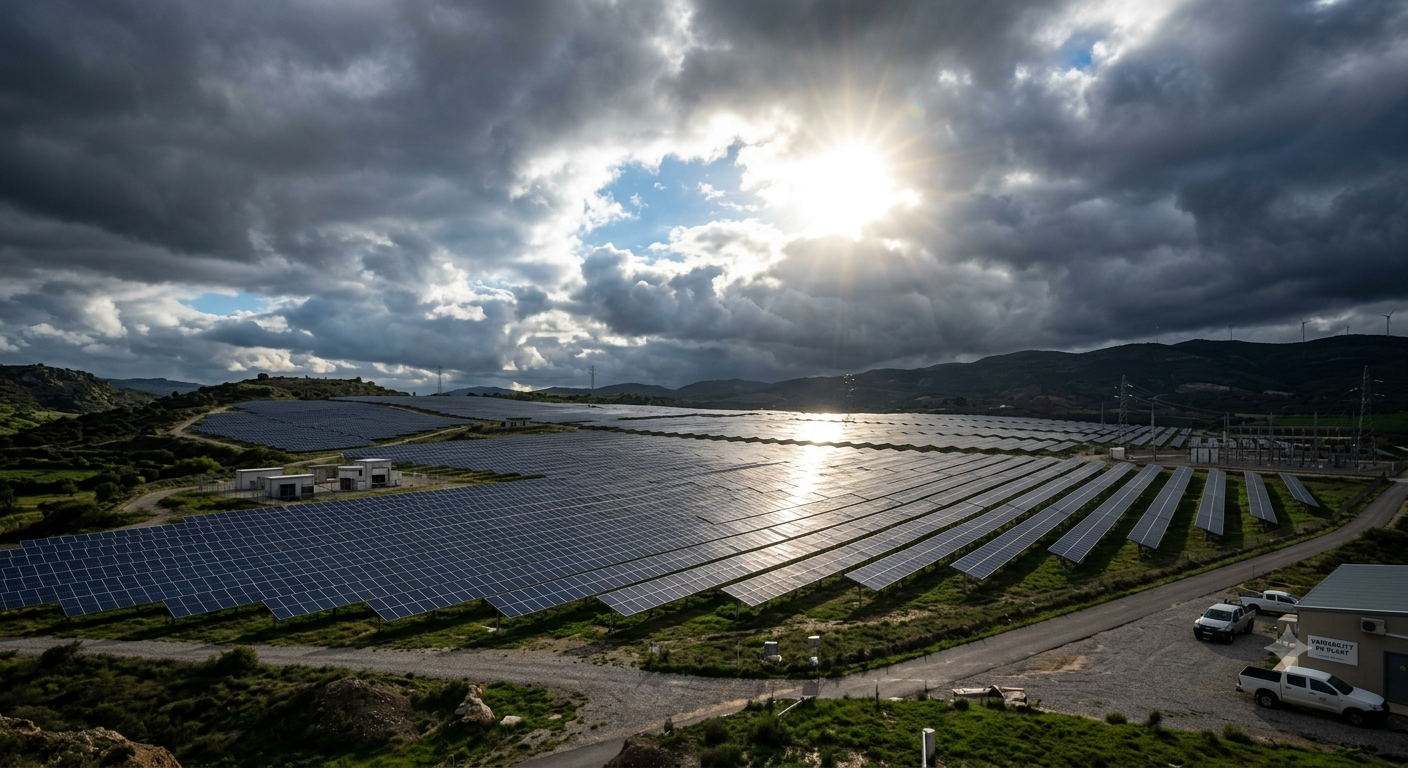
A research team from Switzerland and the Netherlands presented a novel framework for intraday spatiotemporal PV power prediction at the national scale. The new framework combines satellite-based deep learning and optical-flow approaches together with physics-based numerical weather prediction models.
“Knowing beforehand how much solar energy will be generated can improve short-term power production planning of additional power sources,” author Angela Meyer from Delft University of Technology (TU Delft) said in a statement. “You can act strategically when there are surpluses or shortages of energy and reduce electricity costs. It’s also highly relevant for keeping the energy grid in balance.”
This method, which Meyer developed with Luca Lanzilao from Bern University of Applied Sciences, is publicly accessible to everyone, including companies. “If energy companies know what will be generated, costs can be reduced because they don’t have to take ad‑hoc measures to keep the system balanced,” Meyer explained. “I believe public organizations have an important role in protecting consumers, so they don’t end up paying unnecessarily high prices for their energy.”
The researchers compared six PV forecasting frameworks: SolarSTEPS, SolarSTEPS-pa, IrradianceNet, SHADECast, IFS-ENS, and a bias-corrected version of IFS-ENS.
First, they compiled the HANNA satellite-derived surface solar irradiance (SSI) dataset covering Switzerland in 2019 and 2020, with images available at 15-minute intervals. They downsampled the SSI fields to the spatial resolution used for model training and converted them into clear-sky index (CSI) fields by dividing the observed irradiance by the corresponding clear-sky irradiance.
Each forecasting model then received four consecutive CSI images, representing the previous hour, as input and predicted the next eight CSI images over a two-hour forecast horizon. The researchers subsequently converted the predicted CSI fields back into SSI and used them to estimate electricity generation. For this step, they trained a separate XGBoost model for each of the 6,434 operational PV systems identified in Switzerland.
Finally, the team compared the predicted electricity generation with measured PV system output. The results showed that the satellite-based approaches outperformed IFS-ENS, particularly at short lead times. SolarSTEPS and SHADECast delivered the most accurate SSI and PV power forecasts, while SHADECast also provided the best-calibrated ensemble spread.
“The deterministic model IrradianceNet achieves the lowest root mean square error, while probabilistic forecasts of SolarSTEPS and SHADECast provide better-calibrated uncertainty. Forecast accuracy generally decreases with elevation,” the researchers concluded. “At a national scale, satellite-based models forecast daily total PV generation with relative errors below 10% on 82% of the days in 2019–2020, demonstrating their robustness and potential for operational use.”
The framework was described in “Intraday spatiotemporal PV power prediction at national scale using satellite-based solar forecast models,” published in Energy and AI.
This content is protected by copyright and may not be reused. If you want to cooperate with us and would like to reuse some of our content, please contact: [email protected].

Please login to comment