Researchers design PVT heat pump with single integrated evaporator

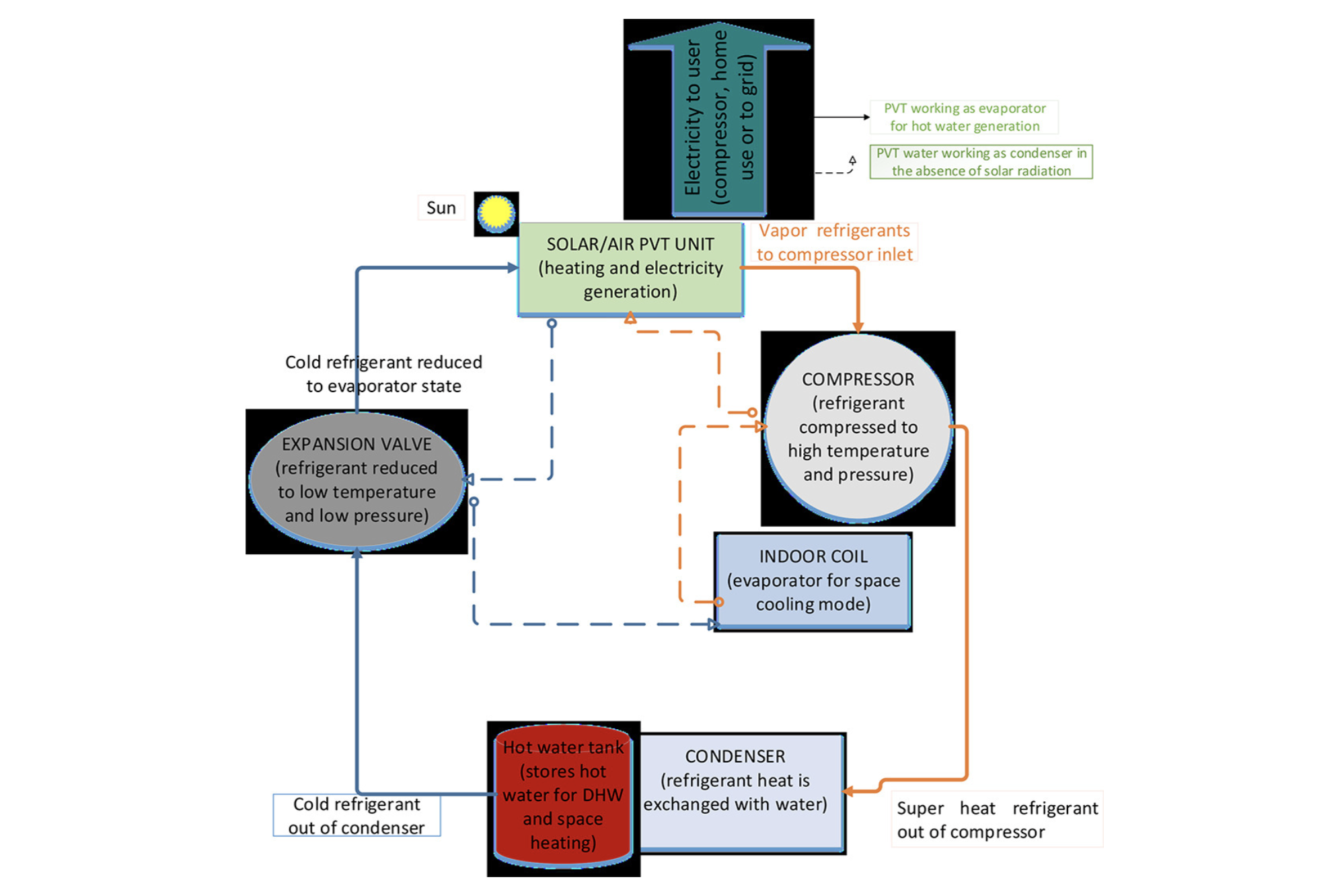
A research team from China and Rwanda has developed a novel dual-source direct-expansion (DX) photovoltaic-thermal (PVT) heat pump that combines solar and ambient-air heat collection in a single finned evaporator, eliminating the need for separate heat exchangers.
Their heat pump is presented in the research paper Heating performance of a dual-source PV/T heat pump with potential for building energy decarbonization, published in Results in Engineering.
Corresponding author Emmanuel Bisengimana told pv magazine the primary novelty of the research lies in the proposed system’s architecture
“Unlike conventional dual-source systems that require separate and complex solar and air evaporators, our design integrates a single, compact, finned PV/T unit that functions as both,” Bisengimana explained.
Bisengimana added that this is achieved by removing the rear insulation of a standard PVT collector and attaching half-cut aluminum fins to the serpentine refrigerant channel, which enables simultaneous heat absorption from solar radiation and ambient air. “This integration significantly reduces structural complexity, installation space, and capital costs while maintaining effective thermal performance,” he highlighted.
The system’s operation was simulated in computing platform MATLAB using a transient finite-difference model and R134a refrigerant. It comprises a 2 m × 1 m PVT absorber containing a 1.34 m² monocrystalline PV section, a serpentine finned evaporator tube with an 8 mm internal and 10 mm external diameter, a compressor operating at 2,900 rpm, an expansion valve and a 10 m-long water-tank condenser coil with a 9 mm internal and 10 mm external diameter.
During operation, the PV cells generate electricity while the collector simultaneously absorbs heat from both sunlight and ambient air to evaporate R134a refrigerant. The vapor is compressed and sent to a water-tank condenser, where it releases heat for space heating or domestic hot water, before passing through an expansion valve and returning to the PVT evaporator to repeat the cycle. The generated electricity is routed through a solar controller and inverter for use, storage, or export to the grid.
The researchers simulated the system under representative winter, spring and summer conditions in Yibin, China. They also investigated how varying solar irradiance (100 W/m² to 900 W/m²), ambient temperature (2 C to 33 C), condensing pressure (12 bar to 20 bar), and water tank mass (7 kg to 24 kg) affected various system performance and coefficient of performance (COP).
Bisengimana said the most encouraging result was the system’s stability and high efficiency across diverse seasonal conditions.
“Under the climate of Yibin, the system maintained a remarkably stable heating COP in the range of 5.2 to 5.38 throughout the year,” Bisengimana told pv magazine. “Furthermore, the parametric analysis revealed a clear trade-off: while higher solar irradiance increases total energy output, it simultaneously intensifies temperature-related losses, reducing electrical efficiency. Conversely, winter conditions, with lower solar irradiance, actually favored higher conversion effectiveness per unit of solar energy due to reduced thermal losses.”
The simulations showed PV surface temperatures ranging from 11 C in winter to 53 C in summer, corresponding to electrical efficiencies of 13.9% to 15.4%, while thermal efficiency remained at approximately 55%. Peak outputs reached approximately 230 W of electrical power and 1,181 W of thermal power, with a maximum heating COP above 5. Increasing condensing pressure from 12 bar to 20 bar reduced the COP from 5.3 to 3.3.
“We are planning several follow-up research directions,” Bisengimana added. “Our immediate focus is on two key areas: conducting experimental validation of the integrated evaporator prototype to confirm our numerical findings, and developing advanced control strategies to optimize the hybrid solar/air operation, thereby maximizing annual system performance. A long-term goal is to perform a comprehensive techno-economic and carbon-emission analysis, coupling the system with actual building loads to better quantify its potential for achieving Net Zero Energy Building (NZEB) status.”
Scientists from China’s Southwest Jiaotong University and the University of Rwanda participated in the study.
This content is protected by copyright and may not be reused. If you want to cooperate with us and would like to reuse some of our content, please contact: [email protected].

Please login to comment