Zinc oxide UV shield cuts heterojunction solar cell degradation and boosts lifetime output by 4.8%

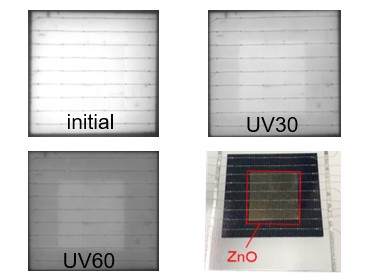
Researchers at the Southwest Petroleum University in China have tested zinc oxide (ZnO) thin films to protect silicon heterojunction (HJT) solar cells from UV-induced degradation (UV-ID) and have found that they can increase cumulative power output by 4.8%
“Current approaches to mitigating UV-ID can be broadly divided into two categories. At the material level, encapsulation materials are primarily used to achieve UV cutoff or UV conversion, thereby blocking or converting incident high-energy UV photons. At the device level, structural optimization is employed to enhance UV resistance, although its potential for further improvement is relatively limited,” the research’s corresponding author, Jian Yu, told pv magazine.
“We proposed a protection strategy based on wide-bandgap metal oxides, using ZnO as a representative example. By efficiently absorbing and blocking high-energy UV photons, a physical protective barrier analogous to a ‘sunscreen’ is formed on the cell surface, effectively suppressing UV-ID from a materials perspective,” he went on to say. “Although the ZnO film may temporarily affect the electrical performance of the cell, a comprehensive assessment from the perspective of long-term reliability over the full photovoltaic module lifecycle shows that the resulting UV resistance gain and extended service life can achieve superior overall cost-effectiveness.”
The researchers explained that ZnO is a promising UV-shielding material for solar cells because of its wide bandgap. It can absorb UV photons in the 300–400 nm range, complementing the spectral response of crystalline silicon. This complementary absorption can reduce short-wavelength photon losses while improving the theoretical photovoltaic potential of silicon devices.
The scientists investigated protection strategies: direct deposition of ZnO onto the TCO surface of pre-metallized HJT cells and deposition onto the front glass of finished modules. The ZnO films were prepared by DC magnetron sputtering, with their optical properties controlled through deposition power, pressure, oxygen flow, and substrate temperature.
The films were found to exhibit only about 16–18% transmittance in the UV region while maintaining an average visible transmittance above 90%. They also effectively functioned as a UV-cutoff layer without significantly compromising visible-light transmission, as they absorbed high-energy UV photons before they reach the underlying HJT structure, thereby reducing UV-induced damage.
The research group also ascertained that direct deposition of ZnO on the cells reduced minority-carrier lifetime degradation from 54.9% to 32.6% after exposure to 60 kWh/m² of UV radiation. Although ZnO initially caused a slight performance loss due to parasitic absorption in the visible spectrum, it significantly mitigated long-term UV-induced degradation. After the same UV dose, power conversion efficiency degradation was limited to 3.49%, compared with 5.74% for uncoated cells.
ZnO-coated glass was found to provide even stronger protection, with full-area coverage limiting carrier-lifetime degradation to 24.9% after 40 kWh/m² of UV exposure. After 60 kWh/m², ZnO-covered cells recorded short-circuit current and efficiency degradation of just 1.23% and 2.31%, respectively, compared with 2.75% and 4.72% for cells without ZnO.
Module-level tests further showed that ZnO-coated glass reduced efficiency degradation from 4.99% to 4.12% after 60 kWh/m² of UV exposure. Over a projected 25-year operating period, ZnO-protected modules were estimated to achieve a lower levelized cost of electricity (LCOE) of $0.0262/kWh and 4.8% higher cumulative power generation than conventional modules.
“We argue that wide-bandgap materials represented by ZnO are not limited to HJT cells; through doping modulation, interface engineering, and optimization of film deposition processes, they can be further extended to TOPCon, perovskite, and perovskite-silicon tandem cells, serving as efficient UV-absorbing layers and interfacial stabilization layers with broad application potential,” Yu stated. “With increasingly stringent requirements for long-term weatherability in high-efficiency photovoltaic devices, we believe that wide-bandgap metal oxides will demonstrate extensive application prospects in all mainstream solar cell systems by virtue of its excellent optical properties and interface compatibility.”
The research findings are available in “Suppressing UV-induced degradation of silicon solar cells and modules by UV-cutoff zinc oxide films,” published in Current Applied Physics.
This content is protected by copyright and may not be reused. If you want to cooperate with us and would like to reuse some of our content, please contact: [email protected].

Please login to comment