‘Biosolar’ design boosts rooftop PV performance by 23.25%

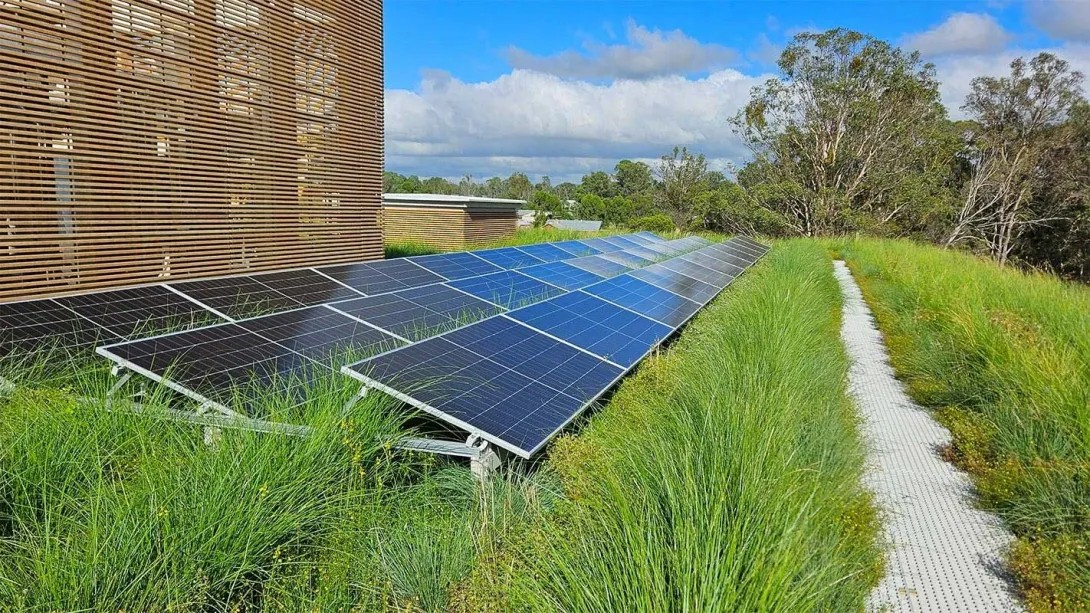
University of Technology Sydney (UTS) research shows PV panels installed as part of an integrated biosolar system installed in Western Sydney have outperformed a conventional rooftop system by an average of 11.1% during the Australian summer, with peak gains of up to 23.25% during extreme heat events.
The study, led by the UTS in collaboration with the Bradfield Development Authority (BDA), focused on a biosolar system installed atop the First Building, the first construction project delivered as part of the greater Bradfield City site being developed in Western Sydney.
The biosolar system combines 319 north-facing solar panels installed over more than 14,000 native plants. The solar system covers 30% of the 1,300 m2 roof.
Lead researcher, UTS Associate Professor Peter Irga, said one of the major challenges for solar generation is high temperatures with solar panels performing most efficiently at 25 C, with efficiency dropping by up to 2% for every degree above that threshold.
He said installing solar arrays directly over a green, living roof footprint allows the vegetation to naturally cool the rooftop microclimate, enhancing solar panel efficiency, while the panels provide partial shade to support the growth of the plants below.
“We found the cooling effect of the vegetation was highly dynamic, and became more effective as the ambient temperature rose,” Irga said. “This means the hotter the day, the harder the plants work to moderate the building’s microclimate and keep the solar panels operating efficiently.”
The research team directly compared the biosolar roof system with a traditional solar array during the 2025 summer and found clear benefits in terms of energy efficiency with the cooling effect of the vegetation increasing PV energy generation by up to 23.25% during extreme heat events.
“Through evapotranspiration, the vegetation cools the surrounding environment, enabling the solar panels to outperform those on the conventional roof by an average of 11.1% over the study period, equivalent to 0.24 kWh per panel per day,” the researchers said. “Performance gains were strongly irradiance-dependent, reaching up to 23.25% on high-irradiance days.”
The benefits of integrating living green roofs with PV panels extended beyond solar generation with the study also confirming that combining native rooftop gardens with solar panels reduces urban heat, with the biosolar roof up to 28 C cooler than a conventional aluminium roof on the hottest of days.

The biosolar configuration also delivered significant environmental benefits with a drainage and irrigation system installed as part of the design retaining an average of 73% of rainfall while the plants act as an effective natural filtration system, removing more than 90% of key air and water pollutants. The study also found the roof supported 39 species of birds, insects, mammals and gastropods.
Irga said the findings confirm that combining rooftop gardens with solar panels can transform the performance and resilience of urban environments, pointing out that the long-term returns, including energy savings, strengthen the economic case.
“Urban development has treated green space and renewable energy as separate goals,” he said. “Our research provides empirical evidence to show that integrating them is more effective.”
“The question is no longer if it works, but how quickly we can make biosolar the new standard.”
BDA Chief Executive Officer Ken Morrison said the findings validate Bradfield City’s master plan which requires 80% of suitable roof space on buildings within the new development to incorporate green or biosolar roofs.
“Bradfield City presents a once-in-a-generation opportunity to embed sustainable solutions from the outset in Australia’s first new city in a century,” he said. “These outstanding results demonstrate what can be achieved when sustainability is integrated from day one.”
This content is protected by copyright and may not be reused. If you want to cooperate with us and would like to reuse some of our content, please contact: [email protected].

Please login to comment