U.S. battery storage capacity grows 70% annually over the past three years

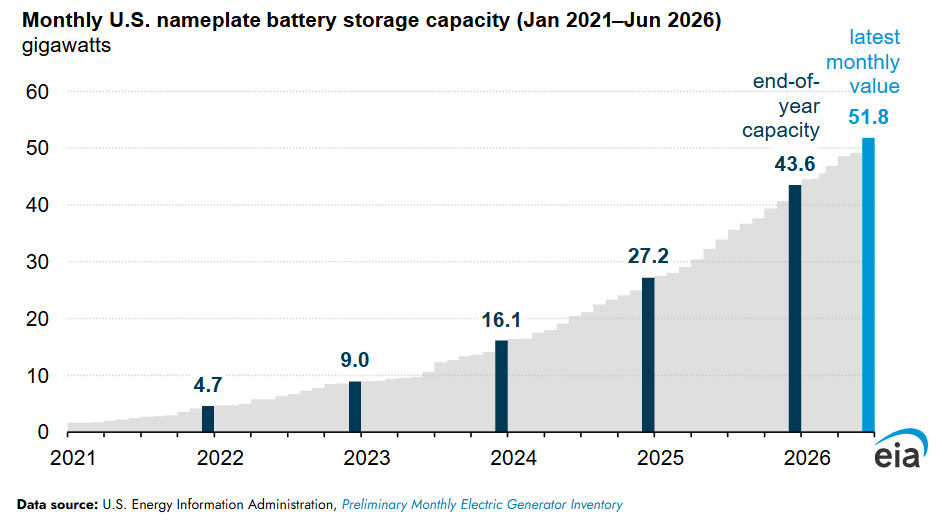
Utility-scale battery storage capacity in the United States grew at an average annual rate of 70% over the last three years, driven by rapid utility-scale solar deployment and wholesale price arbitrage, according to the latest Preliminary Monthly Electric Generator Inventory report from the U.S. Energy Information Administration (EIA).
The U.S. power grid closed 2025 with 43.6 GW of operational battery storage capacity. During the first six months of 2026, project developers brought an additional 8.3 GW online, pushing total nameplate storage capacity to nearly 52 GW.
Looking ahead, project developers report plans to bring another 54 GW of battery storage online over the next two and a half years. The planned pipeline includes 14 GW scheduled for the second half of 2026, 26 GW scheduled for 2027, and 14 GW scheduled for 2028.
Total national operational storage capacity is expected to pass 105 GW by the end of 2028.
Solar photovoltaic (PV) facilities host the largest battery storage units on the U.S. grid. Co-locating storage with PV plants allows project owners to store zero-marginal-cost solar power when wholesale electricity prices are low or negative, discharging back into the grid during peak demand windows when power prices spike.
Several mega-scale operational hybrid projects currently lead national capacity. The Bellefield Solar and Energy Storage Farm in California, placed in service in December 2025 for the CAISO grid, couples 500 MW of solar PV with 500 MW of battery storage. Developers plan to double both solar and storage capacity at the Bellefield site by November 2026, which would make it the largest power storage facility in the country.
The Manatee Solar Energy Center in Florida, operational since 2021, combines 75 MW of solar PV with 409 MW of battery storage.
Additionally, the Gemini Solar Hybrid plant in Nevada came online in 2024, pairing 690 MW of solar PV with 380 MW of battery storage capacity.
The sustained 70% growth rate demonstrates how rapidly battery assets are being deployed across regional markets to firm up expanding solar capacity, integrate growing load, and reduce reliance on peaker plants during high-demand events.
Battery storage growth moves along with EIA forecasts predicting 70 GW of new solar generating capacity coming online in 2026 and 2027, representing a 49% increase in total U.S. operating solar capacity compared to the end of 2025.
The utility-scale solar growth is expected to drive national solar output from 290 billion kWh in 2025 to 424 billion kWh by 2027, helping renewable sources reach a 21% share of total U.S. generation as total national electricity demand grows to 4,423 billion kWh.
Storage expansion is following solar additions regionally. ERCOT territory alone is projected to expand its battery storage fleet from 15 GW in 2025 to 37 GW by the end of 2027 to manage surging solar generation in Texas.
This content is protected by copyright and may not be reused. If you want to cooperate with us and would like to reuse some of our content, please contact: [email protected].

Please login to comment