Georgia Tech, Bert Thin Films build 24.3%-efficient copper-contacted TOPCon solar cell via LECO

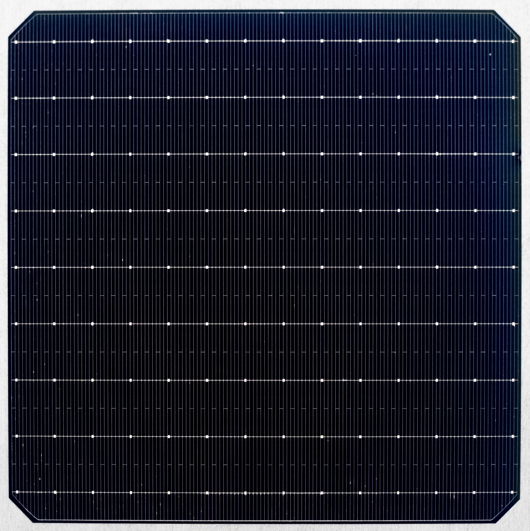
A research team led by the Georgia Institute of Technology (Georgia Tech) has fabricated a TOPCon solar cell that combines copper (Cu) metallization with laser-enhanced contact optimization (LECO) in an effort reduce silver consumption and manufacturing costs without compromising cell efficiency.
“The cell technology uses a novel screen-printable Cu paste that is compatible with a broad range of firing temperatures and environments, providing a plug-and-play alternative to screen-printed silver (Ag) contacts for silicon solar cells,” corresponding author Ruohan Zhong told pv magazine. “The combination of optimized paste chemistry, Cu firing at 540 C, and laser-enhanced contact optimization enabled a cell efficiency comparable to that of Ag-contacted n-TOPCon cells.”
For the metallization process, the team used a screen-printable Cu paste for rear-side solar cell metallization that US-based specialist Bert Thin Films (BTF) launched in February. The paste can be fired in air using conventional industrial screen-printing and firing equipment. During firing, rapid oxidation forms a conductive copper oxide shell around the Cu particles, limiting their diffusion into the silicon substrate.
“While conventional silver pastes generally require firing temperatures above 700 C, the copper paste can be processed at approximately 500 C when used with LECO,” Zhong said. “Before LECO treatment, the contacts were deliberately underfired to create selected low-resistance pathways. A laser then scanned the front surface while a reverse bias was applied across the cell, producing intense localized carrier injection through these regions and improving contact formation.”
The researchers built the device using a commercially available n-TOPCon precursor with a textured, boron-doped front emitter. The rear side featured a tunnel oxide and a planar, 90-nm-thick n-type polycrystalline silicon layer. An aluminum oxide and silicon nitride (AlOₓ/SiNₓ) bilayer provided front-side passivation, while a thin AlOₓ layer capped with approximately 70 nm of SiNₓ passivated the rear.
The team screen-printed a silver contact on the front and fired it at 685 C before applying the copper paste to the rear. It then fired the rear Cu contact separately at approximately 540 C to limit copper migration into the silicon substrate. After metallization, the cell underwent optimized LECO treatment to reduce contact resistance and improve its electrical performance.
For comparison, the researchers also fabricated a reference solar cell with silver contacts on both sides.
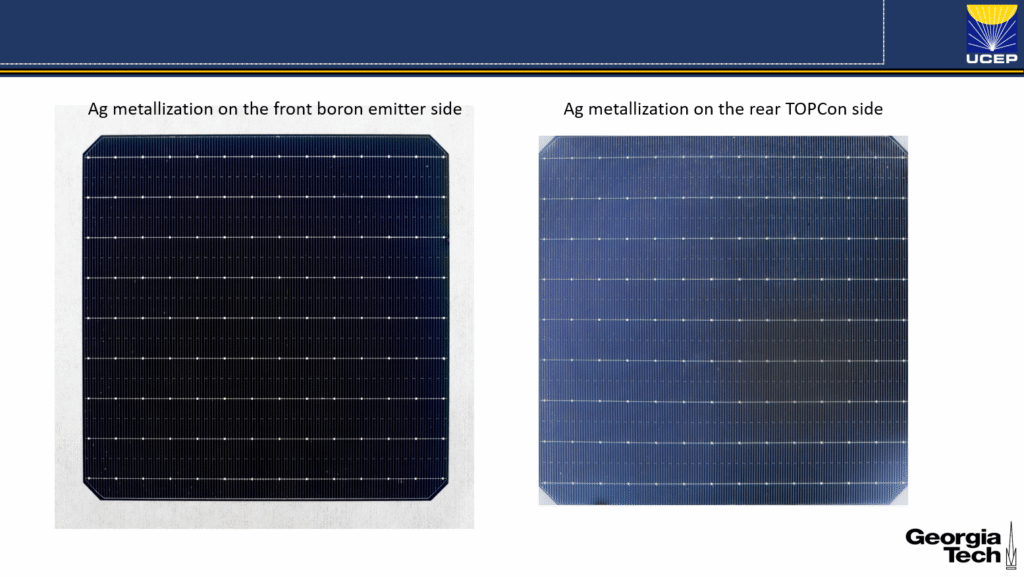
Under standard illumination conditions, the best Cu-contacted cell achieved 24.3% efficiency, compared with 24.5% for the Ag reference. Independent measurements confirmed efficiencies of 24.4% and 24.6% for the Cu- and Ag-contacted devices, respectively. Both cells achieved open-circuit voltages above 730 mV. However, the Cu device exhibited higher series resistance, which slightly reduced its fill factor and overall efficiency.
The scientists said LECO significantly improved contact performance, reducing the rear Cu contact resistivity from more than 100 mΩ·cm² to 19.7 mΩ·cm² and the front Ag contact resistivity from 273 mΩ·cm² to 4.2 mΩ·cm². A separate experiment also showed that LECO could transform a poorly conducting Cu-contacted cell into a functional, high-efficiency device.
“Microscopy analysis confirmed that Cu remains confined within the rear poly-Si layer of the TOPCon structure, supporting high cell efficiency,” Zhong said. “It also showed that LECO significantly reduces the contact resistance of Cu metallization. Although the mechanisms governing Cu behavior during LECO remain under investigation, the results demonstrate the potential of screen-printed Cu metallization for future commercial deployment.”
The researchers described the cell in “Characterization of 24.3% screen-printed Cu-contacted n-type tunnel oxide passivated contact solar cell with laser enhanced contact optimization,” which was recently published in Solar Energy. The research team included scientists from Georgia Tech, the US Department of Energy’s National Laboratory of the Rockies, and Bert Thin Films.
This content is protected by copyright and may not be reused. If you want to cooperate with us and would like to reuse some of our content, please contact: [email protected].

Please login to comment