Noria Energy launches single-axis tracker for floating solar applications

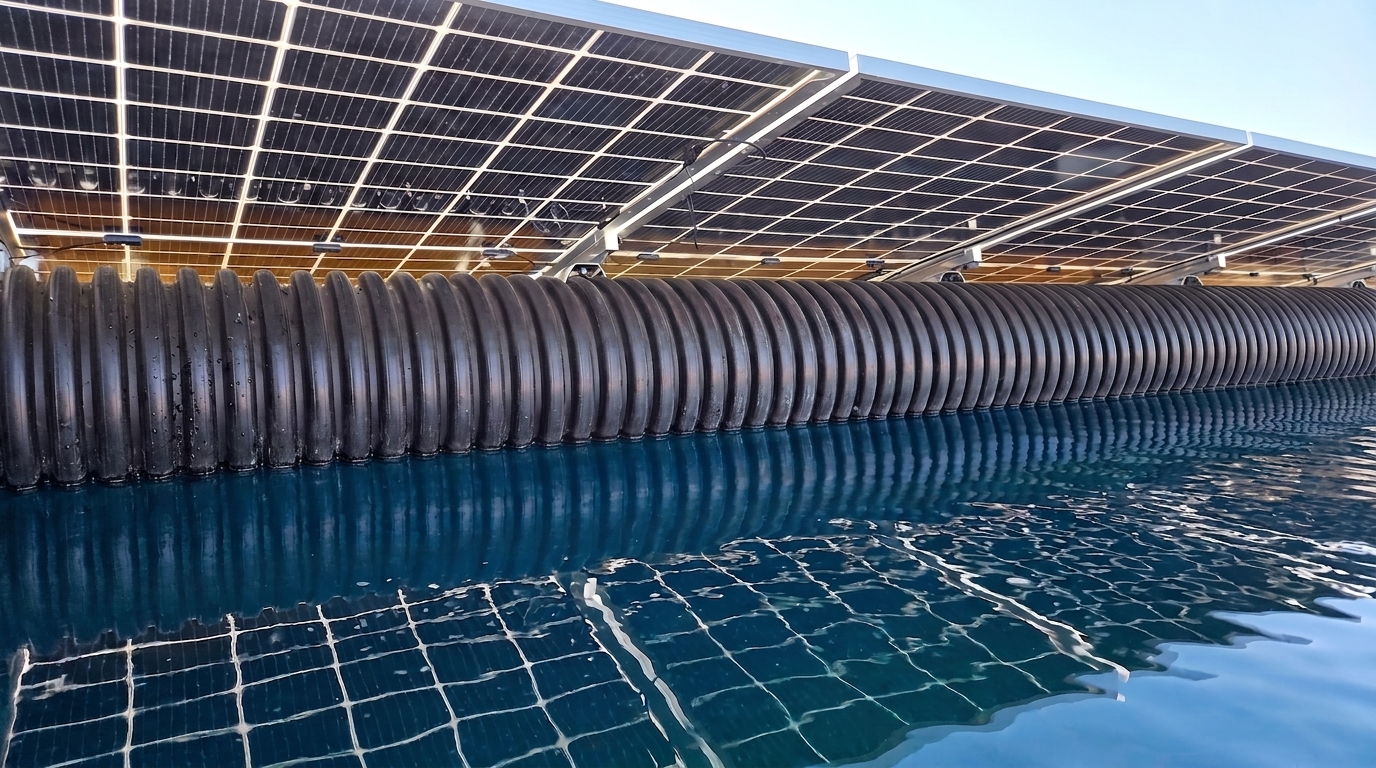
California-based floating solar developer Noria Energy has launched Airon, a single-axis tracker designed specifically for floating photovoltaic (FPV) installations. The company claims the system generates up to 20% more electricity than conventional fixed-tilt floating arrays while matching their overall installed cost.
The launch marks Noria’s transition into an independent equipment technology company. As part of the commercial roll-out, distributed solar developer Sunrock Distributed Generation and floating-structure manufacturer AccuSolar have joined as strategic investors and partners. AccuSolar will serve as Noria’s domestic manufacturing partner, while Sunrock will provide project co-development and financing.
Unlike ground-mounted utility projects where single-axis trackers dominate, floating solar systems historically rely on fixed-tilt mounting platforms to manage aquatic environments. Airon adapts horizontal single-axis tracking for water bodies using a low-profile architectural design, passive stabilizers, and automatic stowing mechanisms to endure wind shear, dynamic wave actions, and fluctuating water levels.
By increasing yield per panel without adding nameplate capacity, single-axis tracking on water provides higher energy density, serving as a crucial factor for project sites constrained by reservoir surface area or localized grid interconnection limits.
“Floating solar can turn underused water surfaces into productive energy assets without competing for valuable land,” said Alex Mayer, CEO of Noria Energy. “With Airon, we are bringing the energy-production advantages of solar tracking to the water, giving customers up to 20% more energy at the same installed cost as a fixed-tilt system.”
Noria engineered the Airon system around a horizontal single-axis design, standardizing on a 1-in-portrait orientation while offering a 1-in-landscape configuration as an option. Built for compatibility with standard crystalline silicon modules, the tracker uses floating torque tubes moored to a perimeter float anchored to the water bed, alongside passive, self-righting architecture for stability. The equipment accommodates ground coverage ratios between 30% and 66%, offers standard tracking ranges of 20 degrees with an available 30 degrees expansion, and supports up to four electrical strings per row.
The underlying hardware ecosystem features a slew drive mechanism powered by a 24 V brushed DC motor, with system auxiliary power supplied by string power or dedicated slim panels. Hardware communications utilize individual row tracker controllers routed through regional gateways (managing up to 100 rows each) which interface with a main controller handling up to four gateways. To guard against environmental fatigue, the system triggers automatic wind stow protection once wind speeds exceed 35 mph.
Noria previously deployed a 50 kW floating tracking system at the Fairmount Reservoir in Golden, Colorado, in 2025 to test operational limits in real-world utility conditions.
The company plans to deploy its first commercial pilot in late 2026. Shipments of the fully certified commercial Airon system to customer sites are scheduled to begin in mid-2027. Sourced entirely through a domestic supply chain, the hardware is structured to assist developers seeking U.S. domestic content bonuses under federal clean energy tax incentives.
This content is protected by copyright and may not be reused. If you want to cooperate with us and would like to reuse some of our content, please contact: [email protected].

Please login to comment